

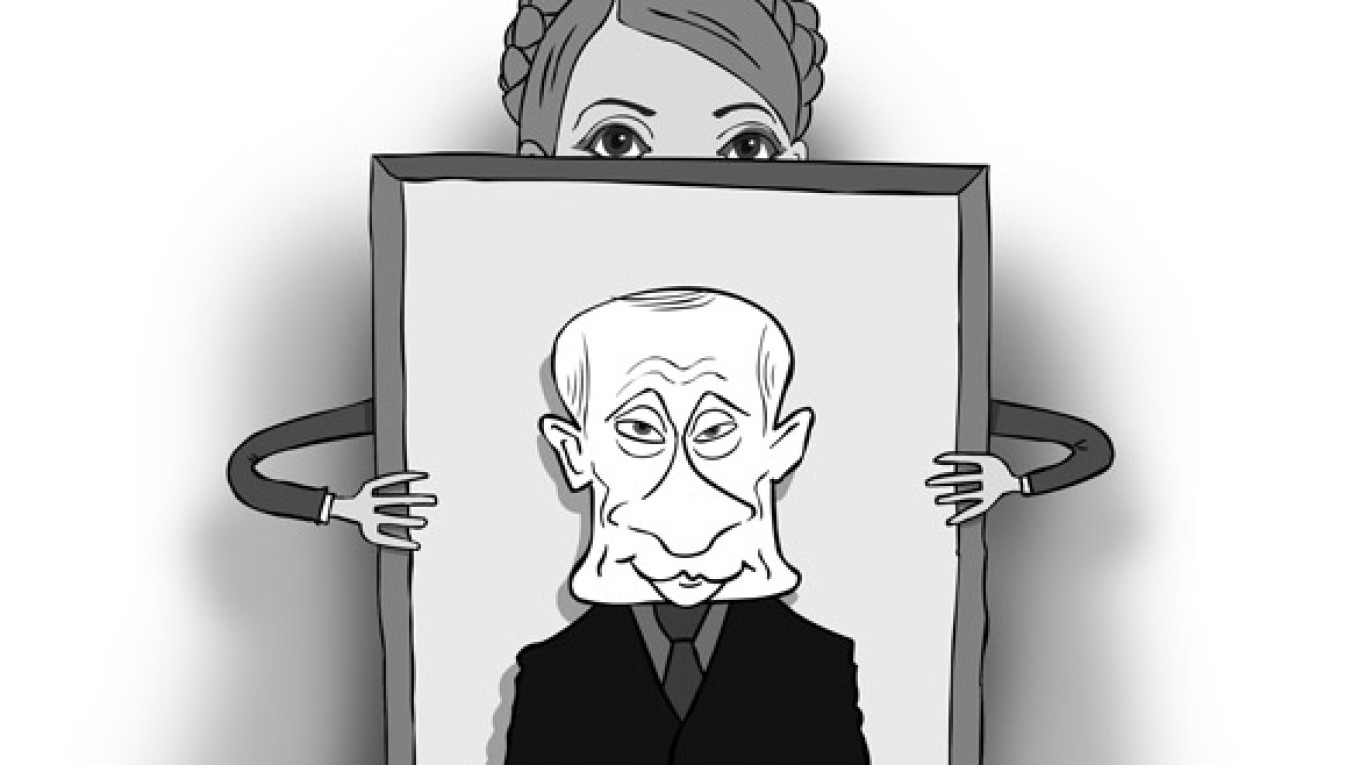
Although the Ukrainian presidential election campaign was officially kicked off last week, the political struggle began long before that. The two main challengers to President Viktor Yushchenko are Prime Minister Yulia Tymoshenko and Viktor Yanukovych, leader of the largest opposition party who lost the 2004 presidential race against Yushchenko.
Tymoshenko and Yanukovych started plastering the entire country with campaign posters and billboards several weeks ago. Yanukovych’s billboards, which were done in a distinctly Soviet style, contain his portrait with the words: “It is important for me to know what you think. I will listen to everyone.” A contact telephone number and e-mail address are displayed as proof. Voters who are nostalgic for the Soviet era will surely vote in large numbers for Yanukovych.
By contrast, Tymoshenko’s election campaign is very creative, somewhat clever and modern. The campaign focuses on a larger-than-life figure who is referred to simply as “She,” but whom everybody understands to be the one-and-only “iron lady” of Ukrainian politics. “She” alone works, while her opponents just twiddle their thumbs. “She” takes concrete actions while her critics blow hot air. “She” is fighting the economic crisis, while others make irresponsible promises. And so on. It is easy to predict that the campaign will end with a slogan along the lines of: “Ukraine needs only her.” But Tymoshenko’s opponents can at any moment flip the slogan to read, “Vote for anyone but her!”
As paradoxical as it might seem, many of the same people who during the Orange Revolution five years ago stood for days in downtown Kiev, protesting the falsified election results favoring Yanukovych and called for the new, fair elections today, see a January victory for Yanukovych as the best and last chance to stop Tymoshenko from achieving absolute control over the country. Many people who are personally acquainted with Tymoshenko are convinced that if she wins the elections, she will try to establish an authoritarian regime along the lines of the one built by Vladimir Putin. Some even contend that Tymoshenko openly admires Putin as a politician and wants to copy his policies. Many suspect that she would like to set strict loyalty rules with Ukraine’s oligarchs, similar to the ones set by Putin after former Yukos CEO Mikhail Khodorkovsky was arrested and jailed, and to put the country’s main media outlets — especially major television stations — under government control.
But Tymoshenko has been unable to cut the 12 percent lead that Yanukovych holds in all the polls over the past weeks. Barring an unusual turn of events — something those in Ukrainian political circles do not anticipate — this spread will remain in Yanukovych’s favor for the near future. And yet, Tymoshenko is behaving as if she’s got the elections in the bag. Is she bluffing or does she have something up her sleeve? And despite having ratings of only 3 percent, President Viktor Yushchenko sincerely believes that he will still be in office six months from now. He is so adamant on this point that many people find themselves involuntarily suspecting that Yushchenko also has some kind of underhanded plan to hold onto power. For example, he might be planning to declare a state of emergency on some pretext and then cite legal grounds for canceling or rescheduling elections.
Moreover, the campaign has been rife with scandals. Yushchenko’s opponents have even claimed that the dioxin poisoning during the 2004 presidential race was fabricated to help him win the election. For some reason, law enforcement officials have never discovered who poisoned him, where it happened, when, why or under whose orders it was done. But it seemed as though everyone believed unconditionally that Yushchenko was poisoned by his adversaries. But the claims that the poisoning was staged are also intended to weaken Tymoshenko as well. After all, she was Yushchenko’s comrade-in-arms during the Orange Revolution, and his poisoning was one of the main factors that led to his victory in the presidential race. If the Orange Revolution had not succeeded, Tymoshenko would not have become prime minister.
People are slinging mud at Yanukovych as well. He is accused of illegally privatizing a luxurious state-owned residence outside Kiev and is alleged to have committed a serious criminal offense. It is no secret that he served an 18-month jail sentence in the late 1960s on robbery and bodily injury charges. Now his opponents are trying to convince voters that there are other crimes Yanukovych is trying to conceal. Yanukovych supporters have simultaneously leveled charges of misconduct with minors against several parliamentary deputies from Tymoshenko’s bloc. The unpleasant Artek sex scandal, so far based on hearsay, rumors and gossip, is widening daily. And that is only the beginning, as there are still more than two months left before the January election.
The stakes are high — and not only for Ukraine. Moscow has a huge interest in who will become Ukraine’s next president since Ukraine remains the most important component in the Kremlin’s ambitious plans to restore its influence in the former Soviet republics.
Yevgeny Kiselyov is a political analyst and hosts a political talk show on Inter television in Ukraine.
A Message from The Moscow Times:
Dear readers,
We are facing unprecedented challenges. Russia's Prosecutor General's Office has designated The Moscow Times as an "undesirable" organization, criminalizing our work and putting our staff at risk of prosecution. This follows our earlier unjust labeling as a "foreign agent."
These actions are direct attempts to silence independent journalism in Russia. The authorities claim our work "discredits the decisions of the Russian leadership." We see things differently: we strive to provide accurate, unbiased reporting on Russia.
We, the journalists of The Moscow Times, refuse to be silenced. But to continue our work, we need your help.
Your support, no matter how small, makes a world of difference. If you can, please support us monthly starting from just $2. It's quick to set up, and every contribution makes a significant impact.
By supporting The Moscow Times, you're defending open, independent journalism in the face of repression. Thank you for standing with us.

Remind me later.