

How did Putinism — that distinctively Russian blend of authoritarian politics and dirigiste economics — happen? And, now that it has, how can Russians move beyond it to realize the rights and liberties promised to them in the country’s Constitution?
An active civil society, which seemed to appear out of nowhere in Mikhail Gorbachev’s Soviet Union of 1989-90 after the long Soviet hibernation, receded far too quickly. The astounding difficulty of daily survival following the Soviet collapse trapped most Russians into focusing on their families’ most urgent needs. Civic apathy set in.
So Putin came to power at a very convenient moment for any ruler — when the people are quiescent. Cunningly, Putin then strapped this apathy to the first shoots of post-Soviet economic growth to conclude a new social contract. He would raise living standards in exchange for ordinary Russians’ acceptance of severe limits on their constitutional rights and liberties.
Until recently, both sides adhered to this tacit contract. But with the global financial crisis, the Kremlin stopped meeting its side of the bargain. Thus, a new social contract is needed, especially as a new, post-Soviet generation of Russians has entered political life — a generation that has not been poisoned by the fear that decades of state terror in the Soviet Union implanted in their forebears.
Putin and his entourage tightened the screws on Russians over the past decade and faced almost no resistance to their claims to unchecked power. Now, from the entire spectrum of civil and political rights enumerated in the Constitution, we have only one right remaining: the right to leave and return to the country freely. All other rights have been lost or substantially weakened.
But Russian citizens, especially younger ones, are beginning to realize what they have lost. By the same token, the post-Soviet generation has a very different idea of a decent standard of living than their parents had, and hence their aspirations are much higher.
Many have traveled abroad, and all have seen foreign films, from which they have learned that people of their social status in the West have a far more comfortable life than they do. The majority of Soviets did not have a car or a country house or even a separate apartment. Now the young feel deprived if they can’t have all of that.
At first, people did not think of civil rights as they strove for such previously unknown comforts. They relied on the Kremlin to set the conditions that would give them new opportunities. Now, they are gradually coming to understand that the government has failed them.
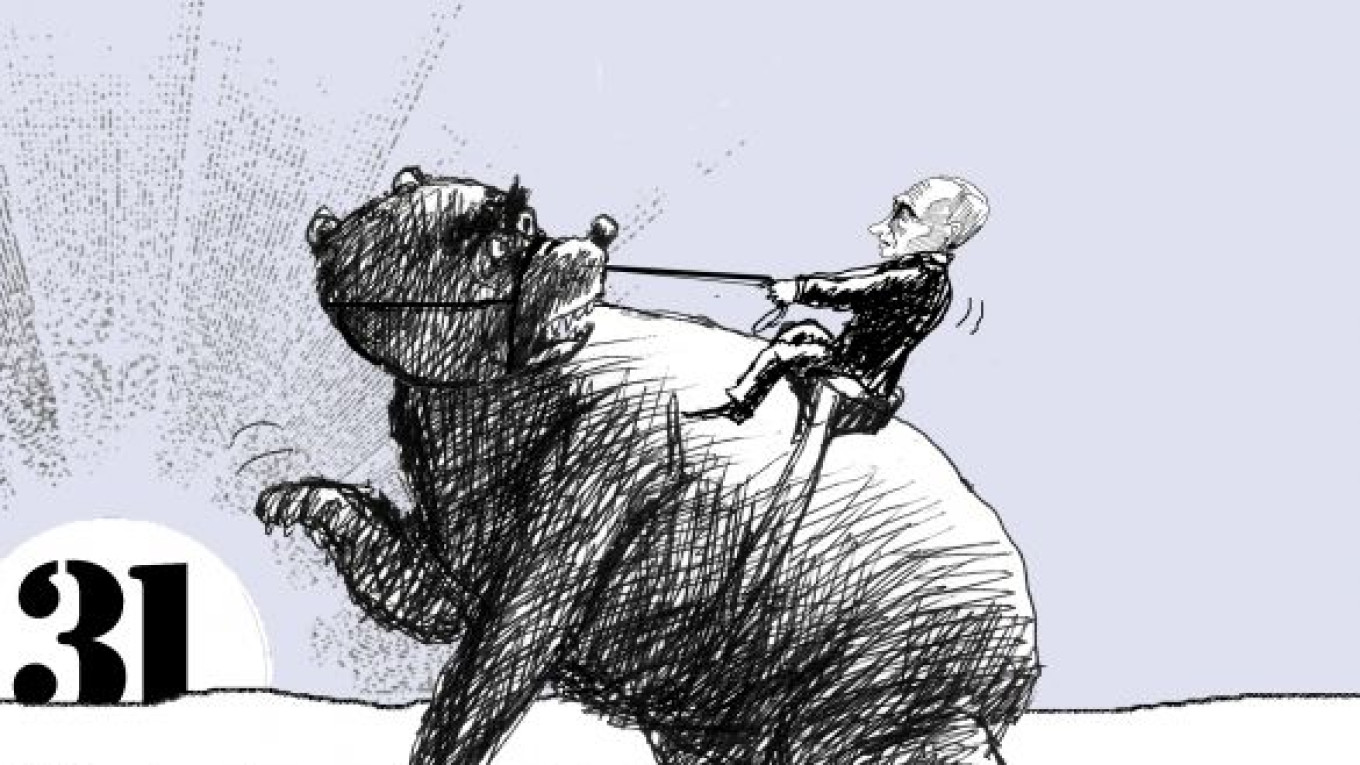
A struggle for the restitution of constitutional rights in Russia first became noticeable in 2009. At Triumfalnaya Ploshchad in Moscow, protestors have consistently demanded that Article 31, which guarantees the right to peaceful assembly, be respected. Strategy 31, an umbrella grouping of like-minded protestors, has spread rapidly, staging simultaneous demonstrations in Moscow and 48 other cities two months ago in support of the right to free assembly. There have been simultaneous protests in the past, but usually against increases in rent or utility charges.
One can understand why the demand to comply with Article 31 has gained popular support. For ordinary citizens, who have neither access to the media nor personal contacts with the authorities, protests are the only opportunity to inform officials of their demands, requests and suggestions.
There are also other signs of awakening civic engagement, which are particularly evident in Internet discussions, which the Kremlin cannot control in the same way that it does other Russian media. Citizens have started to use the Internet for self-organization, for example, to generate simultaneous “flash mobs,” as well as protests by automobile owners, in different cities.
Most recently, the Internet has become a means of public control over civil rights violations by the authorities, as images taken with mobile phones become available instantaneously to all. The authorities have to reckon with the fallout, punishing officials who have come into the spotlight this way.
The federal government and regional authorities are clearly alarmed by this rapidly growing civic activism. But despite changed conditions, they respond with the same old methods — suppression, intimidation and misinformation. With elections to the State Duma in December 2011, followed by the presidential election in March 2012, officials are particularly concerned by an upsurge of civic activism.
It is not hard to see why. Over the past decade, the electoral system was manipulated in such a way that no outcome can lead to a change in the federal government. That leaves street demonstrations and other forms of civic activism as the only way to challenge the standard-bearers of Putinism. Indeed, given state control of the mainstream media, such activism may be the only way to learn what citizens really think about their rulers.
Lyudmila Alexeyeva is director of the Moscow Helsinki Group. © Project Syndicate
A Message from The Moscow Times:
Dear readers,
We are facing unprecedented challenges. Russia's Prosecutor General's Office has designated The Moscow Times as an "undesirable" organization, criminalizing our work and putting our staff at risk of prosecution. This follows our earlier unjust labeling as a "foreign agent."
These actions are direct attempts to silence independent journalism in Russia. The authorities claim our work "discredits the decisions of the Russian leadership." We see things differently: we strive to provide accurate, unbiased reporting on Russia.
We, the journalists of The Moscow Times, refuse to be silenced. But to continue our work, we need your help.
Your support, no matter how small, makes a world of difference. If you can, please support us monthly starting from just $2. It's quick to set up, and every contribution makes a significant impact.
By supporting The Moscow Times, you're defending open, independent journalism in the face of repression. Thank you for standing with us.

Remind me later.