

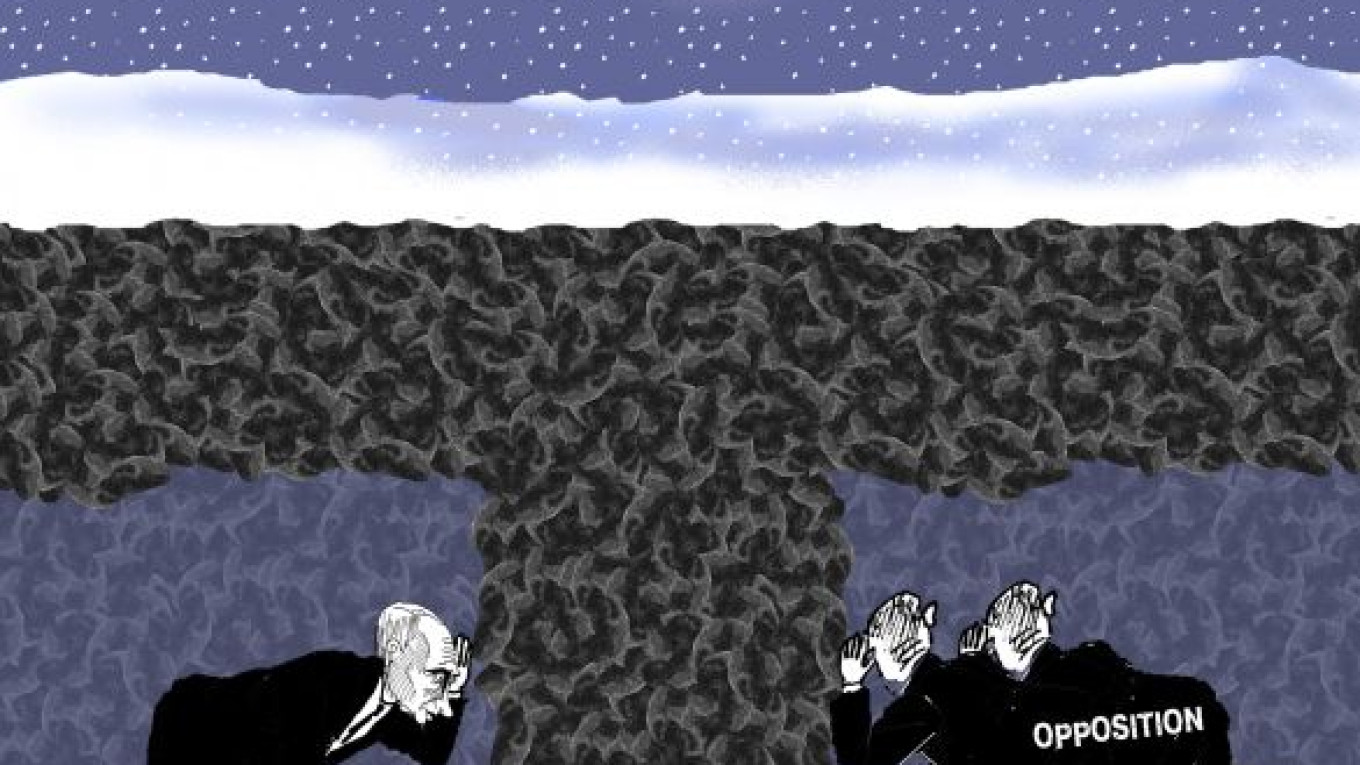
The global political crisis — a natural outcome of the continuing economic crisis — finally made it to Russia in December before getting derailed by the country's traditional hibernation in early January. Nothing ever happens in Russia between Dec. 31 and Jan. 13 — and particularly not a revolution. While the organizers of the protest demonstrations headed for swanky resorts in Mexico and other sunny spots, their grassroot supporters were stuck in cold, dreary Russia. They retired to their cramped apartments to drink vodka and discuss the country's uncertain fate.
The two-week vacation turned out to be a gift for both the authorities and the opposition. The authorities were quite happy because the holiday brought a lull in the opposition's passions and drained the protest movement of the momentum it had only begun to build. And even though Russians made a psychological shift from passivity to active protest in December, that momentum will have to be generated anew if the demonstrations are to resume in early February as planned.
The holidays have also given the Kremlin time to reflect and work out a strategy for handling future protests and protesters' demands. Rather than altering policy, however, leaders have focused on staffing changes.
President Dmitry Medvedev proposed a couple of political reforms in December, but they would be implemented only in early 2013. Thus, it is clear that Medvedev's proposals are little more than an imitation of concessions to the protesters.
Most disturbing of all, Russia may not have the luxury to wait until 2013 to make even these cosmetic changes. The looming recession and the possible failure of the euro zone in the West could lead to falling oil prices and, thus, serious economic and political consequences for Russia.
The opposition is not in a much better situation. The liberal politicians who set the tone for the Moscow demonstrations understand that people responded to their call only because they are fed up with the lies, corruption and lawlessness of the government. Disgust with the government by no means indicates that protesters have a deep trust or admiration of the opposition leaders. Recall how nearly half the speakers at the rally on Prospekt Akademika Sakharova on Dec. 24 were met with catcalls by various groups.
Moreover, the leaders of the opposition risk losing their only trump card. Either the protesting masses will become more radicalized, uncontrollable and prone to violence, or the reverse will happen: They will grow tired, divided, demoralized and increasingly difficult to mobilize. Either outcome would be catastrophic for the liberals. Of course, the authorities would prefer the latter scenario, but there is no guarantee it will be the one to play out.
Both sides have an interest in reaching a mutual agreement as soon as possible. The liberals must exact at least a few concessions from the Kremlin before the next round of demonstrations— their only bargaining chip with the authorities — slip out from under their control. For its part, the Kremlin would do better to reach agreement with the opposition now than to face unpredictable and perhaps violent protests later.
Several opposition figures leaked the information that secret negotiations with the authorities began in December. The question now is: What are the two sides discussing and have they reached an agreement?
Despite calls for compromise from such disparate groups as the business community and the Russian Orthodox Church, it is not at all clear that the parties will manage to reach an agreement. The opposition might demand a postponement of the presidential election scheduled for March to allow for real opposition candidates — and not the soft ones who were handpicked by Putin — to be registered so they can run against Prime Minister Vladimir Putin. Note that nobody is calling for the replacement of liberals within the economic ministries who are themselves supporters of former Finance Minister Alexei Kudrin and his economic course.
The real problem is Prime Minister Vladimir Putin. For the ruling elite, Putin's additional six or 12-year hold on power is their guarantee of stability, and they will not sacrifice him to satisfy protesters.
As a result, the authorities and the opposition might find themselves drawn into a new round of confrontation, and neither side would be prepared for it.
The liberals have a sincere and deep desire to achieve their goals peacefully, constitutionally and without a revolution. But if they are guided by their fears, they could very well push the situation toward an impasse in which violence is the only option available.
Boris Kagarlitsky is the director of the Institute of Globalization Studies.
A Message from The Moscow Times:
Dear readers,
We are facing unprecedented challenges. Russia's Prosecutor General's Office has designated The Moscow Times as an "undesirable" organization, criminalizing our work and putting our staff at risk of prosecution. This follows our earlier unjust labeling as a "foreign agent."
These actions are direct attempts to silence independent journalism in Russia. The authorities claim our work "discredits the decisions of the Russian leadership." We see things differently: we strive to provide accurate, unbiased reporting on Russia.
We, the journalists of The Moscow Times, refuse to be silenced. But to continue our work, we need your help.
Your support, no matter how small, makes a world of difference. If you can, please support us monthly starting from just $2. It's quick to set up, and every contribution makes a significant impact.
By supporting The Moscow Times, you're defending open, independent journalism in the face of repression. Thank you for standing with us.

Remind me later.