

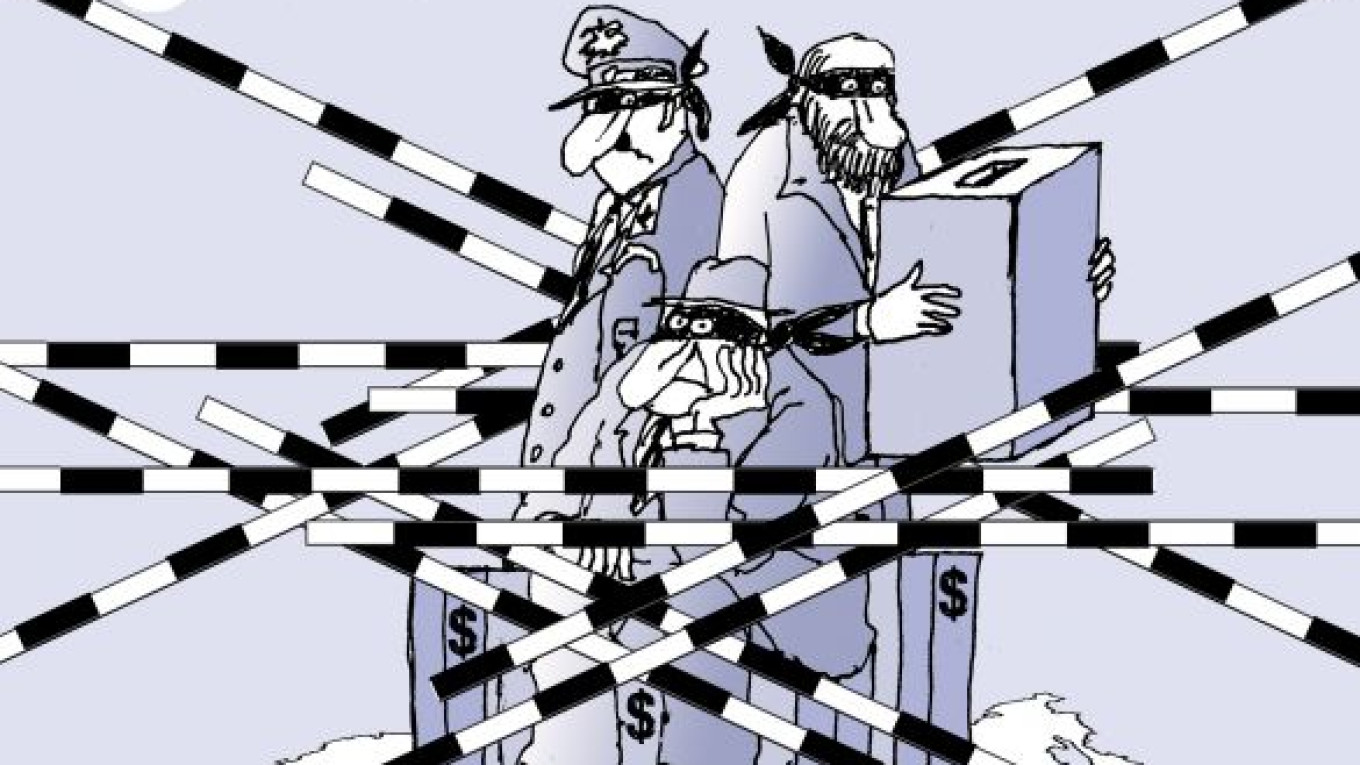
Relations between Cold War-era foes Moscow and Washington have long been distrustful, hypocritical, peppered with mutual insinuations and patched together with the most tenuous of threads. But now, on the eve of State Duma and presidential elections, an inevitable crisis in relations is nearing that threatens to tear them apart at the seams.
Last week, a group of 15 U.S. senators formally introduced a bill targeting Russians for human rights violations and corruption, including 60 officials connected to the jail death of Hermitage lawyer Sergei Magnitsky. The bill would ban them from entering the United States and freeze any U.S.-based assets.
Chances are high that the bill will be passed. The sanctions against corrupt officials and criminals-cum-politicians could serve as a replacement for the Jackson-Vanik amendment that has long been in need of repeal. When U.S. Vice President Joe Biden met with Russian opposition leaders during his visit to Moscow in March, he told us that support was growing on Capitol Hill for new sanctions against Russian crooks and thieves that could replace the old Cold War-era law.
An important precedent of this type was recently enacted in Europe. Swiss authorities froze a bank account and started an investigation into a former Russian tax official implicated in Magnitsky’s death.
Relatively new anti-corruption legislation in the United States, Britain and a number of other European Union countries that are now in the early stages of implementation open up new opportunities for prosecuting Russians involved in corrupt dealings.
It is inevitable that a conflict will erupt late this year or in early 2012 between Russian authorities and the Organization for Security and Cooperation in Europe — and in particular with its Office for Democratic Institutions and Human Rights. Four years ago, the OSCE refused to send observers to the 2007 State Duma elections because of conditions set by the Russian side. The Kremlin, the Foreign Ministry and Central Election Commission chief Vladimir Churov created obstacles like reducing the number of observers from 450 to 70 and prohibiting Russian citizens from acting as observers.
Although United Russia swept the dubious elections, the party’s popularity now has fallen to a record low. That means the ruling authorities will have to resort to even greater shenanigans this year to ensure the same landslide results. They will most likely keep international election observers out again or make it impossible for them to ascertain what is really happening at the ballot boxes.
A conflict is also brewing at the Council of Europe over Russia’s open non-compliance of commitments it undertook when it ratified European democracy and human rights conventions.
The Russian government has recently suffered a series of highly embarrassing defeats in the European Court of Human Rights, including cases concerning former arms control researcher Igor Sutyagin and my disbanded Republican Party.
In the near future, the court might make a ruling on the case concerning former Yukos CEO Mikhail Khodorkovsky. Considering that the Russian government loses almost all of the cases that come before the court, the outcome of this one is obvious. A defeat could lead to defeat in European arbitration courts, forcing the Kremlin to pay billions of dollars in fines and damages.
The Russian government behaves like a hardened offender, paying fines to its citizens based on European court rulings and yet repeating the same offenses and refusing to change the law or its practices.
The Council of Europe requires that court rulings be implemented and that poor laws and practices be changed.
But Russian leaders like Constitutional Court chief justice Valery Zorkin have increasingly spoken of a “threat to Russian sovereignty” posed by the rulings and even of the possibility of withdrawing from the Council of Europe. They have voiced outrageous proposals to impose fees on filing appeals to the European court and prohibit appeals until after a ruling by Russia’s Supreme Court. Meanwhile, with 33,000 appeals pending, Russia leads all other countries in the number of cases put before the European court.
Whether it comes through a new U.S. law, the OSCE or the Council of Europe, corrupt Russian officials are being served notice that the world is becoming less inclined to close its eyes to criminal activity in Russia. The rug is being pulled out from under their feet both in Russia and abroad.
Vladimir Ryzhkov, a State Duma deputy from 1993 to 2007, hosts a political talk show on Ekho Moskvy radio and is a co-founder of the opposition Party of People’s Freedom.
A Message from The Moscow Times:
Dear readers,
We are facing unprecedented challenges. Russia's Prosecutor General's Office has designated The Moscow Times as an "undesirable" organization, criminalizing our work and putting our staff at risk of prosecution. This follows our earlier unjust labeling as a "foreign agent."
These actions are direct attempts to silence independent journalism in Russia. The authorities claim our work "discredits the decisions of the Russian leadership." We see things differently: we strive to provide accurate, unbiased reporting on Russia.
We, the journalists of The Moscow Times, refuse to be silenced. But to continue our work, we need your help.
Your support, no matter how small, makes a world of difference. If you can, please support us monthly starting from just $2. It's quick to set up, and every contribution makes a significant impact.
By supporting The Moscow Times, you're defending open, independent journalism in the face of repression. Thank you for standing with us.

Remind me later.