

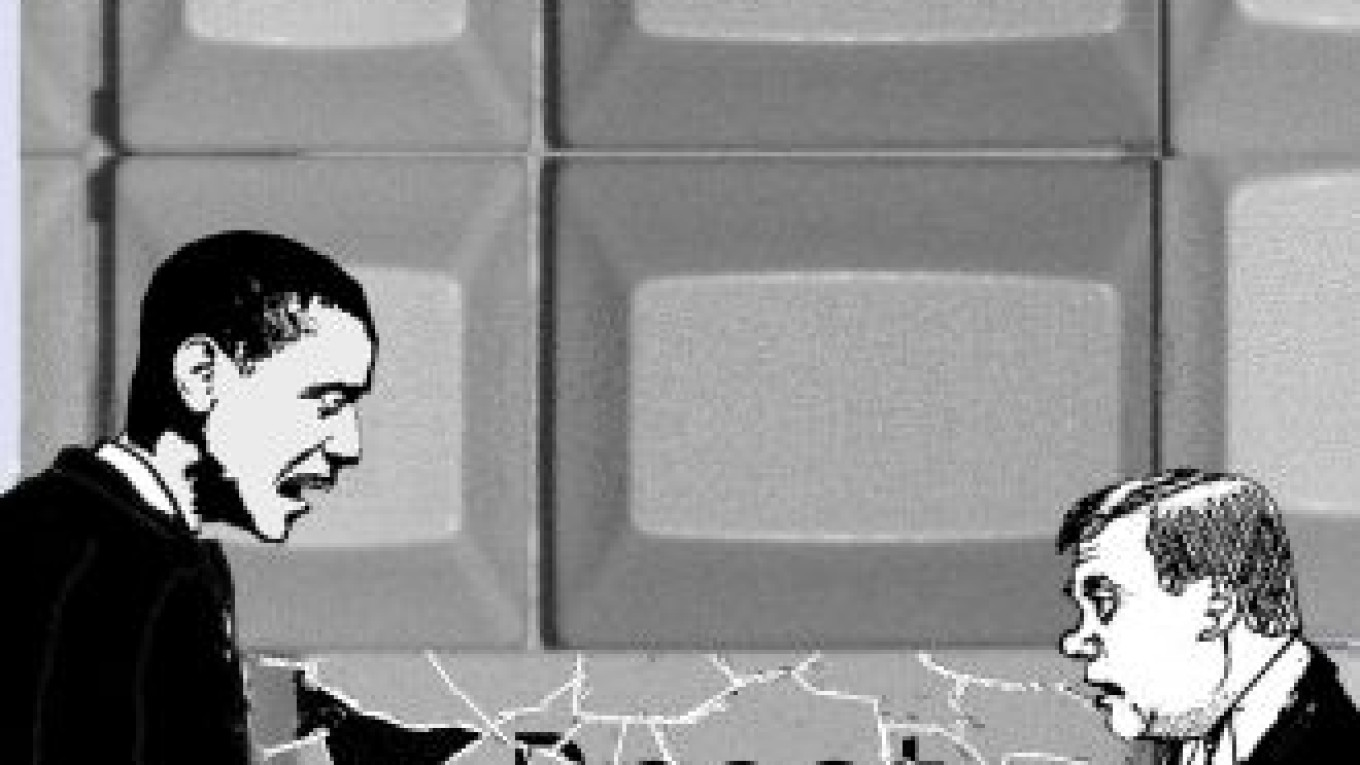
Since the reset button in U.S.-Russian relations has been pressed, Russia and the West have learned to cooperate on multiple issues from Iran and Afghanistan to nuclear arms control. Still, the momentum for improving Western ties with Russia seems to be caught in a holding pattern. It seems that both sides are increasingly frustrated with each other's policies.
NATO Secretary-General Anders Fogh Rasmussen recently condemned Russia for its sharp reaction to NATO's plans for a missile defense system in Europe. The Kremlin threatened to develop new intercontinental ballistic missiles that could spark a new arms race. Clearly frustrated, Rasmussen chided Russia's outdated thinking. "We are not a threat to Russia, we will not attack Russia, we will not undermine the security of Russia," he said.
The Kremlin, however, maintains that NATO's missile defense plans could undermine Russia's security as soon as 2020, when the system's fourth phase will be deployed. Moscow is suspicious of the fact that in response to the concerns it voices, it only receives vague, rhetorical assurances and other brushoffs.
Moscow is very much interested in improving security ties with the West. The Kremlin's initiatives — from merging the two missile defense systems to negotiating a new pan-European security treaty — demonstrate the desire to develop the kind of mutual trust that befits true allies. But U.S.-Russian relations have never been able to graduate from the status of being "partners" on certain occasional projects.
Russia blames the West for its reluctance to move to a new level of relations. The West has never hidden what it wants from the relationship: more favors from Moscow — from allowing transit routes to Afghanistan to pressuring Iran into nuclear compliance and negotiating a political exit for Libyan leader Moammar Gadhafi. But Moscow rightfully wants something in exchange, and when the Kremlin repeatedly gets the cold shoulder to its initiatives, this impedes the reset.
There are other issues that divide the two sides besides missile defense. At the end of 2010, Moscow shelved its initiative to negotiate a new security treaty with European nations after not getting any support from NATO officials and the United States. More recently, the Kremlin has criticized the West's handling of the Middle Eastern crisis by going after the regime change and Gadhafi personally. Now that France and Britain are pushing for a new resolution on Syria, Russia is not likely to let it pass.
The underlying reason why the United States developed a reset policy toward Russia has less to do with Russia itself and more to do with the U.S. economic decline and its fear of strategic competitors, such as China, Iran and radical Islam. This was not lost on the Kremlin, which wants much more out of the relationship than a being simply a means to U.S. ends.
The United States must move from fear to confidence. But this would require a new vision — one that would transform the nature of security ties with Russia. In the absence of a new vision, another cycle of hostilities shaped by clashing perceptions of each other's intentions is likely.
To prevent this, the two sides should clarify their long-term objectives, which could be assessed by an ad hoc Russian-Western advisory council made up of Russia and foreign policy experts. This could help minimize existing fears, stereotypes and misperceptions from both sides.
Ideally, this process would lead to an agreement on common threats facing both countries, such as the danger of Islamist extremism spreading to Central Asia and perhaps Russia after U.S. forces leave Afghanistan. This could pave the way to a greater cooperation in collective security for both Eurasia and Europe.
Andrei Tsygankov is professor of international relations and political science at San Francisco State University.
A Message from The Moscow Times:
Dear readers,
We are facing unprecedented challenges. Russia's Prosecutor General's Office has designated The Moscow Times as an "undesirable" organization, criminalizing our work and putting our staff at risk of prosecution. This follows our earlier unjust labeling as a "foreign agent."
These actions are direct attempts to silence independent journalism in Russia. The authorities claim our work "discredits the decisions of the Russian leadership." We see things differently: we strive to provide accurate, unbiased reporting on Russia.
We, the journalists of The Moscow Times, refuse to be silenced. But to continue our work, we need your help.
Your support, no matter how small, makes a world of difference. If you can, please support us monthly starting from just $2. It's quick to set up, and every contribution makes a significant impact.
By supporting The Moscow Times, you're defending open, independent journalism in the face of repression. Thank you for standing with us.

Remind me later.