

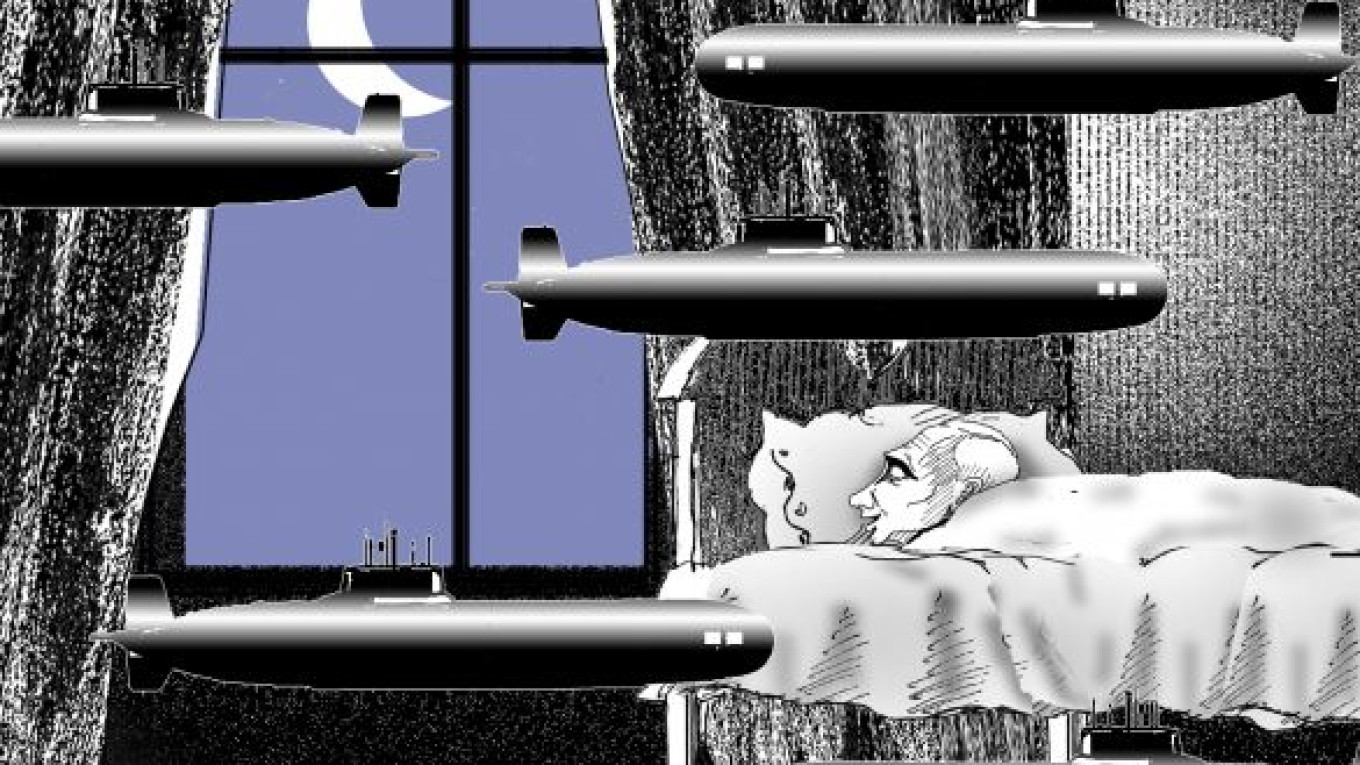
There is one contradiction that is a standard component of the Russian military: Although the military funds some programs that meet the country’s security needs, many others have little value at all.
For example, President Dmitry Medvedev signed an decree last week that nearly triples salaries for military personnel. This is an extremely important step for strengthening the military. Higher salaries will finally make it easier to attract the best and the brightest for military service.
At the same time, however, Prime Minister Vladimir Putin last week pressured leaders from the Defense Ministry and the United Shipbuilding Corporation to sign several major contracts worth 280 billion rubles ($9.2 billion) that will primarily be used to fund the development and construction of a new generation of nuclear submarines.
That total is expected to rise even further next year when the final cost is set in the main contract to build a series of Borei-type nuclear submarines. Plans call for the production of eight of these new submarines by 2020 to be outfitted with more than one-third of Russia’s nuclear warheads. Ten Yasen-type attack submarines will also be built. Overall, the program will result in a sweeping modernization of Russia’s submarine forces.
Putin explained the goals of the program at a conference that was specially convened one day before the submarine contracts were signed.
In response to comments about the Northern Sea Route made by State Duma Deputy Arthur Chilingarov, who is also a specialist in polar exploration, Putin immediately responded: “Tomorrow, new naval submarines will arrive at [Severodvinsk-based shipbuilding company] Sevmash after completing factory tests and high-seas trial runs. We will also beef up our military bases there, and we will certainly increase national security in the north.”
Putin is very fond of the idea that the Arctic ice will soon melt, giving Moscow the golden opportunity to control the shortest route between Europe and Asia. But when Putin discussed the Northern Sea Route, he failed to mention that almost the entire fleet of Russian icebreakers is aging and will soon be out of service. Moreover, Murmansk and Vladivostok lack modern ports capable of handling heavy ocean-going freight traffic.
What Putin did promise, however, was that the country’s strategic nuclear submarines, such as the Yury Dolgoruky and the Alexander Nevsky, will ensure the security of the Northern Sea Route. But the problem with this promise is that the main function of these submarines is not to protect transportation lines but to serve as a nuclear deterrent against U.S. and NATO strategic nuclear forces.
The third nuclear submarine, the Severodvinsk, is an attack ship designed to destroy naval forces and strike the enemy along its coastlines. It is definitely able to destroy a potential enemy’s transportation lines, but it is hardly capable of defending Russia’s Northern Sea Route, particularly if the military’s worst nightmare comes true — if U.S. aircraft carriers one day seize those shipping lanes.
In general, most plans to protect and defend the Arctic boil down to fairly pointless militaristic rhetoric. Russian officials invariably begin by speaking about exploitation of natural resources and end by promising to deploy thousands of soldiers to “protect our national interests.” At the same time, they ignore a glaring internal contradiction: Moscow intends to sell its abundant natural resources to leading Western powers — that is, to the same countries that many military leaders claim Russia needs to defend itself against.
What’s more, Russian shipping demand is too low to justify developing and defending the Northern Sea Route. If Russia will make any money from the route, it will be from collecting transit fees from Japanese, South Korean and U.S. ships that want to travel through it. In this case, then, why patrol the route with nuclear submarines?
Russia’s plans to build and deploy new nuclear submarines might be explained by its desire to maintain nuclear parity with the United States, but there is no conceivable reason why it would need a fleet of attack submarines. But if Washington considers Russia’s buildup of nuclear submarines a threat to its own security, it might respond by unleashing a new arms race — something that Putin and Medvedev have threatened several times themselves. If the Kremlin gets bogged down in a new arms race, there will be no money left over to pay the higher military salaries needed to make the transition to a professional army.
To make matters worse, former Finance Minister Alexei Kudrin has repeatedly warned that the huge increase in military spending planned for the next decade is fiscally untenable and must be reconsidered.
This means that Putin must choose between pursuing prudent and efficient military programs or indulge in huge wasteful and useless Cold War-era military buildup programs. Let’s hope he chooses prudence over foolishness.
Alexander Golts is deputy editor of the online newspaper Yezhednevny Zhurnal.
A Message from The Moscow Times:
Dear readers,
We are facing unprecedented challenges. Russia's Prosecutor General's Office has designated The Moscow Times as an "undesirable" organization, criminalizing our work and putting our staff at risk of prosecution. This follows our earlier unjust labeling as a "foreign agent."
These actions are direct attempts to silence independent journalism in Russia. The authorities claim our work "discredits the decisions of the Russian leadership." We see things differently: we strive to provide accurate, unbiased reporting on Russia.
We, the journalists of The Moscow Times, refuse to be silenced. But to continue our work, we need your help.
Your support, no matter how small, makes a world of difference. If you can, please support us monthly starting from just $2. It's quick to set up, and every contribution makes a significant impact.
By supporting The Moscow Times, you're defending open, independent journalism in the face of repression. Thank you for standing with us.

Remind me later.