

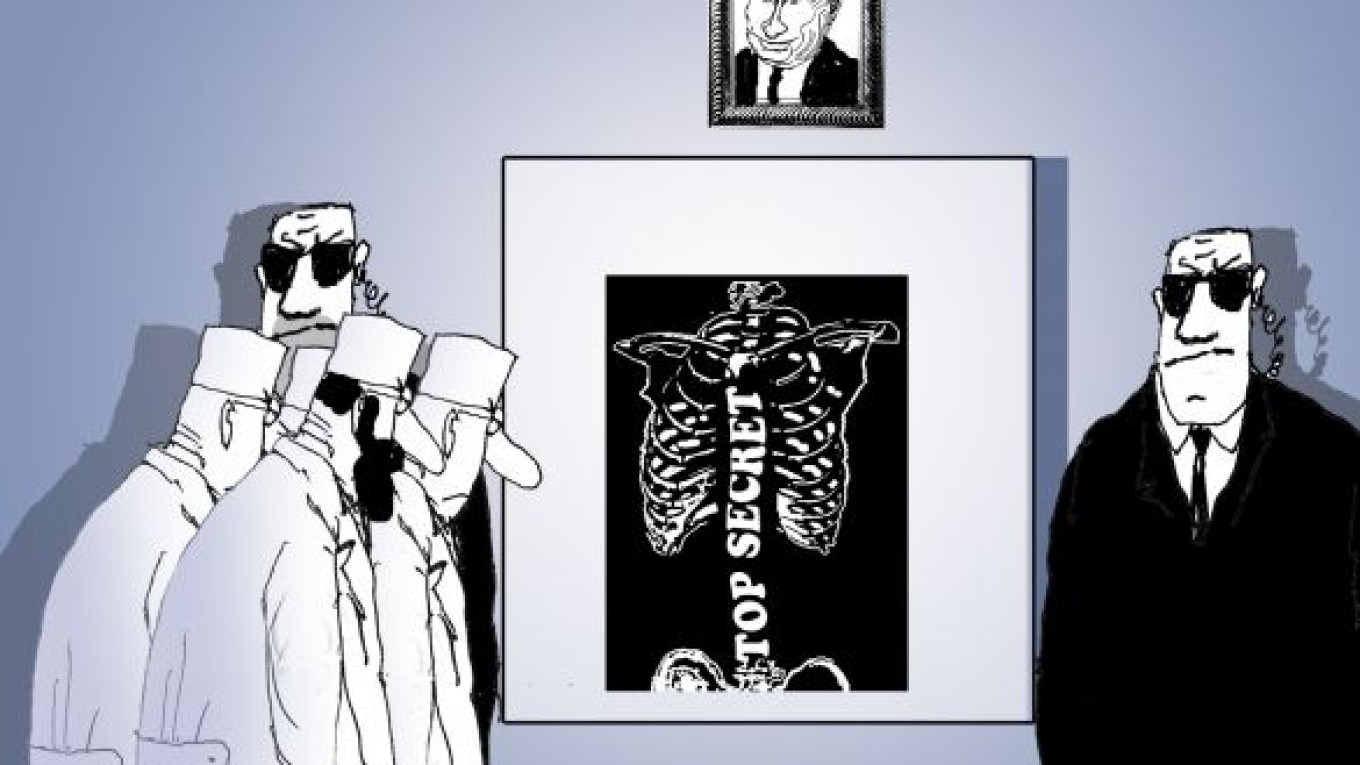
Speculation about President Vladimir Putin's health problems was revived this week when he met with Turkish Prime Minister Recep Tayyip Erdogan in Ankara. Judging from a Reuters photograph, it seemed that Putin was wincing as he lowered himself into a chair, while Erdogan extended his arms as if to help. (Needless to say, Russia's state-controlled media did not show this scene.) This follows a similar incident in early September when Putin was seen limping and painfully bracing himself against a chair at the APEC summit in Vladivostok.
What's more, throughout October and November, Putin postponed several planned foreign trips without explanation. During this period, he worked largely out of his Novo-Ogaryovo residence. The reason for this, according to the president's handlers, was Putin's (newly discovered) concern that the near-daily trips that he and his cortege make to the Kremlin would inconvenience drivers by blocking traffic for hours.
Putin also moved his annual December televised call-in show to the summer and delayed his state-of-the-nation address, usually delivered in November, by a month. While Kremlin sources told national media that the speech was postponed over a dispute about its content, Putin's spokesman Dmitry Peskov said the call-in show had been rescheduled so that the few participants who pose questions from public squares would not have to endure the winter cold.
Peskov has firmly dismissed the notion that Putin has a serious back condition that might even require surgery, saying that he simply incurred a minor muscle strain caused by a sports injury. During Putin's trip to Ankara, Peskov became visibly irritated when asked about Putin's health, saying: "I'm sick and tired of explaining. I don't see any sense in explaining it again."
But because of Russia's historical record of secrecy and deception concerning the health of leaders, many people are highly skeptical of Kremlin denials. Russians over 40 remember how they were kept in the dark about the true medical condition and hospitalization of Soviet leaders Leonid Brezhnev, Yury Andropov and Konstantin Chernenko. President Boris Yeltsin continued this tradition, concealing the fact that he had suffered a heart attack until he won re-election in 1996. (It was only after this election that the Kremlin came forward with the announcement that Yeltsin would need a quintuple coronary bypass, which was performed in November 1996.)
Thus, it is no surprise that Russians are more inclined to believe foreign sources, such as Japanese Prime Minister Yoshihiko Noda, about what is really happening in the Kremlin. Noda told Japanese journalists a week ago that he had canceled a December meeting in Moscow because of Putin's "bad health condition."
You would think Putin's health is as top secret as the country's nuclear launch codes. There are several reasons for this. First, Putin has vigilantly shielded many aspects of his personal life, including his family, from public view, and he may sincerely believe that details about his health are also something that need not be shared with the public.
Second, in autocracies like Russia, where rule is highly personalized, any public knowledge of a ruler's serious ailment could exacerbate existing interclan feuds and help trigger a power grab.
Third, it is crucial for Putin to maintain his strongman image, particularly before core supporters who believe that Putin is the all-powerful and kind tsar who has brought order and stability to the country. How can he fulfill this image if he suffers from acute, chronic back pain or something even more serious? After all, according to the Kremlin script, the country's strongman has to be strong — all the time. The Kremlin's worst nightmare would be if Putin appears spineless.
In contrast, democracies tend to be more transparent about the health of their leaders. For example, U.S. President Ronald Reagan went public early in his first term about his need for a hearing aid. The White House also described in great detail Reagan's 1985 surgery to remove cancerous polyps from his colon. France, however, was a rare exception to this transparency rule. President Francois Mitterrand and his doctors concealed from the public for most of his 14 years in office that he had prostate cancer. Strangely enough, even Hugo Chavez, Venezuela's autocratic president, appeared more democratic than Putin when he acknowledged in June 2011 that he was being treated for cancer (although he refused to name the type of cancer).
Trying to clear up the speculation over Putin's back, Belarussian President Alexander Lukashenko said last week that Putin had injured his spine during a recent judo bout. Whether Putin has serious health problems or not, Nezavisimaya Gazeta reported on Tuesday that Kremlin image-makers want to finally ditch the idea of spinning Putin as a macho, athletic strongman and instead try to present him as a more subtle and sophisticated "political elder."
This is highly unlikely. If anything, Putin needs to strengthen his vertical power structure to remain in control. And a strong vertical power structure requires strong vertebrae to stand firm.
Yet if Putin's back is indeed ailing, he knows exactly where to turn for treatment — Kremlin spin doctors, who will try their best to keep him healthy and strong for many years to come.
Michael Bohm is opinion page editor of The Moscow Times.
A Message from The Moscow Times:
Dear readers,
We are facing unprecedented challenges. Russia's Prosecutor General's Office has designated The Moscow Times as an "undesirable" organization, criminalizing our work and putting our staff at risk of prosecution. This follows our earlier unjust labeling as a "foreign agent."
These actions are direct attempts to silence independent journalism in Russia. The authorities claim our work "discredits the decisions of the Russian leadership." We see things differently: we strive to provide accurate, unbiased reporting on Russia.
We, the journalists of The Moscow Times, refuse to be silenced. But to continue our work, we need your help.
Your support, no matter how small, makes a world of difference. If you can, please support us monthly starting from just $2. It's quick to set up, and every contribution makes a significant impact.
By supporting The Moscow Times, you're defending open, independent journalism in the face of repression. Thank you for standing with us.

Remind me later.