

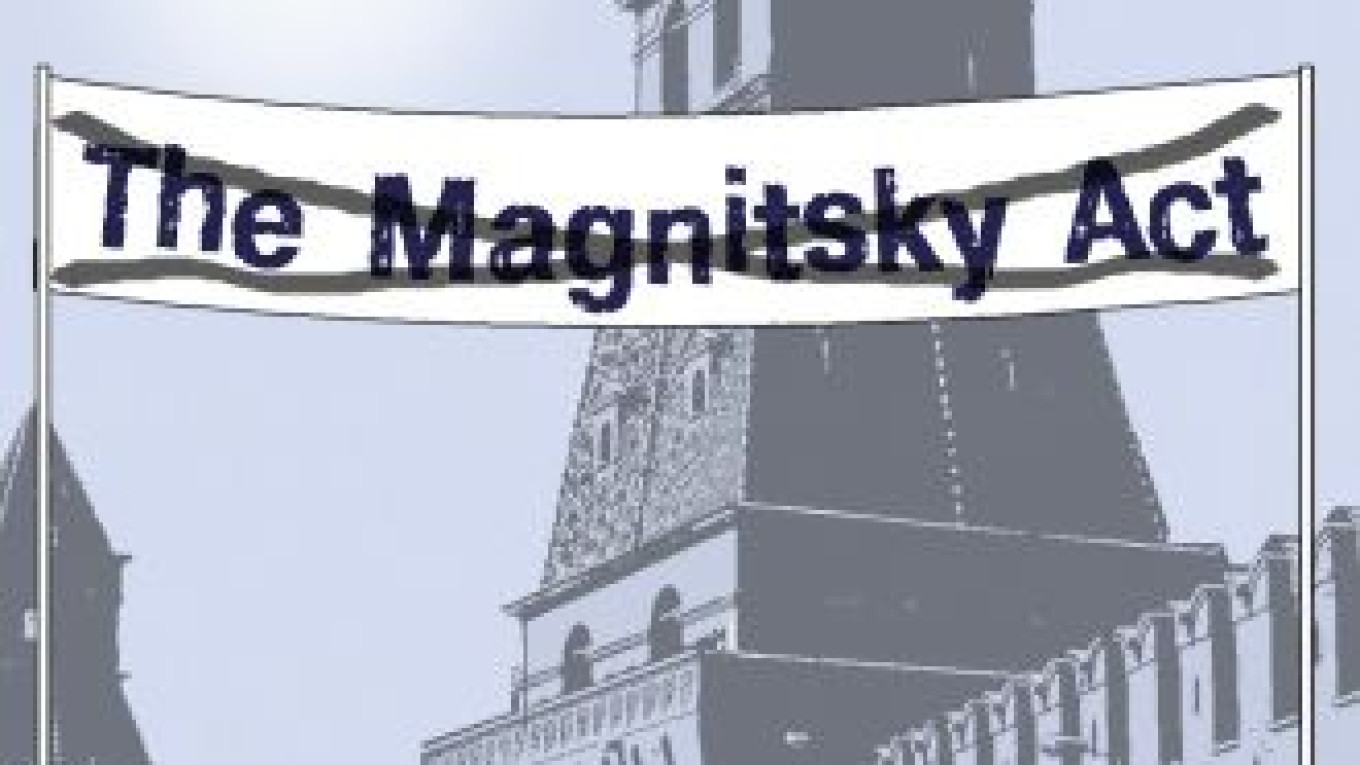
The Magnitsky Act has passed both the U.S. House of Representatives and the Senate, and President Barack Obama will likely sign it into law by the end of the year. Meanwhile, Moscow faces a serious quandary, partly of its own making and from which it cannot easily escape. It seems that Moscow's reflexive "symmetrical" responses are likely to be ineffective and will backfire on the Kremlin.
Authorities effectively fired their first salvo at the U.S. when Gennady Onishchenko, Russia's chief health regulator, recommended a ban on U.S. beef and pork imports. Onishchenko suddenly discovered that the U.S. feed additive used in beef and pork is unsafe for Russian consumers. If the ban survives a challenge before the World Trade Organization, it will cost U.S. producers $500 million in yearly exports to Russia. At the same time, however, it will likely increase the cost of pork and beef for Russian consumers.
The State Duma is also discussing the creation of various blacklists of U.S. officials and other citizens who will be denied visas and whose Russian bank accounts will be frozen. Yet the proposed measures contradict the Kremlin's legitimate argument that matters of domestic law and order are internal affairs. The measures are also easily susceptible to ridicule since nobody on the blacklist is likely to ever hold their money in a Russian bank or buy property in the country.
The best thing the authorities could have done to prevent this dilemma was to vigorously investigate the circumstances of Magnitsky's death. Even if only a few of the main figures had been properly investigated and prosecuted in a timely fashion, Russia might have averted the Magnitsky Act. It also would have sent a much-needed message to corrupt officials that their actions compromise national interests and tarnish the country's reputation.
But now, the Kremlin has backed itself in a corner. Since the Magnitsky Act has passed both houses of Congress, Russia is even less likely to prosecute the people associated with Magnitsky's death and the related embezzlement scheme because it might look like Moscow caved in to U.S. pressure.
Russia's response reveals one of its greatest weaknesses: a deep-seated sense of insecurity. It needs the self-confidence to accept criticism when it is warranted. Russia's insistence that the U.S. and European countries respect its dignity is legitimate, but that does not mean it can ignore its obligations, particularly those codified in international conventions on corruption, human rights and money laundering.
Nonetheless, Russia is correct on one issue: The Magnitsky Act is a counterproductive intrusion into Russia's internal affairs, and it appears as if the U.S. is going out of its way to publicly humiliate Russia. It would have been strange if Russia had stayed silent in response to the U.S. provocation. What the Kremlin should do is adopt a position of diplomatic and restrained indignation. It can reasonably stand on principles of jurisprudence and international mutual respect. But hysterical rhetoric and political grandstanding may have exactly the opposite effect that Duma deputies and Kremlin bureaucrats desire.?
The Kremlin may believe that it needs to adopt a public stance that will satisfy domestic opinion, but the costs of exaggerated outrage may be greater than the benefits. A thorough investigation of Magnitsky's death is the only real solution to Russia's present dilemma. It is also the best course of action for the country's long-term interests and global reputation.
Mark Nuckols is a? professor of? law and? business at? Moscow State University and? at the? Russian Academy of? National Economy.
Related articles:
A Message from The Moscow Times:
Dear readers,
We are facing unprecedented challenges. Russia's Prosecutor General's Office has designated The Moscow Times as an "undesirable" organization, criminalizing our work and putting our staff at risk of prosecution. This follows our earlier unjust labeling as a "foreign agent."
These actions are direct attempts to silence independent journalism in Russia. The authorities claim our work "discredits the decisions of the Russian leadership." We see things differently: we strive to provide accurate, unbiased reporting on Russia.
We, the journalists of The Moscow Times, refuse to be silenced. But to continue our work, we need your help.
Your support, no matter how small, makes a world of difference. If you can, please support us monthly starting from just $2. It's quick to set up, and every contribution makes a significant impact.
By supporting The Moscow Times, you're defending open, independent journalism in the face of repression. Thank you for standing with us.

Remind me later.