

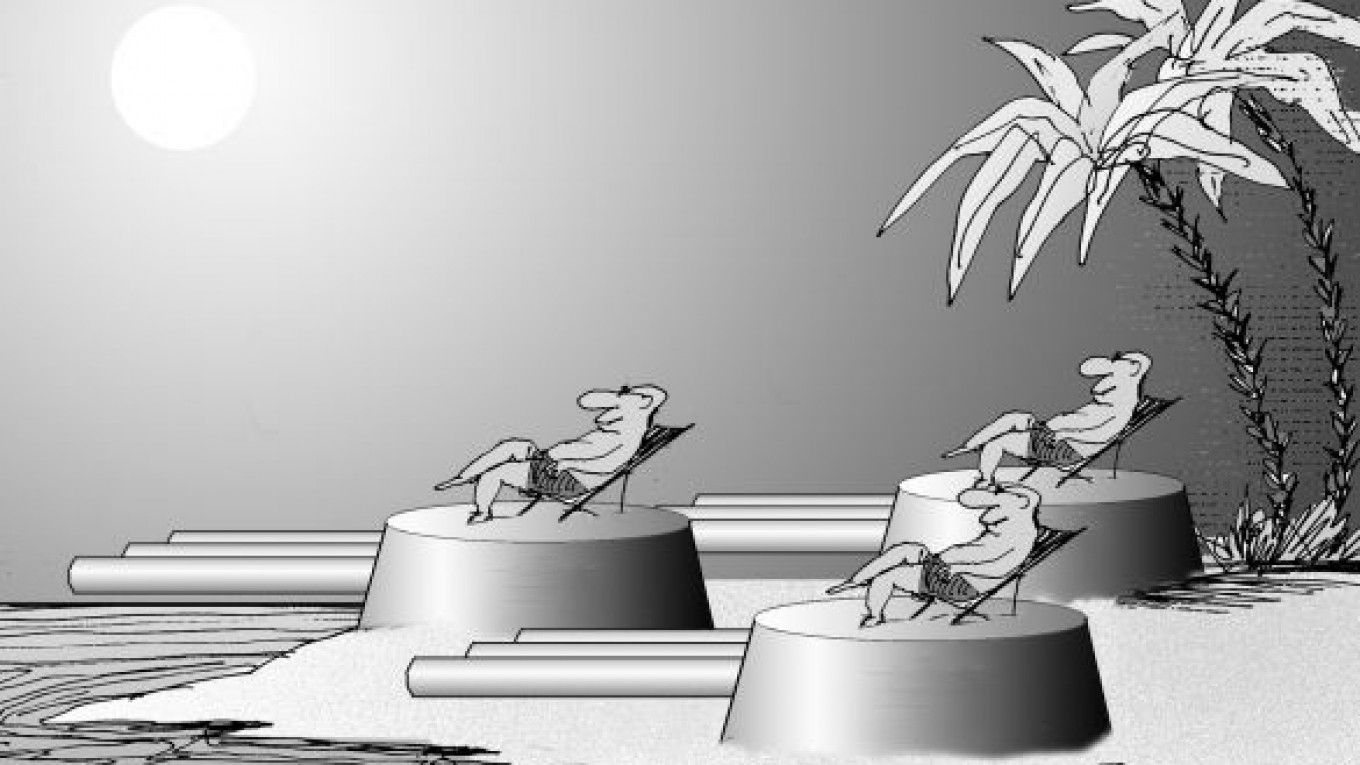
Will military power become less important in the coming decades? It is true that the number of large-scale, interstate wars continues to decline, and fighting is unlikely among advanced democracies and on many issues. But as U.S. President Barack Obama said in accepting the Nobel Peace Prize in December: “We must begin by acknowledging the hard truth that we will not eradicate violent conflict in our lifetimes. There will be times when nations — acting individually or in concert — will find the use of force not only necessary but morally justified.”
When people speak of military power, they tend to think in terms of the resources that underlie the hard-power behavior of fighting and threatening to fight — soldiers, tanks, planes, ships and so forth. In the end, if push comes to shove, such military resources matter. Napoleon famously said, “God is on the side of the big battalions,” and Mao Zedong argued that power comes from the barrel of a gun.
In today’s world, however, there is much more to military resources than guns and battalions and more to hard-power behavior than fighting or threatening to fight. Military power is also used to provide protection for allies and assistance to friends. Such noncoercive use of military resources can be an important source of the soft-power behavior of framing agendas, persuading other governments and attracting support in world politics.
Even when thinking only of fighting and threats, many analysts focus solely on interstate war and concentrate on soldiers in uniforms, organized and equipped by the state in formal military units. But in the 21st century, most “wars” occur within, rather than between states, and many combatants do not wear uniforms. Of the 226 significant armed conflicts between 1945 and 2002, less than half in the 1950s were fought between states and armed groups. By the 1990s, such conflicts were the dominant form.
Of course, civil war and irregular combatants are not new, as even the traditional law of war recognizes. What is new is the increase in irregular combat and the technological changes that put ever-increasing destructive power in the hands of small groups that would have been priced out of the market for massive destruction in earlier eras. And now technology has brought a new dimension to warfare: the prospect of cyber attacks by which an enemy — state or nonstate — can create enormous physical destruction (or threaten to do so) without an army that physically crosses another state’s border.
War and force may be down, but they are not out. Instead, the use of force is taking new forms. Military theorists today write about “fourth-generation warfare” that sometimes has “no definable battlefields or fronts.” Indeed, the distinction between civilian and military may disappear.
The first generation of modern warfare reflected the tactics of line and column following the French Revolution. The second generation relied on massed firepower and culminated in World War I; its slogan was that artillery conquers and infantry occupies. The third generation arose from tactics developed by the Germans to break the stalemate of trench warfare in 1918, which Germany perfected in the Blitzkrieg tactics that allowed it to defeat larger French and British tank forces in the conquest of France in 1940.
Both ideas and technology drove these changes. The same is true of today’s fourth-generation of modern warfare, which focuses on the enemy’s society and political will to fight.
Even if the prospect or threat of the use of force among states has become less probable, it will retain a high impact, and it is just such situations that lead rational actors to purchase expensive insurance. The United States is likely to be the major issuer of such insurance policies.
This leads to a larger point about the role of military force in world politics. Military power remains important because it structures world politics. It is true that in many relationships and issues, military force is increasingly difficult or costly for states to use. But the fact that military power is not always sufficient in particular situations does not mean that it has lost the ability to structure expectations and shape political calculations.
Markets and economic power rest upon political frameworks. In chaotic conditions of great political uncertainty, markets fail. Political frameworks, in turn, rest upon norms and institutions, but also upon the management of coercive power. A well-ordered modern state is defined by a monopoly on the legitimate use of force, which allows domestic markets to operate.
Internationally, where order is more tenuous, residual concerns about the coercive use of force, even if a low probability, can have important effects. Military force, along with norms and institutions, helps to provide a minimal degree of order.
Metaphorically, military power provides a degree of security that is to political and economic order as oxygen is to breathing: little noticed until it begins to become scarce. Once that occurs, its absence dominates all else.
In this sense, the role of military power in structuring world politics is likely to persist well into the 21st century. Military power will not have the utility for states that it had in the 19th century, but it will remain a crucial component of power in world politics.
Joseph S. Nye, a former U.S. assistant defense secretary, is a professor at Harvard University and author of “Soft Power: The Means to Success in World Politics.” © Project Syndicate
A Message from The Moscow Times:
Dear readers,
We are facing unprecedented challenges. Russia's Prosecutor General's Office has designated The Moscow Times as an "undesirable" organization, criminalizing our work and putting our staff at risk of prosecution. This follows our earlier unjust labeling as a "foreign agent."
These actions are direct attempts to silence independent journalism in Russia. The authorities claim our work "discredits the decisions of the Russian leadership." We see things differently: we strive to provide accurate, unbiased reporting on Russia.
We, the journalists of The Moscow Times, refuse to be silenced. But to continue our work, we need your help.
Your support, no matter how small, makes a world of difference. If you can, please support us monthly starting from just $2. It's quick to set up, and every contribution makes a significant impact.
By supporting The Moscow Times, you're defending open, independent journalism in the face of repression. Thank you for standing with us.

Remind me later.