

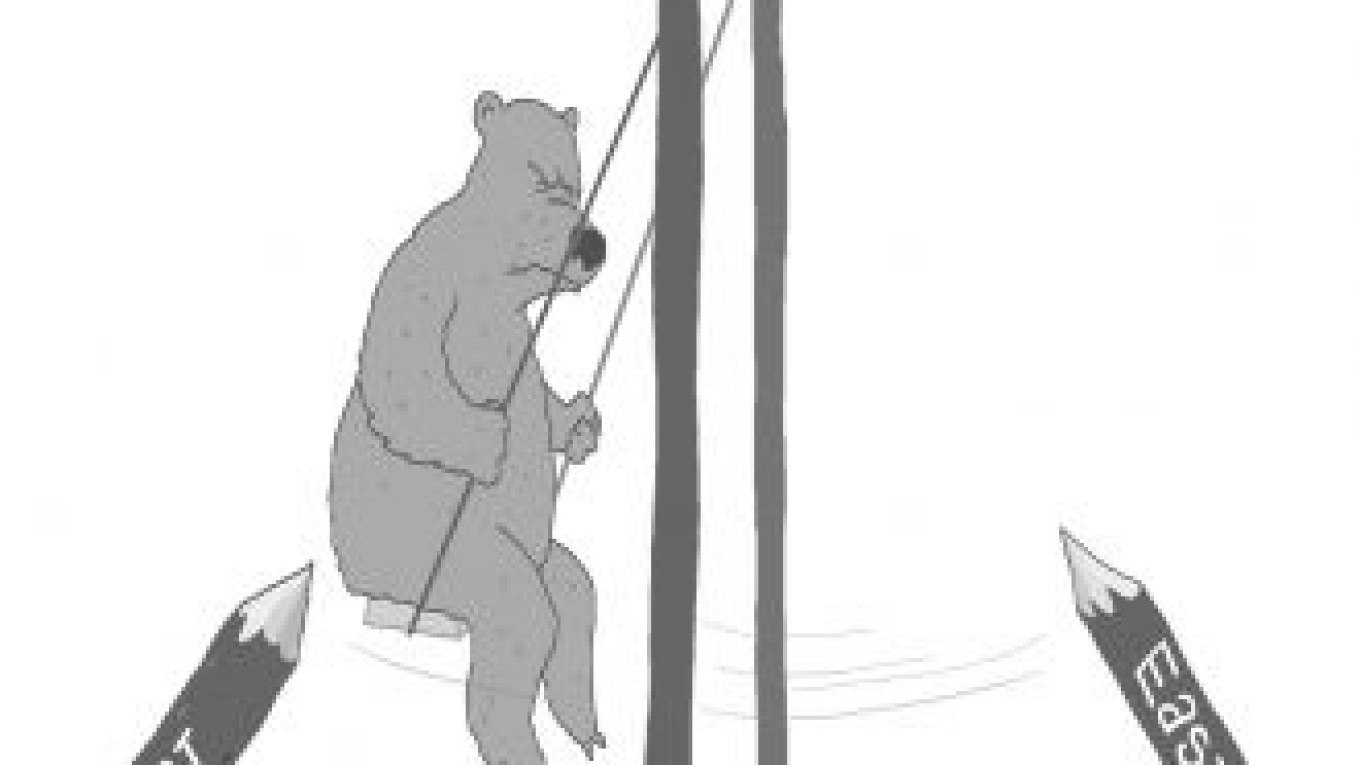
Next year will mark the 20th anniversary of the collapse of the Soviet Union, and there will certainly be plenty of analyses about what that meant and where the country stands two decades later. But one of the most important results became apparent in 2010: Russia made a psychological break with its past and its former status as an empire.
Former Presidents Boris Yeltsin and Vladimir Putin — and until recently President Dmitry Medvedev — tried to restore Russia’s former status as a major world player and regional power center among the former Soviet republics. Russia’s foreign policy attempted to convince the West that the country’s weakness throughout the 1990s was a historical accident and that the ascendancy of the West in relation to Russia was a mere coincidence. Until recently, the Soviet collapse served as the main prism through which the country’s identity was defined, and the foreign policy of the first three presidents focused on the West.
But the Russia-Georgia war in August 2008 was the turning point in this process. It demonstrated Russia’s ability to stop what had appeared to be NATO’s creeping, eastward expansion and clearly defined Moscow’s sphere of influence in the North Caucasus.
After the conflict, the Kremlin had two basic choices: Either it could build on the military and political success and try to project its power in new areas, or it could be content with the fact that it had given Georgia’s largest supporter, the United States, a slap on the wrist and continue the process of walking away from its imperial ambitions. In 2010, it became clear that Russia had chosen the second option.
At the same time, Moscow has taken a decisive turn toward Asia. Although past Russian policy toward Asia was meant to show the West that Moscow had an alternative partner, now that policy is independent of other considerations. The problem is that in its relations with Asia, Russia must essentially start from scratch. Even when Russia was at its weakest in the 1990s, it still held considerable political significance for Europe. But for most Asian countries, Russia practically never existed as a regional strategic factor, and this remained true even when it became more powerful in the global arena in the 2000s.
The reduction in tensions between Russia and both NATO and the EU is linked to their gradual declines. Although Russia continues to see Europe as a source of modernization, Moscow no longer views it as the sole source.
The stakes in European politics have fallen sharply. Two years ago, it seemed as if the question of keeping the Black Sea Fleet at Sevastopol was almost worth going to war over. But when leaders reached an agreement last spring to keep the fleet in place for many more years, the world hardly noticed.
The New START treaty will probably be the last in the series of Cold War-style disarmament treaties. Most likely, Russia’s nuclear strategy in the future will no longer be based on maintaining nuclear parity with the United States. Moscow is? beginning to understand that it needs a nuclear arsenal of sufficient size to deter threats from other countries.
Another significant event in 2010 was Russia’s decision to not intervene in the Kyrgyz riots in April or in the coup that followed. True, the decision was strongly driven by pragmatism since the risks of intervention far outweighed the chance for success in resolving the situation in Bishkek. But it was also another example that the Kremlin is not willing to take advantage of instability in its backyard to restore — even in part — its lost empire.
Russia’s policy of noninterference extended to other former Soviet republics as well. The Orange forces backing former Ukrainian President Viktor Yushchenko have only themselves to blame for their defeat during the presidential election in January. Moreover, President Viktor Yanukovych shows no signs of cozying up to Moscow. Belarussian President Alexander Lukashenko had no problem securing his re-election on Sunday despite having differed sharply with the Kremlin throughout 2010. Although Moscow did take an interest in parliamentary elections in Moldova, the outcome reflects the result of a purely internal balance of power. Even the success enjoyed by the seemingly pro-Russia party in Latvia was due more to the severe economic crisis in the country than to any effort by Russia.
All of these events benefit Russia. The former Soviet republics are now just neighbors that are on more or less good terms and dependent on one another. When Moscow does attempt to influence them, it is with the intention of creating more favorable conditions for its own economy and not to throw its weight around or to achieve geopolitical gain.
There is still competition between Russia and its neighbors, but it is largely connected with China. This rivalry is all business and nothing personal, in contrast to Russian-European relations.
The violence this month by ultranationalist groups in Moscow has also signaled a change in the Kremlin’s thinking. Following the Soviet collapse, Russia has waged three wars in the Caucasus — two in Chechnya and one in South Ossetia — to keep the region under Kremlin control. Paradoxically, it now turns out that a significant portion of the population — and not only violent mobs chanting racist slogans — has little desire to consider people from the Caucasus as their fellow citizens.
Ethnic nationalism and xenophobia, which have increased in the 2000s, are the opposite of an imperial mindset, which, by definition, is multicultural and tries to co-opt foreign groups to project its power.
Ever since the 1990s, we have often heard the argument that the new Russia will truly appear only when it changes from an empire into a “normal country.” 2010 showed that this transformation has made significant progress. The question is to what degree that country will remain normal and stable over the long term.
While Russia has left its imperial ambitions behind, the main reference point for defining itself is no longer rooted in the Soviet collapse but somewhere in the uncertain future. The main task facing the country is to do everything it can so this future will be stable and prosperous.
Fyodor Lukyanov is editor of Russia in Global Affairs.
A Message from The Moscow Times:
Dear readers,
We are facing unprecedented challenges. Russia's Prosecutor General's Office has designated The Moscow Times as an "undesirable" organization, criminalizing our work and putting our staff at risk of prosecution. This follows our earlier unjust labeling as a "foreign agent."
These actions are direct attempts to silence independent journalism in Russia. The authorities claim our work "discredits the decisions of the Russian leadership." We see things differently: we strive to provide accurate, unbiased reporting on Russia.
We, the journalists of The Moscow Times, refuse to be silenced. But to continue our work, we need your help.
Your support, no matter how small, makes a world of difference. If you can, please support us monthly starting from just $2. It's quick to set up, and every contribution makes a significant impact.
By supporting The Moscow Times, you're defending open, independent journalism in the face of repression. Thank you for standing with us.

Remind me later.