

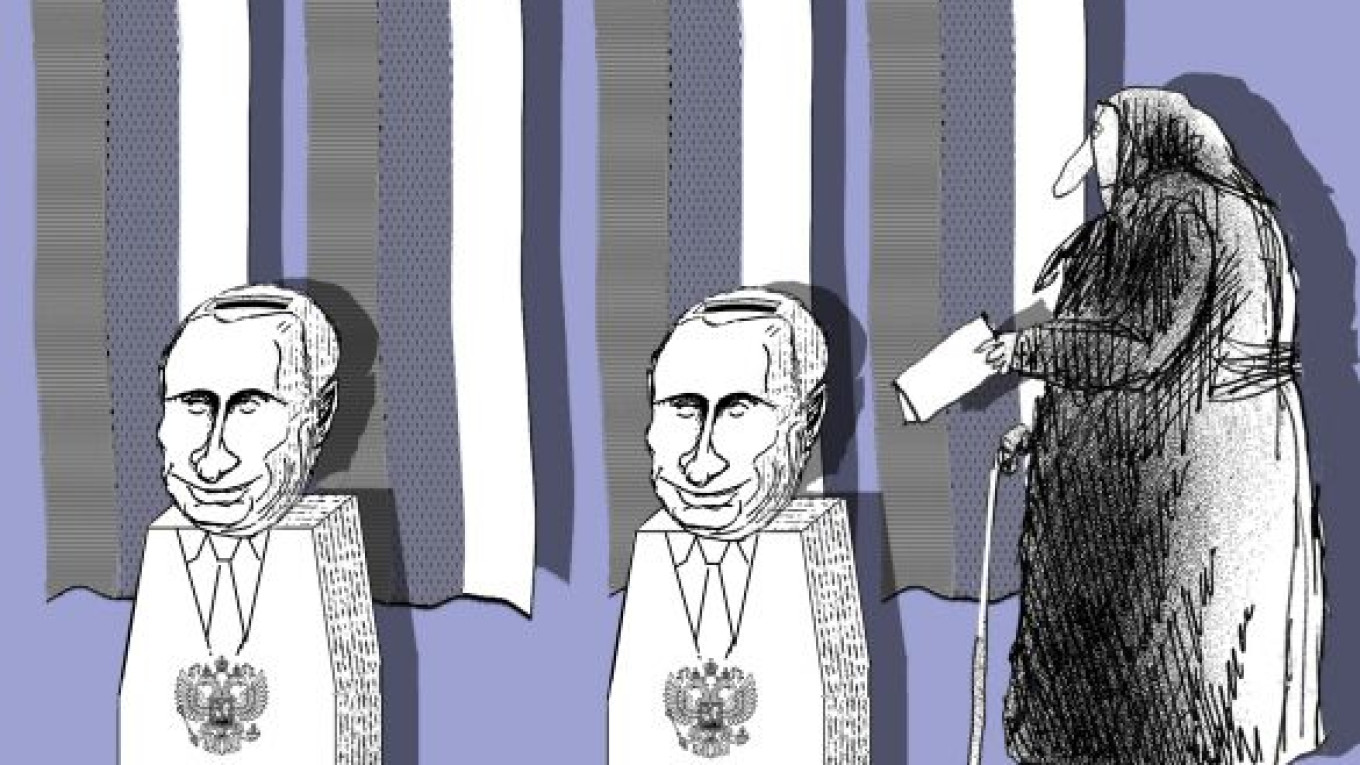
Even more people took part in the demonstration on Saturday at Prospekt Akademika Sakharova than they did for the rally on Dec. 10 on Bolotnaya Ploshchad.
Even before the second demonstration took place, the authorities began making concessions to protesters. In a hastily prepared speech last week, President Dmitry Medvedev proposed reinstating the direct election of governors, reducing the required number of signatures for a party to register for elections from 45,000 to just 500, and reducing the number of signatures required for a candidate to run for president from 2 million to 300,000.
I very much doubt that the lame duck president's proposed reforms will be implemented. In general, how much weight do they carry coming from a person whose name neither Prime Minister Vladimir Putin nor the opposition has so much as mentioned even once in recent weeks? Moreover, Medvedev has never fulfilled a single promise he has made.
The authorities will try to turn their current moral failure into a technical victory. They will send the Putin-jugend organizations like Nashi and Stal against their rivals and attempt to foment discord within the ranks of the opposition. Anything is possible. In fact, I would advise opposition leader Alexei Navalny to never leave home without an escort of friends and well-wishers.
A kleptocracy differs from a totalitarian regime in that totalitarian leaders send missiles and tanks at the cursed West, while kleptocrats send their money there. Another difference is that kleptocratic governments are afraid to cross the line and be labeled a "rogue state" by the West. If that happens, all their money will be frozen in Western bank accounts. What is the sense of going to all the trouble to set up and maintain a kleptocracy if you can't spend and hold your money and assets in the West?
In this sense, the story with the Moscow demonstrations is very similar to what happened with Georgia. After the Russia-Georgia war in August 2008, the Kremlin was out to hang Georgian President Mikheil Saakashvili by his crown jewels, but no sooner did then-U.S. President George W. Bush raise his voice than the Kremlin bullies began acting like good little boys.
And the same thing happened now. The authorities began cracking down on the demonstrators on Dec. 5 at Chistiye Prudy, but as soon as U.S. Secretary of State Hillary Clinton and the European Union raised their voices, the Kremlin bullies immediately backed down.
As it turns out, it's not the protesters who take signals from the U.S. State Department. It's the Kremlin. They might be angry and gnashing their teeth at what they hear, but in the end they follow the West's cues.
Putin and his inner circle need to achieve legitimacy in the eyes of the West. Putin also needs to win the presidential election in March during the first round of voting. If the vote goes to a second round, it is entirely possible that Communist Party leader Gennady Zyuganov could become the next president. It will be difficult to repeat the same trick of 1996, in which the West clearly supported the better of two evils — Boris Yeltsin over Zyuganov. In a Putin-Zyuganov showdown, both are worse.
To ensure a Putin victory in March, it will be necessary to rig the election. Every government official will take an active part in the fraud to win points with Putin, and the governors know that if they don't secure the "correct" number of votes for the national leader, Putin will blame them for his electoral defeat.
What's more, this system cannot even rig an election properly because the real goal of every government official is simply to steal as much money as possible whenever the opportunity arises — whether bidding for a construction project or rigging elections.
Because it is known beforehand that the authorities will falsify the presidential election results, the whole future of the now-awakened civil society will depend on its ability to catch officials red-handed and prove their crimes to the world. The opposition must build an organization that will fully document election violations in the same way that Navalny's RosPil web site exposes government corruption and theft.
Whoever can successfully build such a grassroots organization will have a good chance at becoming the next president. In fact, the ability of opposition leaders to accomplish this task will be a litmus test of their ability to govern if they ever gain power. Otherwise, we will see that both the authorities and the opposition are ineffective, and the elections will be won by whichever of the two has the most money and resources — that is, the Kremlin.
Yulia Latynina hosts a political talk show on Ekho Moskvy radio.
A Message from The Moscow Times:
Dear readers,
We are facing unprecedented challenges. Russia's Prosecutor General's Office has designated The Moscow Times as an "undesirable" organization, criminalizing our work and putting our staff at risk of prosecution. This follows our earlier unjust labeling as a "foreign agent."
These actions are direct attempts to silence independent journalism in Russia. The authorities claim our work "discredits the decisions of the Russian leadership." We see things differently: we strive to provide accurate, unbiased reporting on Russia.
We, the journalists of The Moscow Times, refuse to be silenced. But to continue our work, we need your help.
Your support, no matter how small, makes a world of difference. If you can, please support us monthly starting from just $2. It's quick to set up, and every contribution makes a significant impact.
By supporting The Moscow Times, you're defending open, independent journalism in the face of repression. Thank you for standing with us.

Remind me later.