

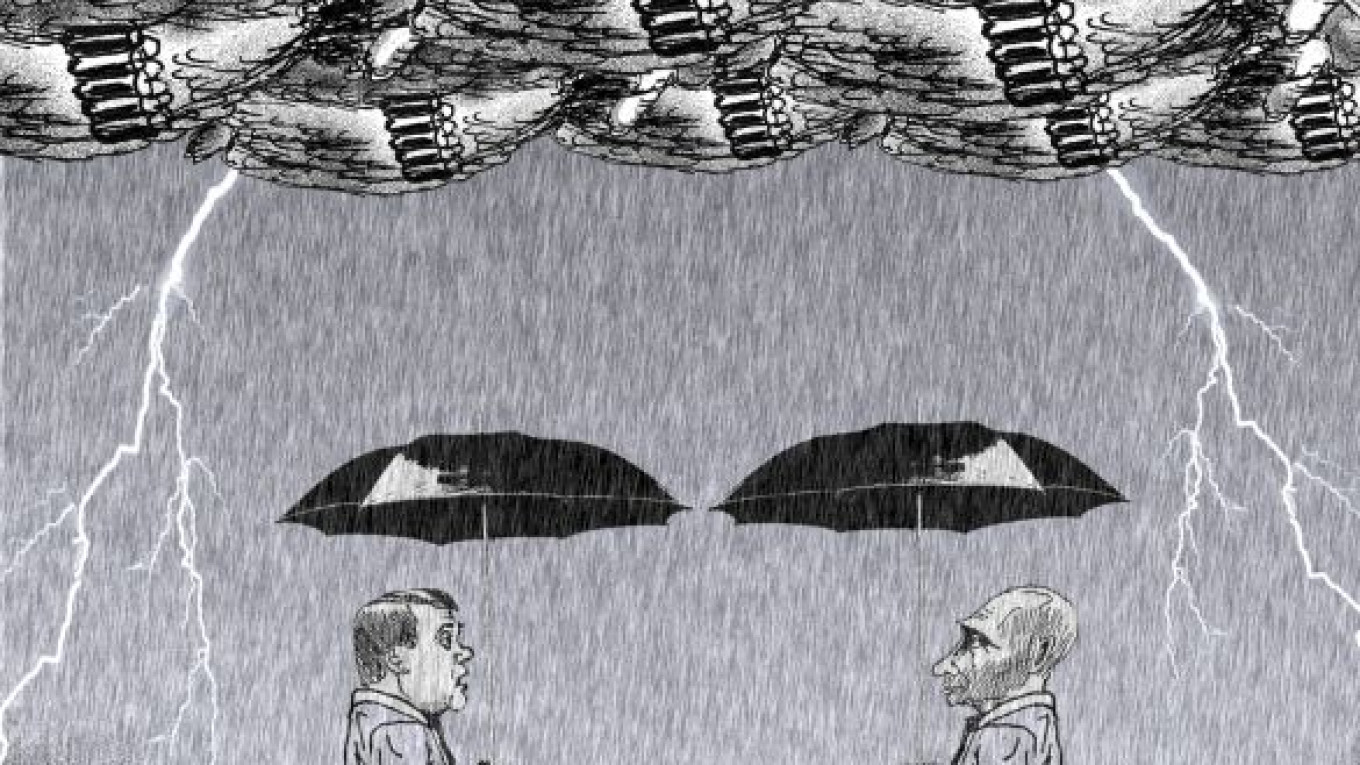
Upon learning of the terrorist attack at Domodedovo Airport, President Dmitry Medvedev convened an emergency meeting with? Investigative Committee head Alexander Bastrykin, Prosecutor General Yury Chaika and Transportation Minister Igor Levitin. Thus, Medvedev invited only those who are directly responsible for responding to a terrorist attack. Bastrykin was charged with creating an investigative task force, Chaika was told to examine all transportation facilities, and Levitin was instructed to beef up security measures at airports.
But there were two top officials who were conspicuously absent from Medvedev’s meeting — Interior Minister Rashid Nurgaliyev and Federal Security Service director Alexander Bortnikov. They should have been grilled on whether everything possible had been done to prevent the attack.
Nurgaliyev and Bortnikov were also not called before Prime Minister Vladimir Putin. Like Medvedev, Putin limited his response to issuing orders, telling Health and Social Development Minister Tatyana Golikova to prepare the necessary documents for providing assistance to the victims’ families.
Bortnikov or Nurgaliyev avoided television cameras during the first eight hours after the explosion.
These tactics clearly demonstrate that? Russia’s top officials view the terrorist attack at Domodedovo as being no different than a natural disaster in which there is no guilty party, only a tragic accident. Questions of the government’s and individual ministers’ negligence and basic responsibility to provide security for its citizens are avoided.
In this spirit, Medvedev on Tuesday gave a hint as to who should be punished for the terrorist attack. First, he said the management of Domodedovo Airport should face criminal charges. Then, he ordered Nurgaliyev and Bortnikov to fire Interior Ministry and FSB officials who were responsible for transportation safety. This underscores Medvedev’s narrow, bureaucratic approach of firing officials instead of focusing on preventing a terrorist attack in the first place.
This is standard practice for the country’s leaders and has been used in nearly every terrorist attack. In 2009 and 2010, Bortnikov did not give end-of-the-year news conferences on the FSB’s activity, although his predecessor, Nikolai Patrushev, did. One year ago, we wrote that Bortnikov’s decision to reject the long-standing practice of holding news conferences was a tacit admission that the FSB is only accountable to the Kremlin. The lack of? official response to the Domodedovo attack creates the impression that the FSB and Interior Ministry are no longer answerable to even the Kremlin on terrorism issues, which doesn’t seem to bother Medvedev or Putin.
In fact, those are not the only agencies and individuals who have adopted a policy of silence regarding terrorist attacks. For many years, former Mayor Yury Luzhkov considered it his duty to visit an attack site immediately and report before journalists on initial investigation results and the measures being taken. There was good reason for that practice. Millions of frightened Muscovites sitting in front of their television sets could see that the city’s leader was in control of the situation. But that tradition was abandoned the moment Medvedev appointed Sergei Sobyanin as Moscow mayor. Sobyanin did arrive at the scene of the tragedy as duty required, but he did not bother speaking to reporters there. Instead, he limited his response to giving a few standard statements to his own hand-picked pool of loyal journalists, none of whom asked difficult questions.
Both Bortnikov and Sobyanin are Medvedev appointees, and both abandoned the practice of their predecessors of facing the media. This means that the type of leader who Medvedev favors does not consider it necessary to be accountable to the people in any way. No amount of secrecy or media manipulation can hide the fact that, by taking this approach for so long, the ruling tandem has finally made the siloviki structures incapable of averting terrorist strikes or responding to them appropriately.
The country is facing a real and dangerous enemy, and it needs competent, professional security agenices that have the ability and skills to prevent terrorist attacks.
The main priority of the government’s anti-terrorism strategy, finalized in 2006, was terribly misguided. It was focused on preventing attacks by large groups of militants or insurgents that could lead to political instability in the regions or the entire country. This was the reason for the buildup of anti-terrorist units in the Air Force, special forces and related agencies.
Meanwhile, terrorists had adopted a completely different strategy — attacking in small groups.? In 2007, they resumed the use of suicide bombers. From 2009 to 2010, they sharply increased the number of terrorist acts, bombings and attacks against siloviki agencies and infrastructure in the North Caucasus. In 2010, they once again sent suicide bombers to Moscow.
While the terrorists constantly changed their strategy, the Kremlin has followed its old strategy of meting out extrajudicial punishment against suspected terrorists — often in the form of “extermination.” But this is by no means a pre-emptive strategy to prevent terrorist attacks. It would be much better, of course,? if special forces hunted down terrorists in the Caucausus Mountains before they carried out a terrorist attack, not after.
Andrei Soldatov and Irina Borogan are co-founders of? Agentura.ru? and co-authors of “The New Nobility: The Restoration of Russia’s Security State” and “The Enduring Legacy of the KGB.”
A Message from The Moscow Times:
Dear readers,
We are facing unprecedented challenges. Russia's Prosecutor General's Office has designated The Moscow Times as an "undesirable" organization, criminalizing our work and putting our staff at risk of prosecution. This follows our earlier unjust labeling as a "foreign agent."
These actions are direct attempts to silence independent journalism in Russia. The authorities claim our work "discredits the decisions of the Russian leadership." We see things differently: we strive to provide accurate, unbiased reporting on Russia.
We, the journalists of The Moscow Times, refuse to be silenced. But to continue our work, we need your help.
Your support, no matter how small, makes a world of difference. If you can, please support us monthly starting from just $2. It's quick to set up, and every contribution makes a significant impact.
By supporting The Moscow Times, you're defending open, independent journalism in the face of repression. Thank you for standing with us.

Remind me later.