

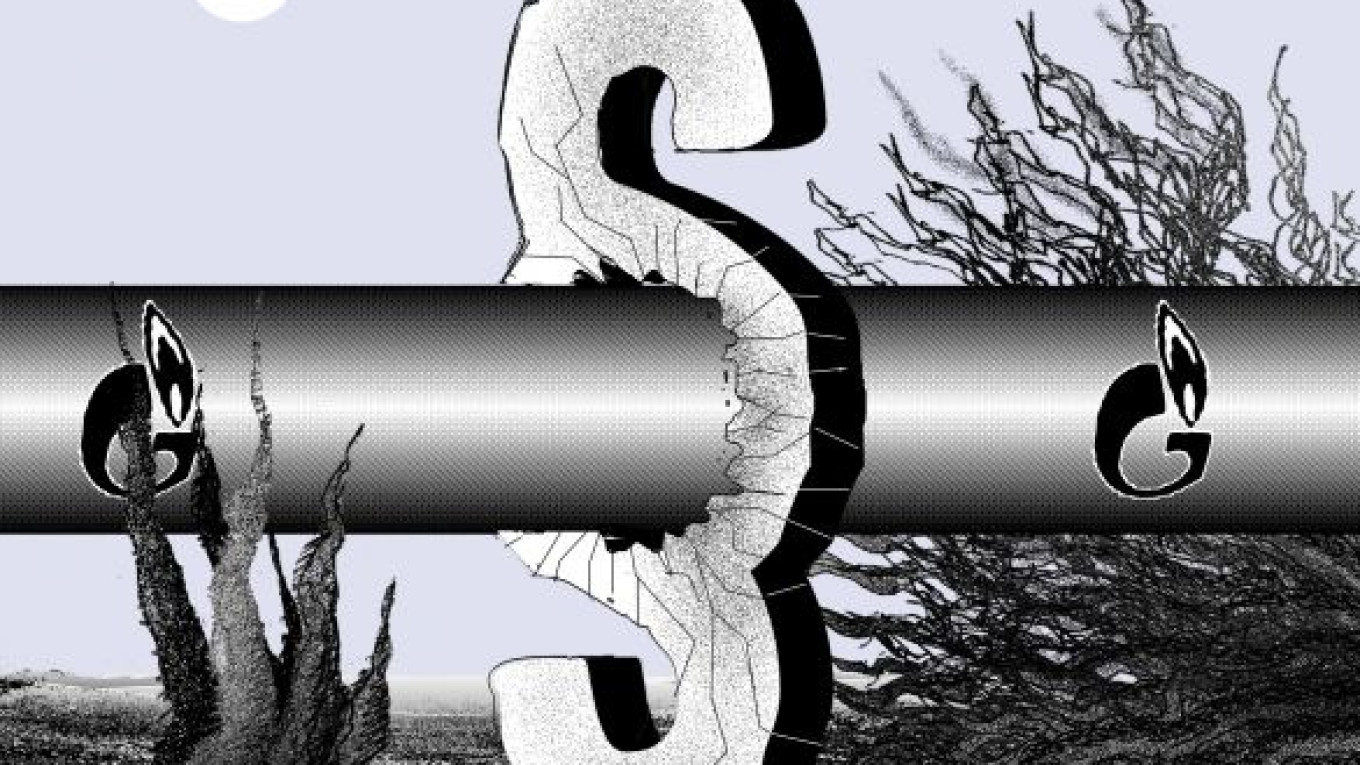
Russia’s first chief of the secret police, Alexander Benkendorf, served two centuries ago under Tsar Nicholas I, and it is his portrait that should be hanging in every office at the Federal Security Service and Interior Ministry. Benkendorf gave a classic definition of the Russian authorities’ relationship to the law when he said: “Laws are written for subordinates, not for rulers.”
That is precisely the principle at the heart of the current Russian government. It justifies everything — from state officials using flashing blue lights to speed through Moscow traffic to governors and mayors continuing the rich tradition of lining their pockets and those of their close associates at the public’s expense.
State officials often abuse their influence and power to avoid answering to the law after committing illegal acts. A vivid example of this principle is the gas pipeline to China that Gazprom is eager to build over the Altai Mountains and directly through the Ukok Plateau, a UNESCO World Heritage Site.
Because the Ukok Plateau has been part of the Golden Mountains of Altai UNESCO World Heritage Site since 1998, the law requires special permission before any heavy construction can be performed. What’s more, environmental impact studies must be made in advance. But, according to a Natural Resources and Environment Ministry letter issued in July, this has not been done. Nevertheless, preliminary work has already begun along the path of the intended pipeline through Altai and in the region that includes the Ukok Sanctuary.
According to many eyewitnesses who visited the region between July and September, the work to construct the pipeline through the protected plateau is proceeding at full steam. Heavy drilling rigs are operating, and surveyors have marked out the path of the pipeline all the way to the Russian-Chinese border. I personally saw the equipment and the surveyors’ markings when I visited the region in October. What’s more, Gazprom contractors have admitted to local environmentalists that they have not obtained permission for the work.
Worse, in September a fire destroyed about 4,000 hectares of alpine steppe in the Ukok Plateau. This area is the habitat for many rare species of birds and animals, including the endangered argali sheep and snow leopard. Local guides suspect that Gazprom contractors might have intentionally caused the blaze in the hope of removing the area’s protected status under a new amendment that would change the borders of nature reserves if those territories “lose their value.” Of course, it is also possible that the fire was caused by the carelessness and negligence of Gazprom workers.
Once remote and inaccessible, Ukok has become a popular tourist destination for travelers all over the world thanks to dozens of articles in top travel and nature magazines, television documentaries and the recent archeological discovery of the 2,500-year-old Ice Maiden found intact in the permafrost. If the gas pipeline is built, the nature of the Ukok Plateau and its ecosystem will be destroyed.
UNESCO already lists the Ukok Plateau as a World Heritage Site that might be under threat. Greenpeace and the World Wildlife Fund are closely monitoring the situation and regularly send inquiries to Russian authorities responsible for protecting the environment. UNESCO plans to send its own mission to Ukok in May to check on compliance with its requirements.
Why doesn’t Gazprom consider alternate routes that would bypass the nature reserve and pass instead through Mongolia or Kazakhstan?
The Chinese are also wondering why the Russians are in such a rush. Chinese authorities have not signed any purchase agreements with Gazprom mainly because they are not willing to pay the high Gazprom gas prices. What’s more, China has its own source of gas in Xinjian as well as a newly opened pipeline bringing gas from Turkmenistan. Beijing officials claim that Prime Minister Vladimir Putin personally insists on the pipeline through Altai at almost every meeting with Chinese leaders. Could it be that Putin and his colleagues who have top positions in the gas sector have the most to gain from the project?
The Gazprom pipeline through the Ukok Plateau could become the largest, most expensive and most environmentally damaging white elephant in history. Members of the ruling elite have already built palaces and luxurious villas in nature reserves on the Black Sea coast and in Adygeya.
The country’s ruling business and political elite have completely corrupt values. For example, at a public hearing in Gorno-Altai, a Gazprom representative gave himself away when he referred to the holiest spot of Russian Orthodoxy, saying, “We will lay a pipeline right through the Trinity Lavra of St. Sergius [in Sergiyev Posad] if we have to!”
Vladimir Ryzhkov, a State Duma deputy from 1993 to 2007, hosts a political talk show on Ekho Moskvy radio and is a co-founder of the opposition Party of People’s Freedom.
A Message from The Moscow Times:
Dear readers,
We are facing unprecedented challenges. Russia's Prosecutor General's Office has designated The Moscow Times as an "undesirable" organization, criminalizing our work and putting our staff at risk of prosecution. This follows our earlier unjust labeling as a "foreign agent."
These actions are direct attempts to silence independent journalism in Russia. The authorities claim our work "discredits the decisions of the Russian leadership." We see things differently: we strive to provide accurate, unbiased reporting on Russia.
We, the journalists of The Moscow Times, refuse to be silenced. But to continue our work, we need your help.
Your support, no matter how small, makes a world of difference. If you can, please support us monthly starting from just $2. It's quick to set up, and every contribution makes a significant impact.
By supporting The Moscow Times, you're defending open, independent journalism in the face of repression. Thank you for standing with us.

Remind me later.