

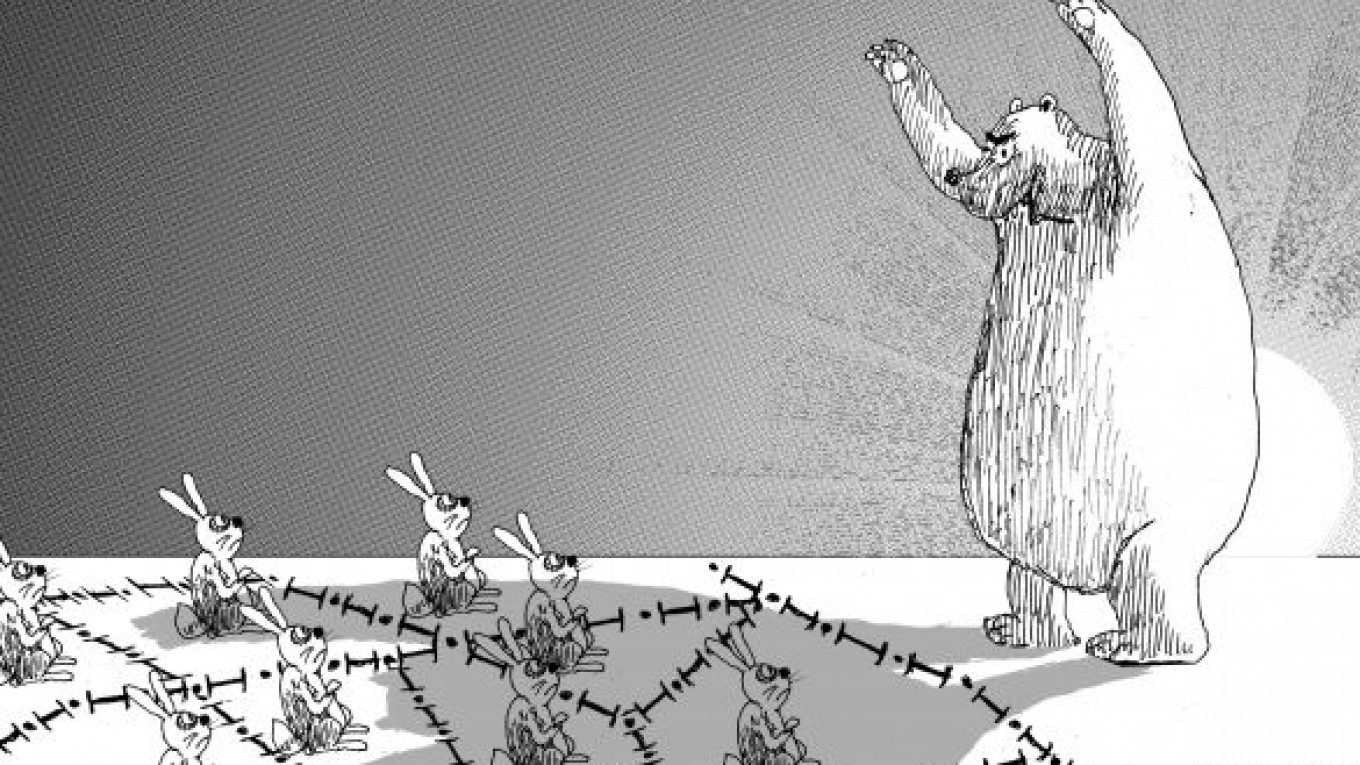
What is the most important source of disagreement today between Russia and the West? It is not the issues most often in the news — Iran or Afghanistan. It is Europe’s contested neighborhood: the future of those countries between the eastern border of NATO and the European Union and the western border of Russia. While the West and Russia still talk the talk of cooperative security in Europe, geopolitical competition for influence has been renewed in these regions.
Russia today openly lays claim to a sphere of interest in its borderlands — in direct contradiction to commitments made under the Helsinki process. It has embraced policies and a military doctrine that places NATO as the top external military danger and justifies the right to intervene in neighboring countries. While packaged in smooth diplomatic language, President Dmitry Medvedev’s new proposal for pan-European security has the less-than-hidden goal of stopping and rolling back Western influence.
Rather than moving into the 21st century, Russia seems determined to revert to 19th-century strategic thinking. With the administration of U.S. President Barack Obama focused on Afghanistan and Iran, the Kremlin hopes that a West in need of its cooperation will acquiesce to its demands.
And it is not only words. Eighteen months ago, a war took place in Europe between Russia and Georgia. It was a little war, but one that raised big questions. It was not fought over the future status of Georgia’s Russian-backed breakaway regions of Abkhazia and South Ossetia (though that source of conflict was a real one). Instead, the war’s root cause was Georgia’s desire to align itself with the West and Russia’s determination to stop it.
Many diplomats would prefer to forget the war or sweep it under the rug, but none of the underlying tensions have been resolved. There is no stable solution in sight for Abkhazia and South Ossetia. Russia has not abandoned the goal of breaking Georgia’s desire to go West. Instability and separatism are growing in the northern Caucasus, making the broader region more volatile.
In late January, the Obama administration issued its first unequivocal reaffirmation of the strategy of democratic enlargement that has guided Western thinking since the collapse of the Iron Curtain two decades ago. Speaking in Paris, Secretary of State Hillary Clinton reminded us that NATO and European Union enlargement created an unprecedented degree of stability and security in the eastern half of the continent, that Russia too had benefited from this stability and that it was critical that Europe’s doors remain open to further enlargement.
But what about those countries in between — for example Ukraine and Georgia? Ukraine has just elected as its president Viktor Yanukovych, who is unlikely to pursue a NATO integration agenda, and if he follows through on his commitment to join a customs union with Russia, Belarus and Kazakhstan, membership in the EU would be precluded. But that does not mean that tensions with Russia will automatically disappear.
Yanukovych’s victory notwithstanding, Ukraine is a country that is becoming more European and gradually moving out of Russia’s orbit in its own chaotic way. Regardless of whether Georgians like or dislike President Mikheil Saakashvilli, they want to go West, too. So Russia’s attempts to bring these countries to heel are likely to continue and remain a bone of contention and conflict.
And what is Western policy? In reality, the West today no longer has a grand strategy toward the East. The moral and strategic vision of the 1990s has exhausted itself and come to a grinding halt after the shock of the Russia-Georgia war and the recent Ukrainian election. As welcome as Clinton’s recent words were on the need to defend the right of countries to decide their own fate, you don’t have to go very far in Europe to hear whispers that some kind of new “Finlandization” might be a reasonable compromise for countries like Ukraine and Georgia.
It is time for the West to openly debate what its strategy is — and what it is not. Two decades ago, the West rejected “spheres of influence” because Europe’s bloody history taught us that compelling nations to align themselves with others against their will was wrong and a recipe for future conflict.
If we still believe that today, we need an updated moral and strategic vision for such countries and to back it up with a real strategy. We need to be clear that Moscow has a right to security, but that it does not have the right to interfere in the affairs of its neighbors, to topple their governments or to deny them their own foreign policy aspirations.
Obama is right to try to reset relations with the Kremlin and engage a revisionist Russia. But we need to do so knowing what our strategy is on this key issue. As the United States and Russia close in on a new arms control treaty, it is time to face the question of how we deal with Europe’s contested neighborhood.
Ronald D. Asmus is executive director of the Transatlantic Center of the German Marshall Fund of the United States in Brussels and author of “The Little War That Shook the World: Georgia, Russia and the Future of the West.” © Project Syndicate
A Message from The Moscow Times:
Dear readers,
We are facing unprecedented challenges. Russia's Prosecutor General's Office has designated The Moscow Times as an "undesirable" organization, criminalizing our work and putting our staff at risk of prosecution. This follows our earlier unjust labeling as a "foreign agent."
These actions are direct attempts to silence independent journalism in Russia. The authorities claim our work "discredits the decisions of the Russian leadership." We see things differently: we strive to provide accurate, unbiased reporting on Russia.
We, the journalists of The Moscow Times, refuse to be silenced. But to continue our work, we need your help.
Your support, no matter how small, makes a world of difference. If you can, please support us monthly starting from just $2. It's quick to set up, and every contribution makes a significant impact.
By supporting The Moscow Times, you're defending open, independent journalism in the face of repression. Thank you for standing with us.

Remind me later.