

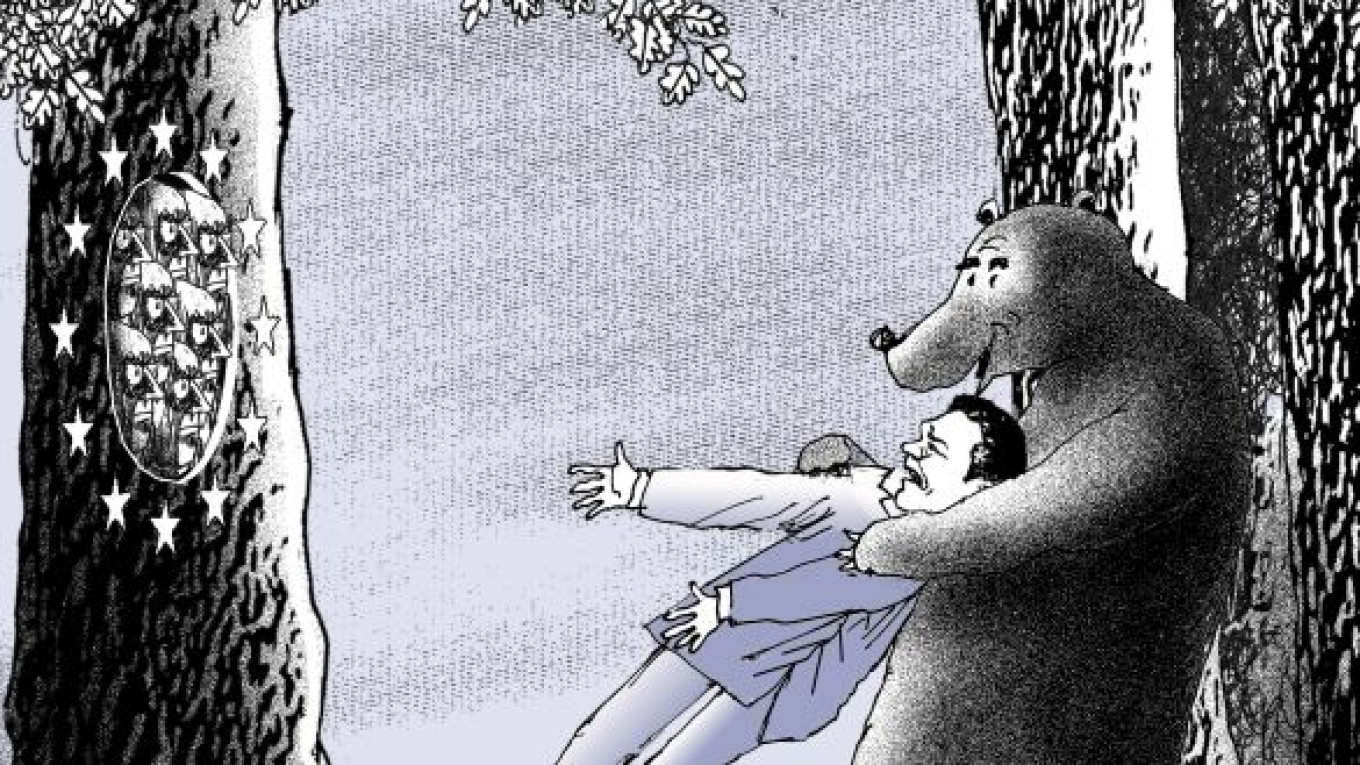
The turmoil that has gripped European-Ukrainian relations following the sentencing of Yulia Tymoshenko risks jeopardizing an important strategic relationship, and both sides stand to lose big from this fallout.
Whether or not Tymoshenko, Ukraine’s former prime minister, is guilty, was given a fair trial or should be punished for her commercial interests and dealings while in office or beforehand is a separate issue. These are questions that Ukrainians will have to answer for themselves. It is primarily their responsibility and decision on how, if at all, they choose to deal with those who profited handsomely from the transition. This is the dark chapter of history that most post-Communist societies are grappling with.
As for Europe, the Tymoshenko case brings forward a different set of challenges. Namely, is this a country that functions and lives by the same set of standards, principles and ideals as Europe?
Obviously, Ukraine is not Sweden, and there is still a lot of work to be done before the reforms in Ukraine bring about institutional and practical changes that will make the country fit into that mold.
But the EU, as a whole, is not Sweden either. It is a collection of many countries, each at different stages in terms of their reforms. Look at the stark differences between Sweden, Germany, Romania and Greece, for example. But all EU members are working toward a common goal: a functional, transparent, equal and fair, and law-abiding community. And therefore, the distance between the quality of institutions in Ukraine and in some new EU members is not so large.
The right thing for the EU to do at this stage is to look into the legal system in Ukraine and assess whether it is functional, free and fair, and whether the legal reforms pursued by the government in Kiev are in accordance with European standards. An opinion on this should be based on objective criteria, and it is Europe’s right to have this opinion.
But pointing fingers in the direction of the current government, calling them thugs and, more problematically, isolating President Viktor Yanukovych is not smart politics on the part of the EU. It does nothing to ensure our strategic interests with regards to Ukraine are protected. Cornering the current leadership will only ensure that Ukraine turns its back on Europe and falls further into the Russian embrace.
This is not in anyone’s interests, except perhaps Prime Minister Vladimir Putin’s, who is keen on making Kiev more dependent on Moscow.
Europe’s strategic interests with regards to Ukraine have not changed overnight. And the Tymoshenko case does nothing to undo the fact that Ukraine is a country through which the bulk of Russia’s gas is sold to Europe. Ukraine has massive agricultural potential — one that is rich in raw materials and minerals and is a huge and still-untapped market for European companies to profit from.
Instability in Ukraine is a major risk for Europe from the perspective of soft security. From illegal immigration, drug and human trafficking to proliferation of illegal weapons, these are not matters to be taken lightly, and they are certainly issues that bind Ukraine and Europe in a strategic partnership.
Europe is by no means better off if Ukraine becomes a criminal state. The border between Europe and Ukraine is large and would be difficult to protect against illegal trading in human beings, or substances like drugs and weapons.
The cost of losing Europe would be equally devastating for Ukraine. The path of reforms would likely stall. Ukrainian industry would lose access to the world’s richest and biggest market. Likewise, Ukraine’s citizens would lose the European dream. The potential for a social crisis is large and would impair the nation’s path toward progress and prosperity. If the economy continues to stall or drop, Ukraine will likely fall further into the Russian sphere of influence, and its reforms would crumble under the spell of Putin’s economic paradigm.
It is time for sobriety and clearheaded strategic thinking on both sides. Ukraine and Europe should hold an emergency summit, where they can openly discuss the Tymoshenko case, come to common resolutions and positions — and move on to larger issues.
The more relevant question, which the summit should address, is how to keep Ukraine and Europe on the path of convergence and work toward the ultimate common end result — a Ukraine fully integrated into the EU.
Borut Grgic is a nonresident senior fellow at the Atlantic Council and founder of the Trans-Caspian Project.
A Message from The Moscow Times:
Dear readers,
We are facing unprecedented challenges. Russia's Prosecutor General's Office has designated The Moscow Times as an "undesirable" organization, criminalizing our work and putting our staff at risk of prosecution. This follows our earlier unjust labeling as a "foreign agent."
These actions are direct attempts to silence independent journalism in Russia. The authorities claim our work "discredits the decisions of the Russian leadership." We see things differently: we strive to provide accurate, unbiased reporting on Russia.
We, the journalists of The Moscow Times, refuse to be silenced. But to continue our work, we need your help.
Your support, no matter how small, makes a world of difference. If you can, please support us monthly starting from just $2. It's quick to set up, and every contribution makes a significant impact.
By supporting The Moscow Times, you're defending open, independent journalism in the face of repression. Thank you for standing with us.

Remind me later.