

Editor's note: This is the first of a three-part series about the Chernobyl disaster.
PRIPYAT, Chernobyl's Exclusion Zone — Once built as the model of a perfect Soviet town, Pripyat is now the perfect model of undisturbed silence.
"We thought we were living in the best city," said Natalya Oleinichenko, 50, a former Pripyat resident.
"I came here when I was 21, directed by the Komsomol after graduation," she said with a slight laugh of irony standing in the deserted center of Pripyat, two kilometers from the Chernobyl nuclear power station.
A contractor by training, Oleinichenko ultimately ended up commanding two construction crews working in the area, including at Power Unit No. 4 where the ill-fated reactor was located. Her other crew raised buildings in the town, she said, pointing at nearby blocks of flats — now staring with black, square holes.
Twenty-five years later, she can recall in detail how she was walking outside with a baby carriage on April 26, 1986, when the first anxiety started to waft through the air, already ionized with radioactive vapor estimated by scientists to have been 10 times greater than the Hiroshima explosion.
"I remember helicopters buzzing back and forth in the sky," said Oleinichenko, who was 25 at the time.
The reactor had blown up a day earlier, at 1:23 a.m. Friday, during a planned experiment as a result of what is still a subject of debate among scientists. But the unequivocal fact remains that the some 50,000 residents of Pripyat, whose average age was 26, continued living their weekend lives, awaiting the upcoming May holiday celebrations.
"Only after lunch we were told to stay inside with the windows closed, while pills of potassium iodide were distributed around the flats," Oleinichenko said. "Late in the evening of April 26, Saturday, it was announced that a bus would stop by the apartment building on April 27 at 2 p.m. to move us away for three days."
No statement was made about what really had happened and that every minute spent in the town within view of the exploded reactor was harming people's health.
Only later did a monotone "Attention! Attention!" announcement start reverberating through the town's loudspeakers, a record of which can be still found in online archives. A woman said in a calm voice that residents needed to evacuate because "in connection with an accident, an … unfavorable radioactive atmosphere is settling on the town of Pripyat."
Offering assurances that the military and other authorities were doing their best to stabilize the situation, officials recommended that residents only take their documents, a few necessities and —"just in case" — some food.
"We left behind everything, taking with us only cloth diapers," Oleinichenko said. She never came back for the rest.
But other people, including looters, returned to collect things, and many apartments have bare walls. In some cases even radiators have been yanked off the walls.
Twenty-five years ago, residents were living in a Soviet paradise with stores stuffed with food, a direct connection to Kiev by water and to Moscow by railway. The population was expected to grow to 75,000.
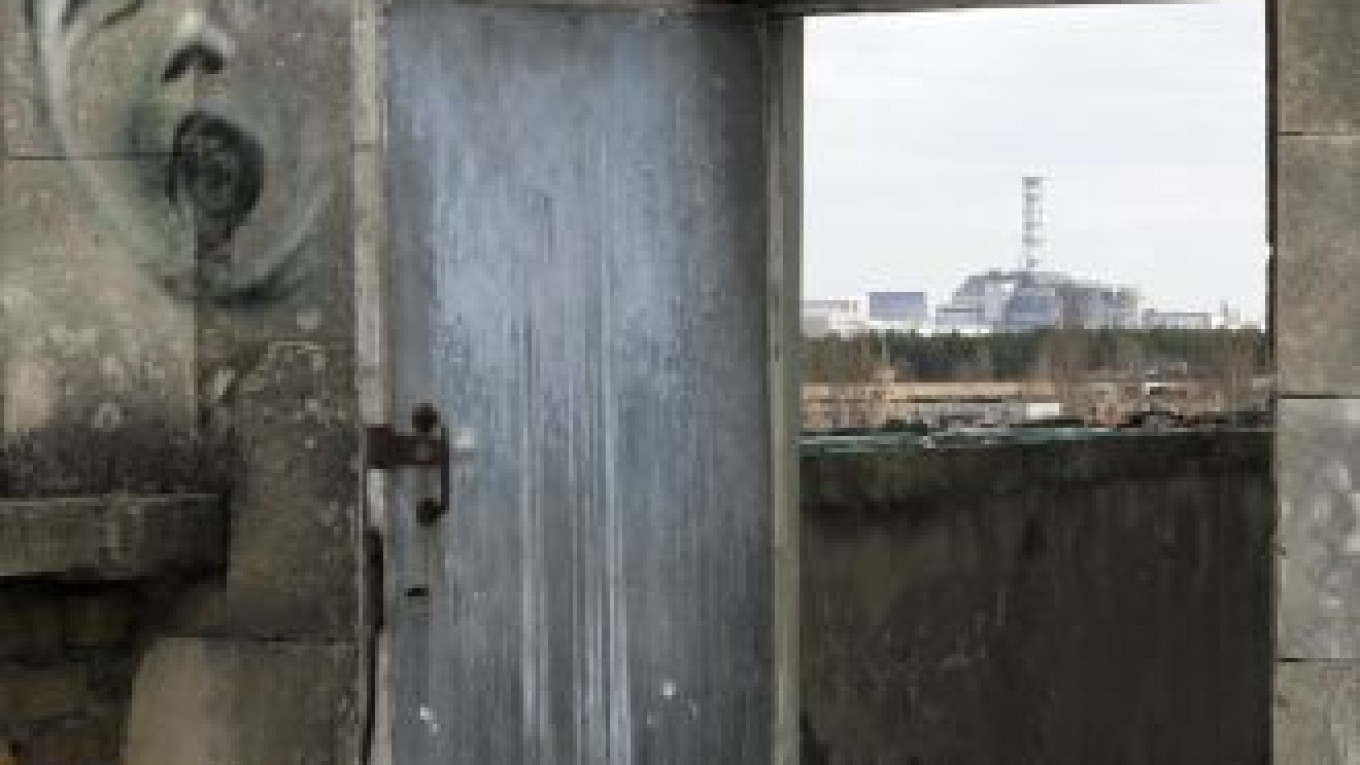
Today, the town resembles a classic picture of a ghost town from a Hollywood doomsday movie. Glassless apartment buildings line straight streets, while concrete buildings that once housed a massive concert hall, a large hotel and a restaurant are crumbling.
While concrete and glass are deteriorating, nature is taking over. Birds can be heard chirping, but not a pigeon or sparrow can be seen.
A rusting amusement park with a frozen yellow Ferris wheel delivered to Pripyat especially for the 1986 May holidays has instead become a symbol of the town's tragedy.
Now and then, graffiti of smiling, playing children can be spotted on abandoned walls, painted by unknown visitors.
"They appeared about five to six years ago," Oleinichenko said. "Maybe there were ghosts."
People are not allowed into the town without special permission, just like in the rest of the 30-kilometer exclusion zone around Chernobyl. But once every year, on April 26, the town opens to former residents who want to visit their former homes and relive old memories.
Oleinichenko, whose husband worked at the station, said she didn't choose to come to Chernobyl and she didn't choose to leave it. But she had to choose to return.
"We were offered to leave the work at the station and move to Kiev or keep it and stay," she said with regret.
They chose to stay. Oleinichenko's husband continues to work at the station, and she holds a position in its information department. A beaming, friendly woman with dyed strawberry-blond hair, Oleinichenko shows no ill effects from the radiation.
They are among only 3,000 people still employed by the station, down from 12,000 in 2000. The number of staff is expected to drop to 1,000 over the next two years as the Ukrainian government further boards up the station as it secures its long-term safety with the help of foreign aid.
Now Oleinichenko and her husband live in the town of Slavutich, established in 1986 to house up to 30,000 evacuated workers and their families and located about 50 kilometers outside the exclusion zone. But many of the people who moved to Slavutich have since left, looking for work and better futures.
"We made the most foolish mistake of our lives," Oleinichenko said. "Slavutich has no future as a town. I don't know what will happen to us here."
A Message from The Moscow Times:
Dear readers,
We are facing unprecedented challenges. Russia's Prosecutor General's Office has designated The Moscow Times as an "undesirable" organization, criminalizing our work and putting our staff at risk of prosecution. This follows our earlier unjust labeling as a "foreign agent."
These actions are direct attempts to silence independent journalism in Russia. The authorities claim our work "discredits the decisions of the Russian leadership." We see things differently: we strive to provide accurate, unbiased reporting on Russia.
We, the journalists of The Moscow Times, refuse to be silenced. But to continue our work, we need your help.
Your support, no matter how small, makes a world of difference. If you can, please support us monthly starting from just $2. It's quick to set up, and every contribution makes a significant impact.
By supporting The Moscow Times, you're defending open, independent journalism in the face of repression. Thank you for standing with us.

Remind me later.