

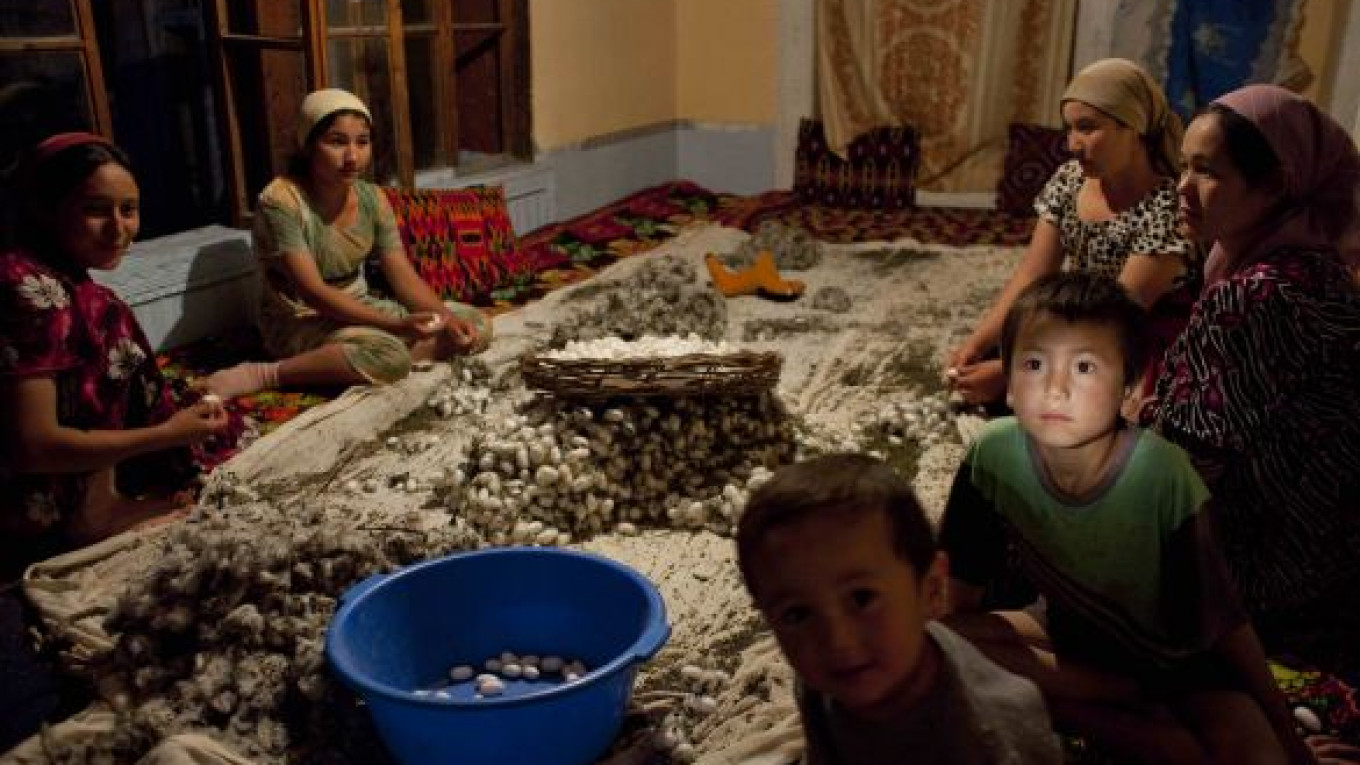
KOKAND, Uzbekistan — For one month a year, from morning to night, Dilorom Nishanova grows silkworms, a painstaking and exhausting job. She has been doing it since she was 8.
Uzbekistan's authoritarian government insists that child labor is banned, but Dilorom, now 15, hasn't heard about it. She and her siblings, aged 9 to 17, think that it's perfectly natural to be helping their father grow silkworms, as well as cotton and wheat.
"We just help our parents," she said, her braided dark hair covered with a traditional Muslim scarf. "That's what children have to do, right?"
Not so, say Uzbek rights groups. They say kids shouldn't be laborers, especially in May, the breeding season, which happens to fall during school exams.
The silkworm business dates back centuries to the Silk Road that ran through this Central Asian country. Kokand, the name of the town in the fertile Ferghana Valley where Dilorom's family farms, is the same as the Uzbek word for "cocoon." Kokand was the destination of the first westbound Chinese caravan carrying silk in 121 B.C. that started the fabled trade route.
But its modern-day incarnation as a state monopoly has a dark side. Farmers say they are threatened with fines or loss of their land leases for missing quotas, and that these are so high that they have no choice but to draft their children into the work.
The use of child labor in Uzbek cotton picking has been widely documented, and Walmart and several other U.S. chain stores won't stock products with cotton sourced from the region. But the silk industry has largely escaped international scrutiny.
Its annual revenues are tiny compared with the $1 billion cotton industry, but the government clearly prizes silk as a link — and tourist draw — to the glory days of the Silk Road.
It also considers silk an export item that has to be state-controlled — like the exports of cotton, gold, peregrine falcons and the pelts of newborn lambs.
Uzbekistan's production accounts for less than 5 percent of the world total, and is dwarfed by China's. But it's proportionately the world's highest: almost a kilogram per head of the population of 27 million. Kakhhor Yavkashtiyev, head of the silk-growing department at the Agriculture Ministry, said 90 percent of Uzbekistan's 2 million farmers are involved in the annual harvest.
"Children are not involved, only adults are," he said in an interview.
Umurzak Kayumov, a 51-year-old farmer from the village of Naiman near the eastern city of Namangan, said his children as well as grandchildren help during cocoon season, when "we suffer for 25 days, from 4 a.m. until midnight."
In Kokand, the high-intensity job of raising silkworms becomes evident from talking to Dilorom and her family.
Her father, Adkham, a bony 42-year-old, farms four hectares of loamy land. In early May, he said, an official from a state-owned nursery handed him two 30-gram? boxes of silkworm eggs to be nurtured into some 100 kilograms of cocoons.
Within four weeks of hatching, silkworms grow to 10,000 times their original, poppy-seed size. Their creamy stomachs turn greenish from their exclusive diet of mulberry leaves, and they need constant attention. "They're as helpless as newborn babies," Dilorom said.
They feed seven times a day and die if their meal is an hour late. Dead ones must be removed promptly lest they infect the others swarming among the fresh mulberry twigs that Dilorom has risen at dawn to gather.
Sensitive to light, noise and breeze, the silkworms grow up in a humid barn next to the family's dilapidated adobe house. Their munching sounds like the patter of raindrops.
Speaking of this year's season, Dilorom recalled: "We worked hard, had to miss some classes. Just like many other kids in school."
And "in some schools, they raise silkworms as part of their home economics class," said Khaitboy Yakubov of Najot, a rights group in the western city of Urgench.
For the farmers and their children, "silk farming opens an annual cycle of forced labor and abuse by authorities," said Ganikhon Mamatkhonov, a rights activist who investigated numerous cases of abuse of Uzbek farmers.
The risks these advocates run are considerable. Months after Mamatkhonov spoke to The Associated Press in May 2009, he was jailed for five years on bribery charges — one of dozens of government critics imprisoned in recent years. Mamatkhonov's colleagues say he was framed.
Underage labor is not limited to Uzbekistan's silk industry; it has been exposed in India's silk industry, too. But this former Soviet republic seems unique in the lengths to which it goes to keep the silk spinning.
Yavkashtiyev of the Agriculture Ministry acknowledged that local authorities prescribe quotas based on farm size. A farmer with 50 to 60 hectares "must harvest two or three tons of raw cocoons," he said.
Artificial substitutes such as viscose and nylon have greatly diminished demand for real silk, but it remains a material associated with luxury and style, and has medicinal and military uses such as parachutes.
The most recent available figures, from the UN Food and Agriculture Organization, put Uzbekistan's silk earnings at $57 million in 2005 from 17,000 tons of raw cocoons.
This month, Uzbek media put the harvest at 25,200 metric tons.
Silk-growing nations such as South Korea and Japan have switched to less labor-intensive mulberry bushes and mechanized leaf harvest. But Uzbek authorities prefer to "follow the old school where big mulberry trees are utilized for feeding silkworms," said Hisham Greiss, a Chicago-based independent expert on silk farming.
And they are relentless. Sukhrobjon Ismoilov of the Expert Working Group, an independent think tank based in the capital, Tashkent, said local officials threaten to annul land leases, delay payments through government-affiliated banks, and even resort to physical abuse.
Although Soviet-era collective farms were disbanded after Uzbekistan became independent in 1991, their land was never privatized, which leaves farmers in constant fear of sanctions and even court convictions for not meeting quotas for cotton, grain and silk cocoons, rights groups say. The Najot group said at least 20 farmers were jailed for terms of up to several years in 2009 alone.
"Farmers and agricultural workers earn low wages, which the state seldom pays on a regular basis," said a 2009 U.S. State Department report on Uzbekistan. "The government controls the agriculture sector, dictates what farms grow, and buys directly from the farmers to sell abroad."
Uzbek Ipagi, the state-run monopoly, exports Uzbek silk to China, India, South Korea and Western Europe. Some stays in Uzbekistan to be woven into scarves or rugs at small factories and mainly sold to tourists.
They rarely reach Western stores. "I never saw any silk garment with a tag 'Made in Uzbekistan'" in U.S. stores, silk expert Greiss said.
Several joint ventures process Uzbek silk, but Western investment here is limited, and the companies keep a low profile.
Rustam Zakhidov, director general of Silver Silk, an Uzbek-British joint venture, said his company sells silk ribbons and thread worth $1.5 million a year to India, Vietnam, China and Turkey. He would not identify his British partners.
In 2009, the Uzbek Ipagi monopoly sold cocoons for about $6 a kilogram — or almost eight times what it paid the farmers, and even that money isn't guaranteed, said the farmers, who complain that payment can be delayed for months, even years.
Pointing to the dry mulberry twigs in his yard, farmer Kayumov said, "All we have left is firewood for the winter."
A Message from The Moscow Times:
Dear readers,
We are facing unprecedented challenges. Russia's Prosecutor General's Office has designated The Moscow Times as an "undesirable" organization, criminalizing our work and putting our staff at risk of prosecution. This follows our earlier unjust labeling as a "foreign agent."
These actions are direct attempts to silence independent journalism in Russia. The authorities claim our work "discredits the decisions of the Russian leadership." We see things differently: we strive to provide accurate, unbiased reporting on Russia.
We, the journalists of The Moscow Times, refuse to be silenced. But to continue our work, we need your help.
Your support, no matter how small, makes a world of difference. If you can, please support us monthly starting from just $2. It's quick to set up, and every contribution makes a significant impact.
By supporting The Moscow Times, you're defending open, independent journalism in the face of repression. Thank you for standing with us.

Remind me later.