

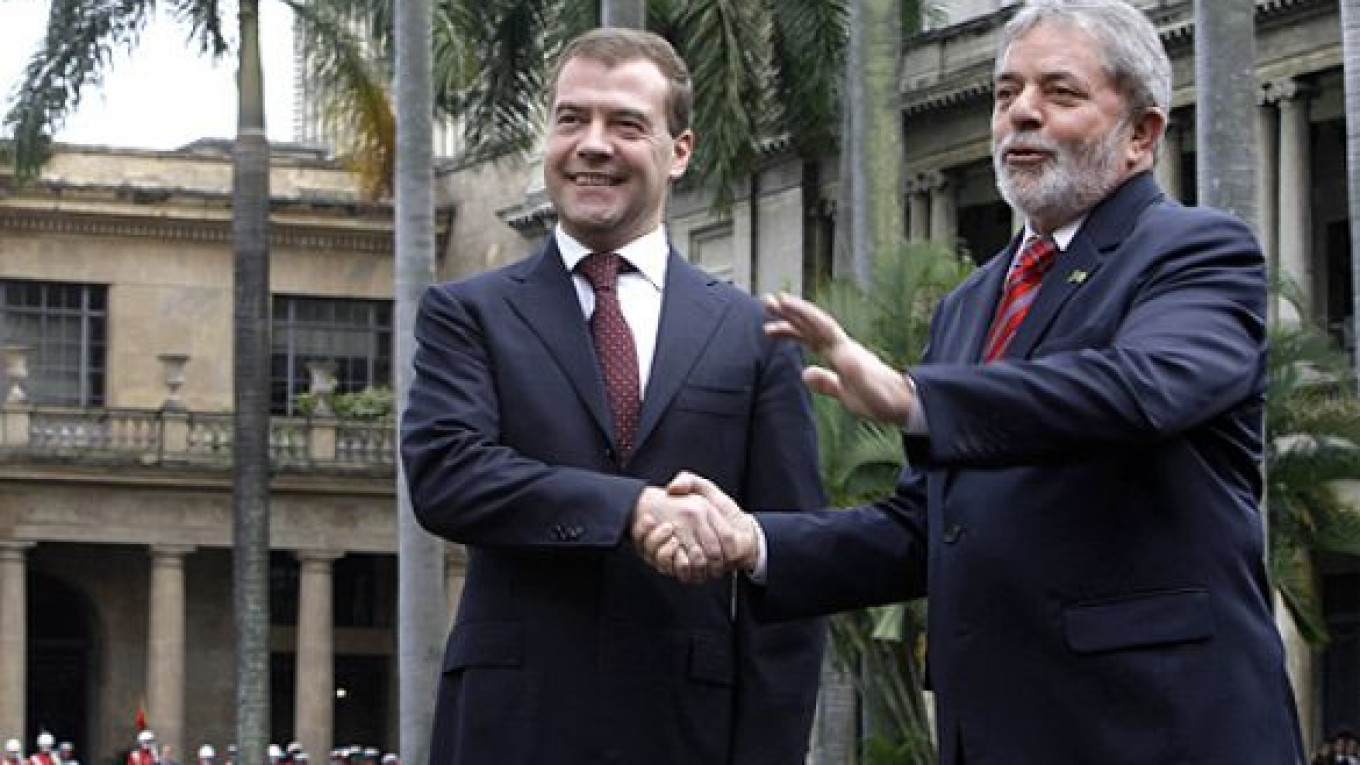
Prime Minister Dmitry Medvedev missed Brazil's world-famous Carnival, but he'll tout Russia's answer to the U.S. GPS navigation system and discuss weapons and nuclear cooperation during a visit to the South American country this week.
The two-day visit, which starts Wednesday, will be Medvedev's second to the continent's only member of BRICS, the emerging markets group that encompasses Brazil, Russia, India, China and South Africa.
He previously visited Brazil in 2008 during the first year of his presidency, and the country's president, Dilma Rouseff, invited him during a visit to Russia in December to return during the Feb. 8-12 Carnival.
"Your visit during the celebration of Carnival would be a very important step toward developing our relationship," she told Medvedev at the time.
Medvedev expressed a desire to witness the six-day festival, which celebrates the last days before Lent and is Brazil's best-known holiday.
But the dates apparently didn't work out for his visit to a country seen by analysts as a more predictable regional partner than Venezuela for Russia.
The Kremlin may feel the same way. Vladimir Putin, as prime minister in 2011, referred to Brazil as a "strategic partner" for Russia.
Medvedev will visit the first Glonass space monitoring station in a foreign country — a ground-based system that uses Glonass technology in Brazil. The station was to be opened later Tuesday.
"This station will be the first point of correction in the Western hemisphere and will significantly improve the accuracy of Glonass navigation signals," a spokesman for the Federal Space Agency told Interfax on Tuesday.
Medvedev will be accompanied by his top aide, Deputy Prime Minister Arkady Dvorkovich, and a group of Russian business leaders.
Both countries are also looking at defense cooperation, which Deputy Prime Minister Dmitry Rogozin, who oversees defense industry, has said holds large potential. Last month, Brazil announced plans to secure assembly licenses for Pantsir-S1 and Igla defense systems in a deal worth more than $1 billion.
An unidentified official in Medvedev's delegation told Prime news agency on Tuesday that no contracts were expected to be signed during the visit.
Alexander Perenzhyev, a researcher with the Association of Military Analysts, said Brazil is shaping up to be a more lucrative market for Russian weapons than Venezuela, a long-time buyer of Russian military equipment.
"The Brazilian economy is more developed, and that allows us to establish joint ventures so we can work together," he said.
Russia has also sold several helicopters to Brazil worth $75.7 million.
During Medvedev's visit, the countries are expected to reach several agreements, including one that will allow Russia to increase its grain imports to Brazil.
Russia is also interested in taking part in Brazilian government tenders to build nuclear power stations in the country, the delegation official said.
But Andrei Baklitsky, a PIR Center analyst who studies nuclear power projects in BRICS countries, said Brazil is more focused on developing hydropower than nuclear power after the global recession in 2008-09.
He said, though, that Brazil might agree to an arrangement under which Russia built and operated a nuclear power station. A similar deal was reached with Turkey.
Russia and Brazil are looking to increase bilateral trade to $10 billion annually from the current $6 billion. Brazil's main exports to Russia are agriculture products, including sugar and meat products, while Russian exports mainly consist of fertilizer.
After Brazil, Medvedev will visit Cuba for talks with the country's leader, Raul Castro. While it will be a working visit, both leaders may discuss the situation in Venezuela, Cuba's main political ally. Venezuelan President Hugo Chavez remains seriously ill after returning home this week after undergoing cancer treatment in Cuba.
Contact the author at [email protected]
Related articles:
A Message from The Moscow Times:
Dear readers,
We are facing unprecedented challenges. Russia's Prosecutor General's Office has designated The Moscow Times as an "undesirable" organization, criminalizing our work and putting our staff at risk of prosecution. This follows our earlier unjust labeling as a "foreign agent."
These actions are direct attempts to silence independent journalism in Russia. The authorities claim our work "discredits the decisions of the Russian leadership." We see things differently: we strive to provide accurate, unbiased reporting on Russia.
We, the journalists of The Moscow Times, refuse to be silenced. But to continue our work, we need your help.
Your support, no matter how small, makes a world of difference. If you can, please support us monthly starting from just $2. It's quick to set up, and every contribution makes a significant impact.
By supporting The Moscow Times, you're defending open, independent journalism in the face of repression. Thank you for standing with us.

Remind me later.