

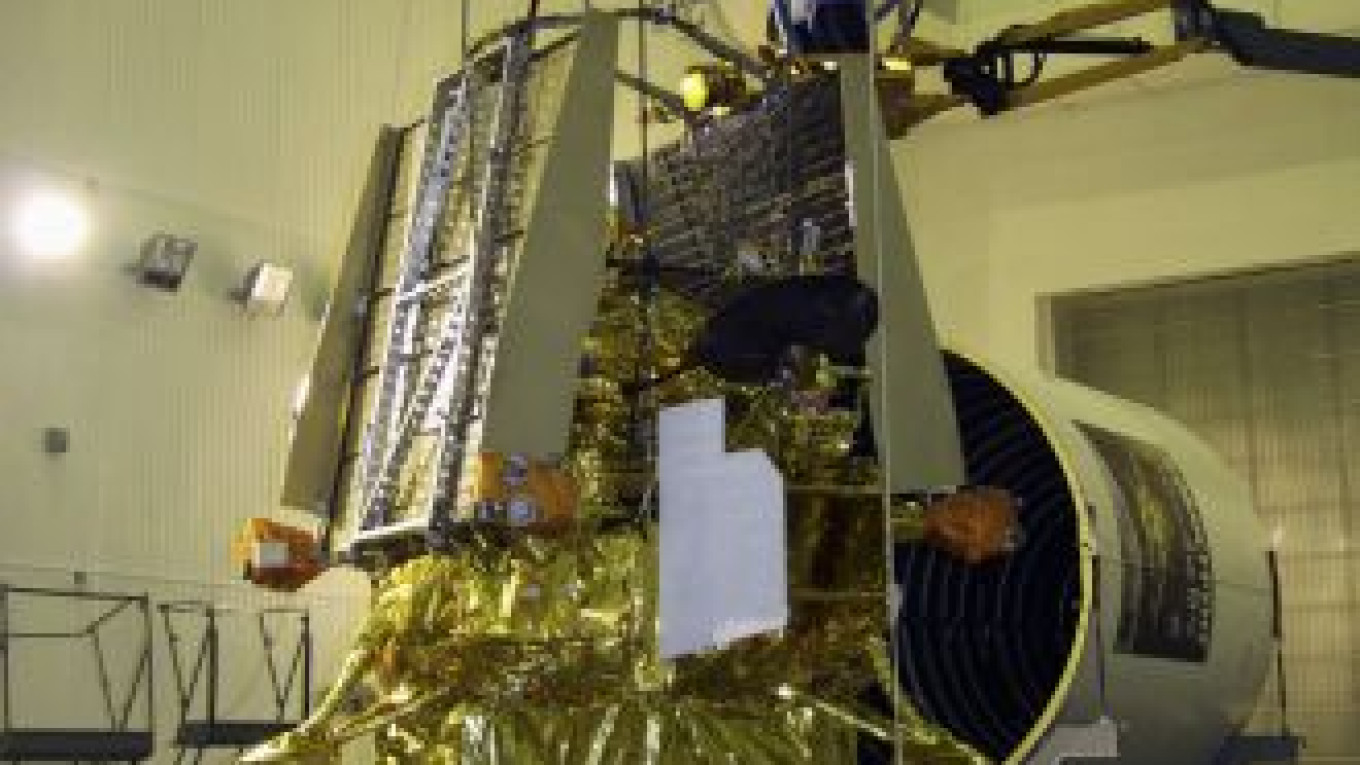
Russia was set early Wednesday to end a humiliating two-decade absence from deep space with the launch of an ambitious three-year mission to bring back a soil sample from Mars' moon Phobos.
Russian scientists have dreamed of probing the Red Planet's potato-shaped satellite since the 1960s heyday of pioneering Soviet forays into space.
Dust from Phobos, they say, will hold clues to the genesis of the solar system's planets and help clarify Mars' enduring mysteries, including whether it is or ever was suited for life.
But the 5 billion ruble ($163 million) Phobos-Grunt mission is haunted by memories of past failures in Moscow's efforts to explore Mars and its moons.
"Mars has always been an inhospitable planet for Russia. The United States has had much more success there," said Maxim Martynov, the project's chief designer at NPO Lavochkin, the major Russian aerospace company that made the Phobos-Grunt.
Russia kept rocketing cosmonauts into orbit though the purse-pinched 1990s and is now the only country whose craft carry crews to the International Space Station.
But Moscow's last interplanetary flight was in 1988 — before the 1991 collapse of the Soviet Union.
That mission was the second of two Soviet Phobos probes to fail, going silent within 50 meters of the moon's silvery surface. In 1996, a Russian Mars lander burned up in a botched launch.
Meanwhile, the United States has logged hundreds of hours on Mars, India and China have sent probes to Earth's moon, and Japan has visited an asteroid and brought back samples.
After such a long absence, Phobos-Grunt has become a test of the space industry following a generation of brain drain and crimped budgets. A missed 2009 launch window for the mission was seen as the reason Lavochkin's former chief lost his job.
This year, Russia's new space agency chief said Moscow had overprioritized human space flight and must shift focus to projects with greater scientific and technological returns.
"This is really a very difficult project, if not the most difficult interplanetary one to date," lead scientist Alexander Zakharov said from behind a mess of papers and a brain-sized model of pockmarked Phobos at Moscow's Space Research Institute.
"We haven't had a successful interplanetary expedition for more than 15 years. In that time, the people, the technology, everything has changed. It's all new for us, in many ways we are working from scratch," he said.
The launch was scheduled for 12:16 a.m. Wednesday. After a voyage across many millions of kilometers, the biggest challenge will be landing the probe on an unknown, weightless world.
"There's no gravity to help you. It's like docking with a space station that has no airlock," said Pascal Lee, Mars planetary scientist at NASA's Ames Research Center.
Scientists hope Phobos-Grunt will touch down on a flat spot and find the ground soft enough to scrape up. "Any big rocks near the surface can capsize it," Zakharov said. "We're worried about every single phase. It's like our child."
Phobos-Grunt must then lift off, navigate Mars' orbit, fly back with a bellyful of dirt and finally make a nail-biting atmospheric re-entry without a parachute or homing beacons. Russia will rely entirely on its conical shape to slow its descent, and on ground radar to help track its re-entry.
"If I was realistic, I'd be very happy if they had a successful landing," Lee said. "We still don't know what Phobos is. It's a very vexing mystery."
Hitching a ride is China's first interplanetary spacecraft, the tiny 115-kilogram Yinghuo-1, which will work in orbit with Phobos-Grunt over one year to study Mars' atmosphere.
Phobos-Grunt will also carry vials of Earth bacteria suited to extreme environments to see if they could survive in space.
"We're trying to see what happens when they're exposed to the environment of deep space," said Bruce Betts of the California-based U.S. Planetary Society, which is flying the study.
The goal is to test part of a theory that life could have evolved on one planet and migrated to another inside meteorites.
It will be the first time microbes spend years rather than days in space and go beyond the protective bubble of Earth's magnetic field.
A Message from The Moscow Times:
Dear readers,
We are facing unprecedented challenges. Russia's Prosecutor General's Office has designated The Moscow Times as an "undesirable" organization, criminalizing our work and putting our staff at risk of prosecution. This follows our earlier unjust labeling as a "foreign agent."
These actions are direct attempts to silence independent journalism in Russia. The authorities claim our work "discredits the decisions of the Russian leadership." We see things differently: we strive to provide accurate, unbiased reporting on Russia.
We, the journalists of The Moscow Times, refuse to be silenced. But to continue our work, we need your help.
Your support, no matter how small, makes a world of difference. If you can, please support us monthly starting from just $2. It's quick to set up, and every contribution makes a significant impact.
By supporting The Moscow Times, you're defending open, independent journalism in the face of repression. Thank you for standing with us.

Remind me later.