

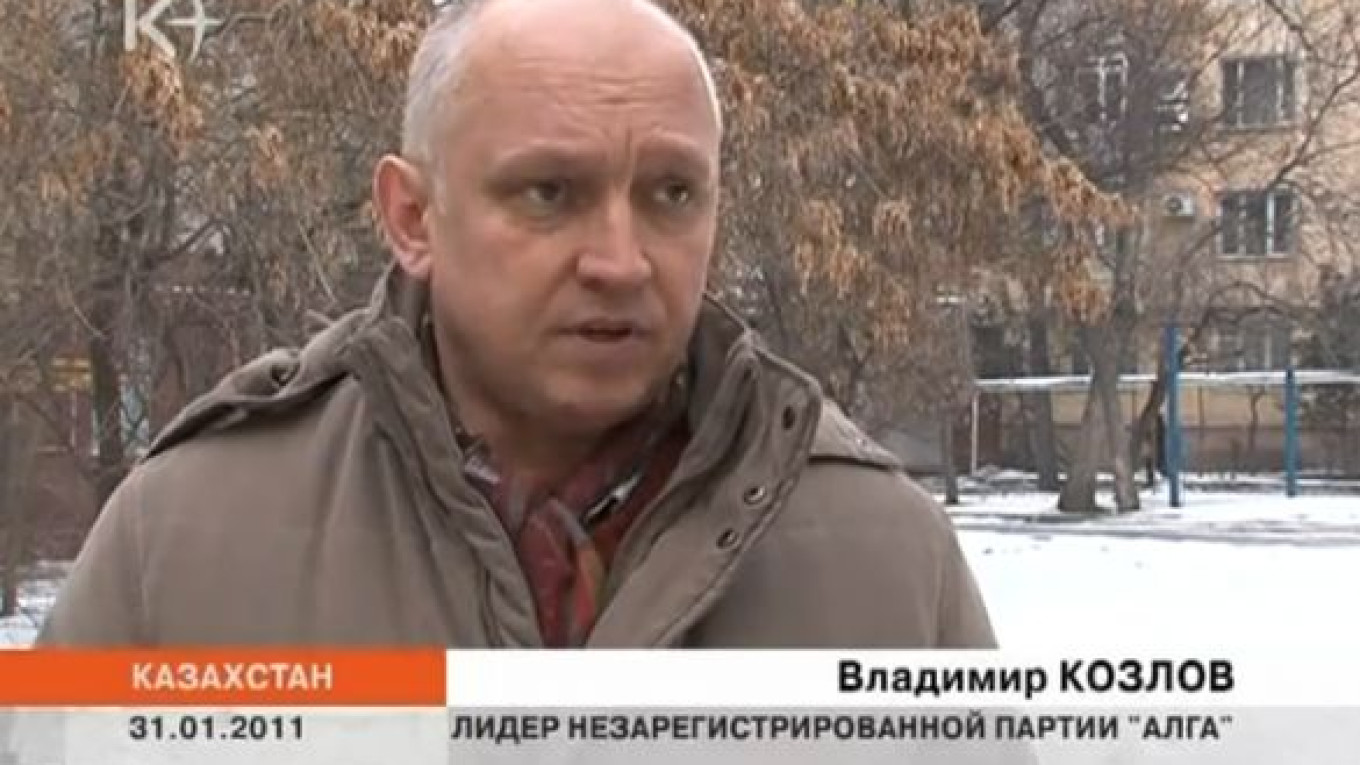
AKTAU, Kazakhstan — The trial of an opposition politician accused of whipping up fatal clashes between oil workers and police late last year is offering up a rare window into whether Kazakhstan is shaking off its reputation as an authoritarian backwater and promoting democratic reforms.
Vladimir Kozlov's supporters had expected his trial, which started in mid-August, to last little more than two weeks and consist of the summary justice usually reserved for activists engaged in unsanctioned anti-government initiatives. But authorities have seemingly wilted under the glare of international scrutiny, and allowed Kozlov a platform to air widely held grievances about political repression and the stagnant living conditions endured by many.
Kozlov addresses the court in his trial on charges of plotting to topple the government with the punctilious patience of a teacher lecturing a university politics class.
"We think that the more people like us there are in a country, the quicker that country will achieve prosperity," Kozlov said from the glass cage typically reserved for defendants in many post-Soviet courts.
The 52-year-old opposition politician faces up to 12 years in jail for purportedly fomenting unrest in a remote oil town last year, but it is the government's claim to being a flourishing democracy-in-waiting that is facing the real test. In a visit to Kazakhstan before the first hearings, U.S. Assistant Secretary of State Robert Blake said Washington would closely monitor whether Kozlov's trial was fair, impartial and open.
Kozlov and his two fellow defendants, opposition activist Serik Sapargali and trade unionist Akzhanat Aminov, were arrested for their suspected involvement in inciting the violence in mid-December in Zhanaozen between striking oil workers and police. At least 14 people died when police opened fire on rioters.
All the three men now in the dock visited and consulted with the workers, who had downed their tools and occupied Zhanaozen's central square for more than half a year to demand higher salaries. For the government, this outreach work constituted an incitement to revolt. Kozlov argues he was performing activism common in any nation that aspires to inoculate itself against social unrest.
Although opposition figures have routinely been denied public platforms, Kozlov was over the past week allowed to speak freely for three days in his own defense, interspersing his testimony with wide-ranging criticisms of government mismanagement, corruption, poverty and political repression.
Kozlov argued that his party tried to warn authorities of the dangers of ignoring the unsettled labor dispute.
When President Nursultan Nazarbayev visited Zhanaozen a few days after the rioting, he claimed in a speech to residents to have been misled by local authorities about the real situation on the ground.
"I would have come to Zhanaozen a long time ago, in the summer, if the oil managers had not said: 'Oh, everything is all right,'" said Nazarbayev, who has ruled his country uninterruptedly for more than two decades. "Everybody, including the governor of the region and the head of [state energy company] Kazmunaigas, all of them cheated me by saying that negotiations were under way."
In fact, developments in Zhanaozen had been extensively covered by independent newspaper Respublika, a bitter critic of the government whose website is blocked in Kazakhstan, and satellite television station K-Plus, whose journalists have routinely faced harassment.
Kozlov said he too repeatedly tried to draw officials' attention to Zhanaozen, including at international conferences attended by top government representatives, but that his words were not heeded.
The text of the often-rambling 677-page indictment against Kozlov suggests a deeper political motivation for the trial by referring repeatedly to the role played by businessman Mukhtar Ablyazov, a self-exiled Nazarbayev foe. Prosecutors describe Ablyazov as the head of an extremist, criminal conspiracy bent on "seizing power by inciting civil strife and hatred."
Ablyazov is wanted by Kazakh authorities on charges of siphoning off billions of dollars from BTA Bank, which is based in the country's business capital, Almaty.
He has been involved in opposition groups for the past decade. Shortly after setting up a reform-oriented party in 2001, he was sentenced to six years in jail for abuse of public office during his earlier stint as energy minister. After being pardoned by Nazarbayev and released from prison in 2003, Ablyazov vowed to stay away from politics ?€” a promise he broke by funneling money to Kozlov's Alga opposition movement.
Political analyst and government critic Petr Svoik said the current trial was actually about the bitter rivalry between Nazarbayev and Ablyazov.
U.S.-based advocacy group Freedom House, which has closely monitored the trial, has noted numerous violations of due process and judicial impartiality. More broadly, there are concerns that Kazakhstan's much-trumpeted democratic reforms are doomed to come to nothing.
Last year's presidential election, which saw Nazarbayev winning with a Soviet-style 95 percent of the vote, was sharply criticized by international observers, who cited numerous cases of ballot box stuffing, voter intimidation and a lack of transparency. A parliamentary election in January distributed seats between Nazarbayev's Nur Otan and two little-known pro-government parties.
If Kozlov is convicted, Alga will likely cease to exist, since most of its assets are registered in his name. With few genuine opposition forces in Kazakhstan, Alga members worry that such an outcome would weaken scrutiny of the government.
"You can smash all your mirrors at home every single day, but if your face is crooked, that will change nothing," Kozlov said at the trial.
Related articles:
A Message from The Moscow Times:
Dear readers,
We are facing unprecedented challenges. Russia's Prosecutor General's Office has designated The Moscow Times as an "undesirable" organization, criminalizing our work and putting our staff at risk of prosecution. This follows our earlier unjust labeling as a "foreign agent."
These actions are direct attempts to silence independent journalism in Russia. The authorities claim our work "discredits the decisions of the Russian leadership." We see things differently: we strive to provide accurate, unbiased reporting on Russia.
We, the journalists of The Moscow Times, refuse to be silenced. But to continue our work, we need your help.
Your support, no matter how small, makes a world of difference. If you can, please support us monthly starting from just $2. It's quick to set up, and every contribution makes a significant impact.
By supporting The Moscow Times, you're defending open, independent journalism in the face of repression. Thank you for standing with us.

Remind me later.