

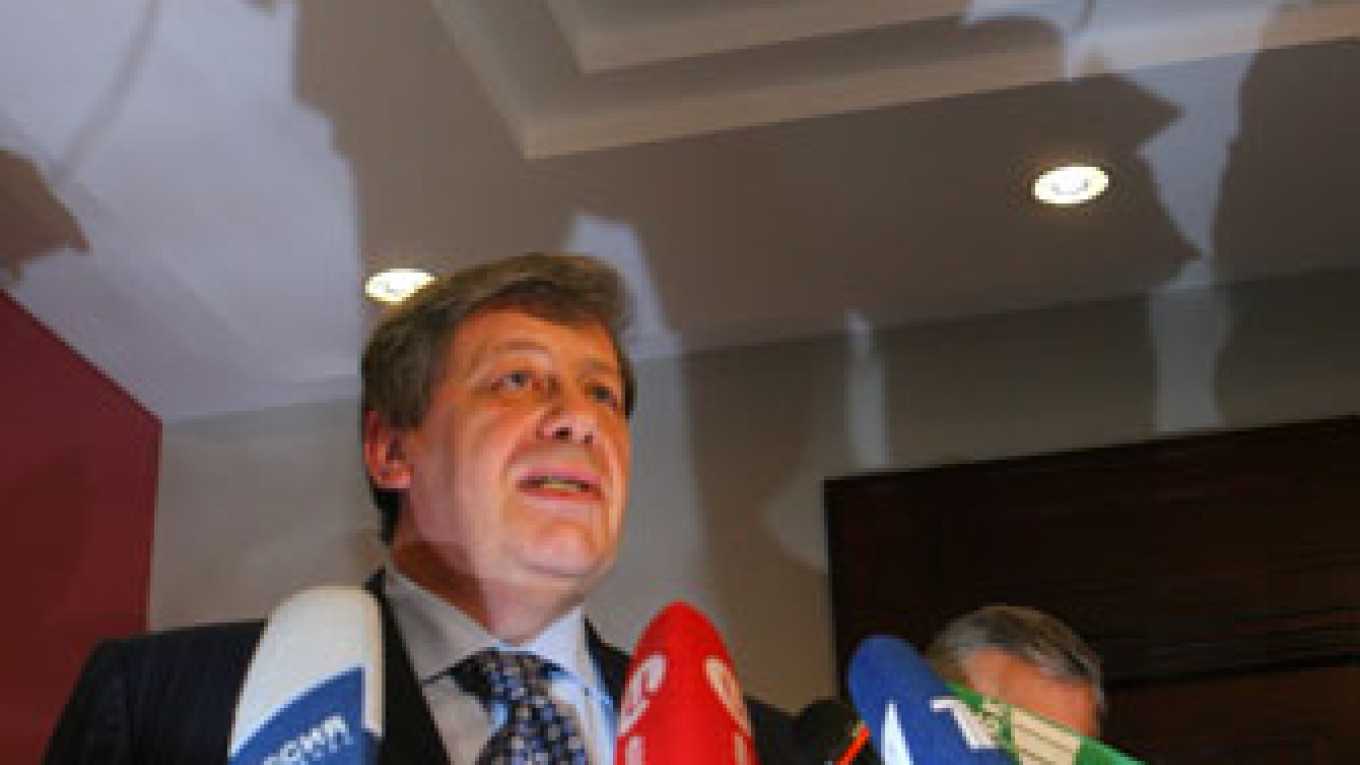
When Yekaterinburg's mayor gave his annual address to the city legislature last week, he had some rather unusual news.
"I do not exclude that this will be my last speech in this capacity," Arkady Chernetsky told the 35 deputies.
"This is no tragedy," he said, adding that he would not resign.
Chernetsky, who has governed the city of 1.3 million since 1992, is the target of a political campaign to oust him that observers say he won't be able to resist much longer.
"He was very emotional, and it was obvious what immense pressure he is under," said Leonid Volkov, an independent local lawmaker who was present during Chernetsky's speech.
This week, the ruling United Russia party introduced a bill into the Yekaterinburg legislature that would abolish direct mayoral elections. Instead, the mayoral title with its ceremonial functions would pass over to the speaker of the legislature, while the task of running the administration would be given to a hired professional with the conspicuous title of "city manager."
United Russia's attempt to introduce a so-called "double-headed system" in Yekaterinburg, Russia's fifth-largest city by population, is a reform that has already been implemented in several major cities. Direct mayoral elections have been abolished in Nizhny Novgorod, Chelyabinsk, Ulyanovsk and Izhevsk.
Critics say city managers will be much easier to fire, while mayors under the new system will be totally dependent on governors, who usually control United Russia at the regional level.
The reform is being deplored by opponents as a step to bring Prime Minister Vladimir Putin's "power vertical" concept of top-down government to the municipal level.
As president, Putin abolished direct elections of governors, triggering criticism that he was rolling back democracy in the country.
Since the scrapping of gubernatorial elections came into force in 2005, mayors are the most senior local officials still elected to office.
Analysts said regional bosses, who are now nominated by the president and approved by regional legislatures, are the driving force in the attempt to do away with elected mayors.
"These governors do not want to and cannot rule together with freely elected mayors," said Yekaterina Yegorova, head of the political consulting firm Nikkolo M and a veteran insider of the country’s political scene.
Others say it is merely a manifestation of United Russia's drive to monopolize the country's politics. In the last regional elections in March, support for United Russia slipped in several places — most prominently in Irkutsk, one of Siberia’s largest cities, where a Communist candidate was elected mayor.
"They just fear their own weakness," said Oleg Shein, a State Duma deputy with the Just Russia party.
United Russia officials interviewed by The Moscow Times were adamant that any changes would only be introduced after thorough debate and public hearings.
Yelena Chechunova, speaker of the lower chamber of parliament for Sverdlovsk, the region whose capital is Yekaterinburg, defended the city manager model as more democratic and preferable in fighting corruption.
"It makes it easier to dissolve relations with an administration head who does not cope with his duties," said Chechunova, who serves as secretary of United Russia's Sverdlovsk branch.
Yekaterinburg's current model is that of a strong mayor, she said. "We are now discussing the introduction of an alternative model. … It is the municipality's right to chose between one model or another," Chechunova said in e-mailed comments.
Nizhny Novgorod Mayor Vadim Bulavinov, who hopes to retain his title as mayor of Russia's third-largest city and to become speaker of its legislature when his job is split with a new city manager after the summer break, said each model of governance had its pluses and minuses. "What is important is that the people profit from it and not any politician," he said in e-mailed comments.
Reform is Legally Sound
Some critics have called the reform unconstitutional, but Anatoly Lokot, a Communist deputy and member of the State Duma's Local Self-Government Committee, said that while deplorable, there was nothing illegal about it.
The federal law on local self-government stipulates that mayors must be elected by popular vote or by members of the local legislature. If elected by the local legislature, the mayor automatically becomes its speaker and cannot run the local administration at the same time. Consequently, Lokot said, that job goes to an appointed city manager.
Lokot said the trend of abolishing mayoral elections signaled a growing conflict between Putin, who heads United Russia, and President Dmitry Medvedev in the run-up to the 2012 presidential election.
"We are seeing a strengthening of the interests on Putin's side and their influence on local politics," he told The Moscow Times.
Despite his more liberal credentials, Medvedev has also helped weaken the position of mayors. Last year, he signed a law that empowers local legislatures to oust mayors on charges such as mismanagement, neglect of duties or losing the respect of lawmakers. The president also granted new powers to governors to fire mayors.
The new rules have lead to the ousting of the independent mayors of Murmansk and Smolensk.
(Moscow and St. Petersburg, the country's two largest cities, have not had mayoral elections since the scrapping of gubernatorial elections because their leaders hold the status of governors.)
Georgy Bovt, a co-leader of the Right Cause liberal opposition party, said local opposition groups were the only hope to oppose the United Russia-led mayoral reform. "This tendency will continue as long as no one opposes it wholeheartedly," he said.
Right Cause has been organizing rallies across the country in recent weeks to demand the preservation of direct mayoral elections.
In some cities, the opposition has been successful.
For example, lawmakers in the Siberian oil town of Surgut voted 14-5 against introducing the reform last week, the Ura.ru web site reported. The deputies acted in defiance of Khanty-Mansiisk Governor Natalya Komarova, who had said city managers should be introduced in all of the region's towns.
Back to Yekaterinburg
In Yekaterinburg, United Russia might face defeat as well. Chernetsky, who was re-elected mayor for a four-year term in 2008, has made it clear that he will not leave without a fight.
"Introducing city managers is a trend we get from the highest echelons of power," he told lawmakers last week, adding that the decision was in their hands. "I don't want to be a city manager or a mayor in this system."
Volkov, who as a Yekaterinburg deputy is planning rallies in favor of keeping mayoral elections, said Chernetsky was struggling to hold on to his job amid immense pressure from Sverdlovsk Governor Alexander Misharin, who was appointed by Medvedev in November.
Misharin, who does not have a good relationship with Chernetsky, replaced the region's long-serving Governor Eduard Rossel, who had led the region since the early 1990s and was friendly with Chernetsky, local media reported.
The mayor's troubles started when the governor unveiled "Big Yekaterinburg," a project to make the city the country's third largest in terms of population by uniting it with surrounding suburbs.
Members of Misharin's administration have said a bigger city would be easier to govern by two people rather than by a single mayor.
Chernetsky has voiced support for the plan but said he does not want to govern a bigger Yekaterinburg.
Both Misharin and Chernetsky belong to United Russia, and the rift goes right through the party, Volkov said. "On the regional level, they support the reform, while on the city level, they oppose it," he said.
Yekaterinburg lawmakers won't manage to pass the necessary legislation before the summer recess begins June 22, Sergei Tushin, the city administration's deputy chief of staff, told the Uralpolit.ru web site Wednesday.
Yet in what has been described as the latest step to oust Chernetsky, United Russia's Sverdlovsk leaders nominated him for a senatorial seat in the Federation Council. The mayor is the only candidate, and the regional legislature, where United Russia enjoys a comfortable majority, is to make a decision next week.
So far, Chernetsky has not spoken publicly about his nomination.
A Message from The Moscow Times:
Dear readers,
We are facing unprecedented challenges. Russia's Prosecutor General's Office has designated The Moscow Times as an "undesirable" organization, criminalizing our work and putting our staff at risk of prosecution. This follows our earlier unjust labeling as a "foreign agent."
These actions are direct attempts to silence independent journalism in Russia. The authorities claim our work "discredits the decisions of the Russian leadership." We see things differently: we strive to provide accurate, unbiased reporting on Russia.
We, the journalists of The Moscow Times, refuse to be silenced. But to continue our work, we need your help.
Your support, no matter how small, makes a world of difference. If you can, please support us monthly starting from just $2. It's quick to set up, and every contribution makes a significant impact.
By supporting The Moscow Times, you're defending open, independent journalism in the face of repression. Thank you for standing with us.

Remind me later.