

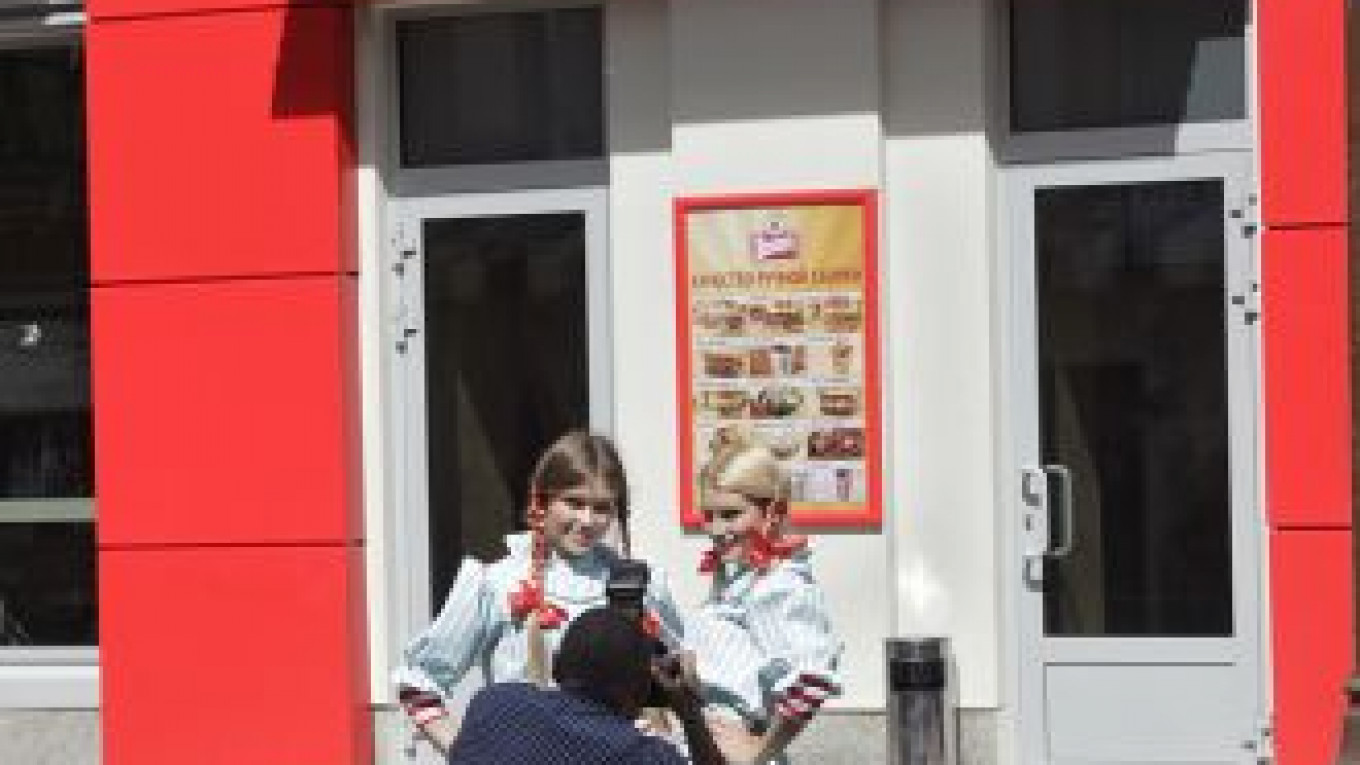
The Wendy's models in trademark pigtails who greeted reporters outside the U.S. hamburger chain's first standalone Russian restaurant on Thursday didn't resemble your traditional Wendy girls.
Instead of the wholesome freckle-faced redhead in old-fashioned pantaloons, these long-legged women wore short dresses, bright red-striped stockings and stilettos.
Meet the Russian Wendy.
Photographers clustered around the women to take photos, but a visiting U.S. executive, Andrew Skehan, was decidedly less impressed.
Skehan, the chain's chief operating officer, said by phone that he had not been aware of franchisee Wenrus Restaurant Group's decision to sex up the chain's icon. He said he would probably have to deal with a flood of phone calls from Wendy's/Arby's headquarters in Atlanta once his associates saw the photos.
Wendy was, after all, the daughter of the chain's late founder and chief executive, Dave Thomas.
But speaking to reporters at the opening, Skehan allowed that the Russians were the most beautiful Wendy's girls he had ever seen.
The girls are a far cry from the Soviet stereotypes that Wendy's lampooned in an award-winning commercial in the 1980s. The commercial poked fun at the lack of choice in the Soviet Union and the stereotypically large Soviet woman, showing a heavyset woman catwalking in a shapeless dress and swinging a flashlight for nightwear and a ball for beachwear.
"Wendy's produced this parody, but today we have the Russian Wendy," Skehan said in the phone interview, adding that he still laughs every time he sees the commercial.
The franchisee's chief executive, Alexander Kovaler, explained that he had changed the outfit to appeal to a younger demographic. "It's our upgrade," he said by phone.
The opening of Wendy's on the Arbat? marks the second step in corporate plans to launch at least 180 restaurants, franchises and sub-franchises in Moscow and the Russian regions over the next 10 years. Russia's first Wendy's opened June 14 in the food court of the Kapitoly shopping center on Prospekt Vernadskogo in southwestern Moscow.
The quick-service restaurant chain hopes to take on main competitor McDonald's and others with individually handmade burgers and better-quality meat, which, according to restaurateur Mikhail Zelman of Food Service Capital Group, does not contain tendons and other flaws.
The restaurant will offer an American menu of hamburgers, cheeseburgers, salads and roast beef sandwiches. The average bill will run 250 rubles ($9), or $3 to $4 more than in the United States. Wenrus projects annual revenue of $1.5 million to $1.6 million per? store, roughly 40 percent higher than at a store in the United States.
The reason for the higher price is the high price of food and overall high cost of living, Kovaler said.
The opening is the latest in Russia's fast-food boom. Burger King opened its first restaurant in January 2010.
Wendy's is the world's third-largest burger chain, after McDonald's and Burger King.
McDonald's, which opened on Pushkin Square in the twilight of the Soviet Union in 1990, continues to grow rapidly in Russia. Local restaurants, numbering 275 at the end of 2010, serve about 700,000 customers a year each, one of the highest numbers for McDonald's in the world. It opened 31 restaurants last year and 40 more this year.
Russian chains have also been riding the wave. Teremok, which sells blini with traditional fillings like caviar and herring, now has 190 restaurants and stands in Moscow and St. Petersburg. The chain plans to open three new restaurants in Moscow before the end of the year.
The Russian dining market holds great growth potential because salaries are growing and there are relatively few restaurants per capita, Finam Holding analyst Maxim Klyagin said.
Fast food holds a share of 30 percent to 40 percent of the dining market. The industry saw growth during and after the recession because people were looking to downgrade to save money, Klyagin said.
The dining market value rose from $3 billion in 2000 to $26 billion in 2010, according to the State Statistics Service.
But there is still much room to grow. Americans spend 17 times more than Russians on dining out, Klyagin said.
Skehan said his American associates might have been misinformed about the Russian market in the 1990s but now are very interested in Russia and eager to visit.
"Russia is a vibrant country with a strong economy," he said. "Fortunately it's a country for people who like to eat meat. We are very excited about the future."
A Message from The Moscow Times:
Dear readers,
We are facing unprecedented challenges. Russia's Prosecutor General's Office has designated The Moscow Times as an "undesirable" organization, criminalizing our work and putting our staff at risk of prosecution. This follows our earlier unjust labeling as a "foreign agent."
These actions are direct attempts to silence independent journalism in Russia. The authorities claim our work "discredits the decisions of the Russian leadership." We see things differently: we strive to provide accurate, unbiased reporting on Russia.
We, the journalists of The Moscow Times, refuse to be silenced. But to continue our work, we need your help.
Your support, no matter how small, makes a world of difference. If you can, please support us monthly starting from just $2. It's quick to set up, and every contribution makes a significant impact.
By supporting The Moscow Times, you're defending open, independent journalism in the face of repression. Thank you for standing with us.

Remind me later.