

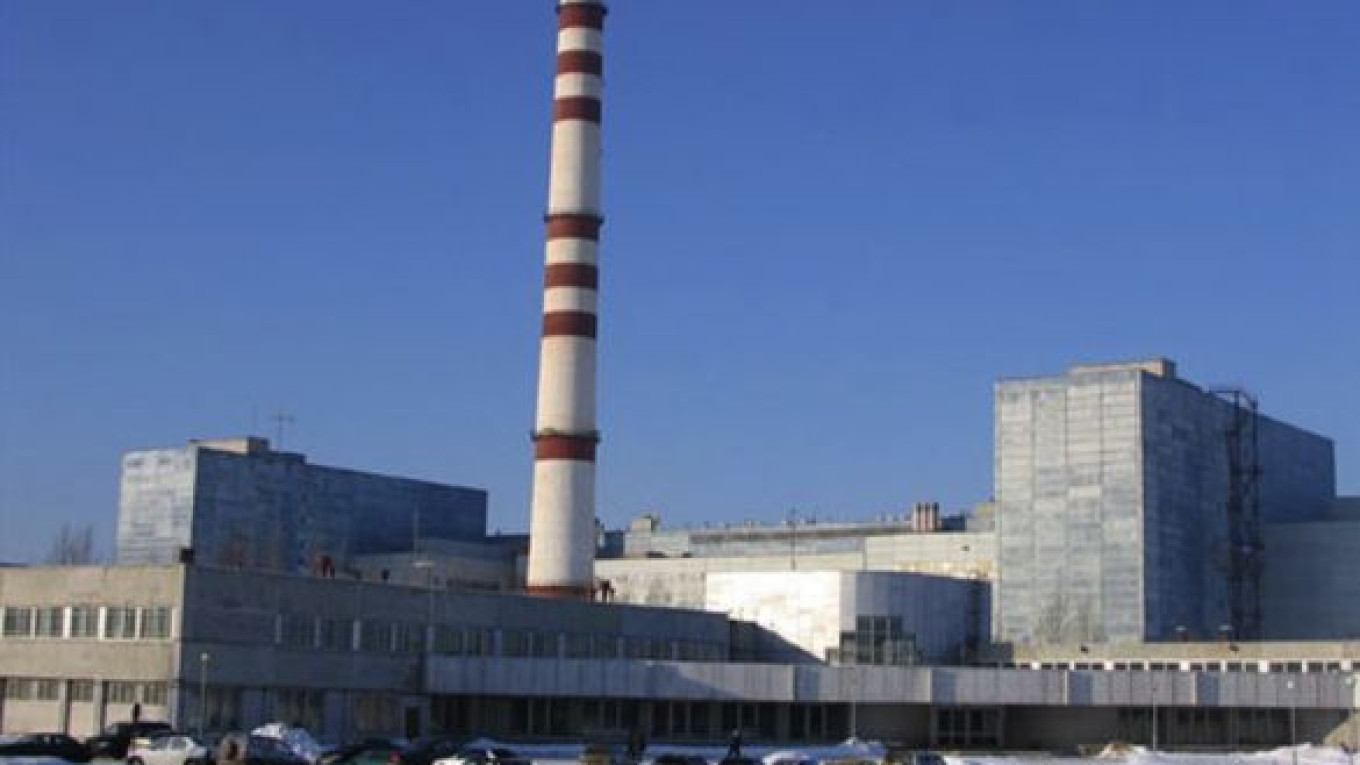
Plans to transfer thousands of tons of spent nuclear fuel from Chernobyl-type nuclear reactors to a new storage facility in Siberia in the coming weeks have been attacked by environmentalists.
State nuclear monopoly Rosatom announced completion of a new dry-storage facility at the Zheleznogorsk Mining and Chemical Factory, in the Krasnoyarsk region, in December. A train carrying 80 tons of spent fuel for the depot is expected to depart the Leningrad nuclear power plant in the near future.
“Dry storage” is considered safer than the current “wet-storage” arrangements — when nuclear material is kept in a pool of water that acts as a barrier to radiation.
“It will now be stored safely in permanent rather than temporary storage facilities, where it can be kept indefinitely until it is eventually reprocessed,” Rosatom spokesman Sergei Novikov told The Moscow Times.
Russia currently reprocesses just 16 percent of the spent fuel it produces annually, though it has set a target to raise efficiency to the point where it reprocesses as much as it turns out each year by 2020, Novikov said.
Although nuclear material is routinely moved from power stations and nuclear submarines to the country's two main storage and reprocessing plants in Zheleznogorsk and Mayak in the Chelyabinsk region, spent fuel from Chernobyl-type RBMK-1000 reactors has traditionally been stored onsite at the stations that use them.
Greenpeace Russia estimates that of 18,000 tons of spent nuclear fuel in storage in Russia, about 10,000 tons is from the RBMK-1000 reactors, which are still used by the Kursk, Smolensk and Leningrad nuclear plants.
“Moving nuclear material by train is routine, they do it annually. But they're planning 96 trains this year — which is several times more than usual,” said Vladimir Chuprov, the head of Greenpeace Russia's energy program.
Greenpeace argues that all nuclear material should be stored and dealt with where it is produced.
Chuprov conceded dry storage is safer, but highlighted two risk factors — damage to the rail bed by the abnormally heavy trains and the small but real risk of accident or terrorist attack on the trains, which pass through cities including Novosibirsk.
The train from Leningrad — the first in the plant's history — has also drawn fire from local environmentalists.
“This is not dealing with the problem — it is just moving it to another part of the country,” Oleg Bodrov, the head of Leningrad region-based group Greenworld, told The Moscow Times.
“We’ve spoken to colleagues in Krasnoyarsk and in other regions and we are planning actions to protest this,” he added.
Bodrov, who lives in the town of Sosnovy Bor, not far from the Leningrad plant, said he first learned of the train from workers at the plant. He said he expected it to depart by the end of January “if everything goes smoothly” with the loading process.
Mayak and Zheleznogorsk also take delivery of spent fuel from some countries, including Finland, Slovakia and Bulgaria, that Rosatom supplies fuel to. Russian legislation forbids the import of nuclear waste — defined as byproducts of the nuclear process that cannot be reused.
A Message from The Moscow Times:
Dear readers,
We are facing unprecedented challenges. Russia's Prosecutor General's Office has designated The Moscow Times as an "undesirable" organization, criminalizing our work and putting our staff at risk of prosecution. This follows our earlier unjust labeling as a "foreign agent."
These actions are direct attempts to silence independent journalism in Russia. The authorities claim our work "discredits the decisions of the Russian leadership." We see things differently: we strive to provide accurate, unbiased reporting on Russia.
We, the journalists of The Moscow Times, refuse to be silenced. But to continue our work, we need your help.
Your support, no matter how small, makes a world of difference. If you can, please support us monthly starting from just $2. It's quick to set up, and every contribution makes a significant impact.
By supporting The Moscow Times, you're defending open, independent journalism in the face of repression. Thank you for standing with us.

Remind me later.