

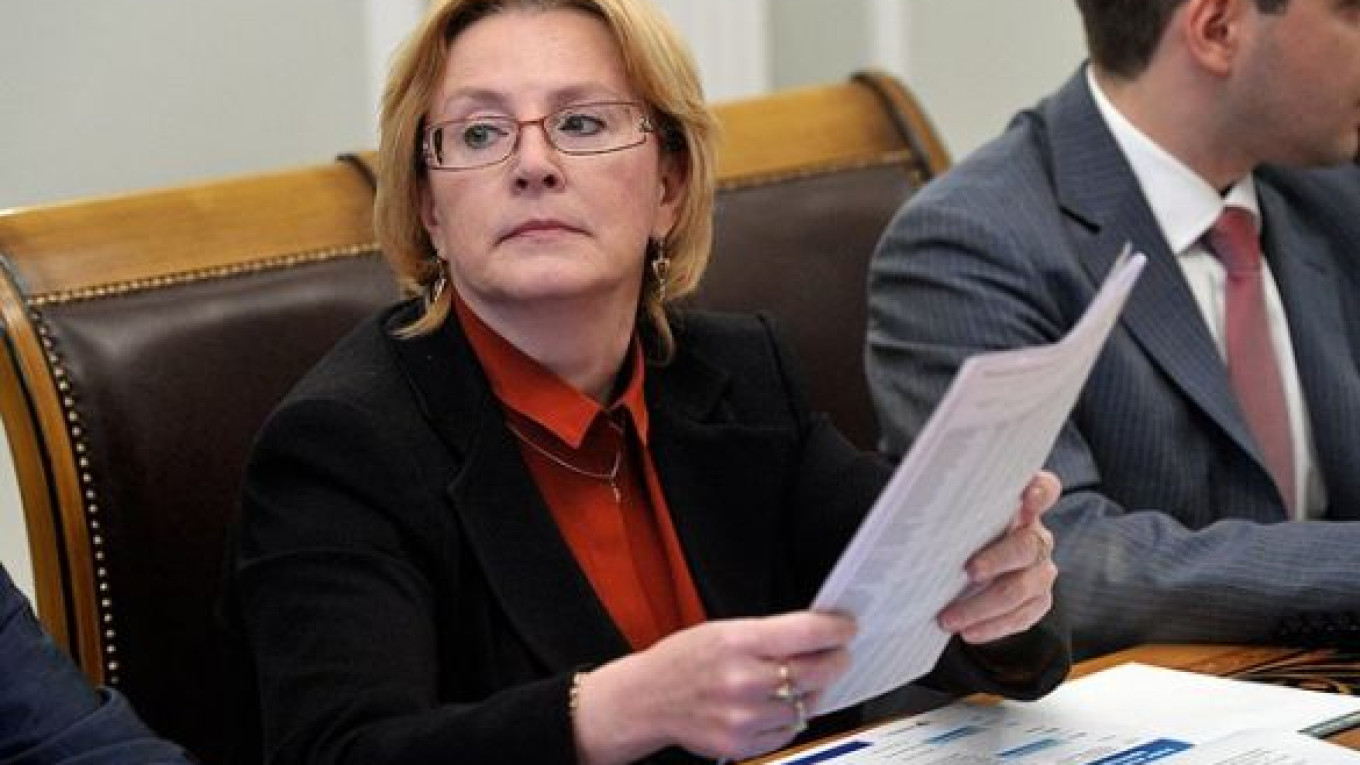
A total of 8,000 doctors in Russia became ruble millionaires over the last two years, as the government seeks to attract young specialists to rural areas to upgrade the quality of medical services, Health Minister Veronika Skvortsova said Friday.
The government provided 1 million rubles ($33,300) in financial support to each of the young specialists, who had agreed to move to the countryside in 2011 and 2012 to work in local hospitals, she said at a news conference after the Cabinet meeting.
The measure is part of the state program aimed at addressing the lack of high-quality medical care in rural areas and targets doctors below the age of 35. To be eligible for the financial support, a specialist must move to a rural area for at least five years.
Increasing the quality of medical services is seen by the Kremlin as one of the key measures to raising life expectancy and reducing mortality rates, which remain twice as high as the average in developed countries, according to figures released by the Organization for European Cooperation and Development last year.
Providing high-quality medical services is critical, as Russia is about to enter a period of birth-rate stagnation — a result of extremely low birth rates in the 1990s, said David Melik-Guseinov, director of the Center for Social Economy,
“A country’s demographic processes usually result from the past historical trends,” he said.
Current birth rates are ensured by the most productive group of the population — girls born in the late 1980s who are becoming mothers now, he said.
However, the situation is likely to change in two to three years, when the generation of the 1990s reaches child-bearing age.
Melik-Guseinov pointed out that very few children were born then, so the number of those who could become parents in a couple of years is extremely low.
“That means Russia will see the so-called demographic hole echo of the 1990s,” he said. The country faced a similar stagnation of birth rates between 1941 and 1951, as a significant number of would-be parents had been killed during World War II, he added.
The upcoming echo of the demographic hole is expected to last for 30 to 40 years, so an overhaul of the country’s health care is the only way to support life expectancy on acceptable levels and fight a population decline during that time period, Melik-Guseinov said.
Recent measures to upgrade the health care system in the regions have borne fruit, Skvortsova said.
Increasing the quality of medical services allowed for a significant reduction of mortality rates, which decreased 6.3 percent over the last two years to reach 13.3 people per every 1,000 residents, she said at the Cabinet meeting.
“More than 130,000 lives have been saved. With an increase of births by 135,000, we saw an increase in population of 4,600 people in 2012 instead of the natural decline,” Skvortsova added.
The overall spending on modernizing health care in the regions over the last two years reached 700 billion rubles, Prime Minister Dmitry Medvedev said at the Cabinet meeting.
This sum was spent on, among other things, developing new areas of medicine, supplying modern equipment to hospitals and providing navigation equipment for ambulances, measures that are part of the government’s effort to modernize regional health care between 2011 and 2013. A total of 50 billion rubles in state funds will be spent on this in 2013,? Skvortsova said.
The government hopes that the number of young specialists moving to rural areas this year will remain at least on the same level as last year, as program implementation will continue.
“One million is big money. They also get housing and a high social status,” Skvortsova said.
The sum is huge compared with the size of salaries in the country’s health care system, which remain low, especially in the regions.
An average doctor’s salary reached 32,700 rubles a month last year after increasing 13 percent from 2011, Skvortsova said at a meeting with President Vladimir Putin last week. The salary of nursing personnel reached 19,000 rubles, up 17 percent from the year before, she said.
Salaries for doctors and medical personnel are expected to increase about 7 percent this year, Skvortsova told reporters Friday.
Contact the author at [email protected]
Related articles:
A Message from The Moscow Times:
Dear readers,
We are facing unprecedented challenges. Russia's Prosecutor General's Office has designated The Moscow Times as an "undesirable" organization, criminalizing our work and putting our staff at risk of prosecution. This follows our earlier unjust labeling as a "foreign agent."
These actions are direct attempts to silence independent journalism in Russia. The authorities claim our work "discredits the decisions of the Russian leadership." We see things differently: we strive to provide accurate, unbiased reporting on Russia.
We, the journalists of The Moscow Times, refuse to be silenced. But to continue our work, we need your help.
Your support, no matter how small, makes a world of difference. If you can, please support us monthly starting from just $2. It's quick to set up, and every contribution makes a significant impact.
By supporting The Moscow Times, you're defending open, independent journalism in the face of repression. Thank you for standing with us.

Remind me later.