

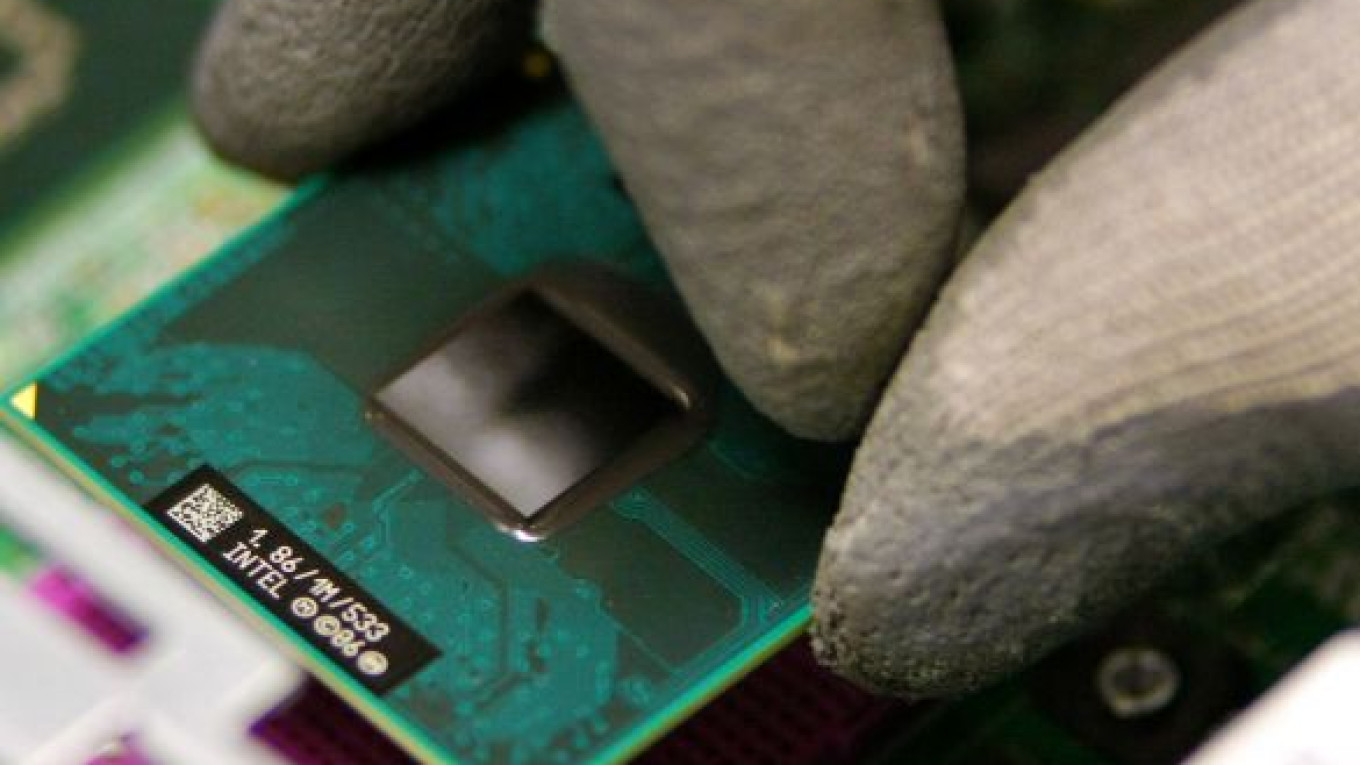
Mikron is proud of its microchips. It uses objects so small that 1,000 of them laid side by side equal the thickness of one human hair.
The only problem is that this achievement —? known as the 90-nanometer process — was set in the West in 2002, a dinosaur age ago for the industry.
So Tom Kilroy, a senior vice president with U.S.-based Intel, which is working with the far-advanced 22-nanometer process, is convinced that software engineering — not microchips — will be Russia's "core competence" as it embarks on a modernization drive.
“It's very rare that I can say that a country represents a core competence critical to our industry,” Kilroy said of Russia's software industry.
The microelectronics industry in Russia is at a turning point. There are two possible futures for Russia: to shift toward software engineering, as people like Kilroy suggest, or to focus on trying to catch up with the rest of the world. The decision that the Russian government decides to pursue could have a significant impact on projects like the Skolkovo innovation center, Russia’s version of the U.S. Silicon Valley.
Russia's share of the $314 billion global semiconductor market is quite small, with annual sales of both Russian-made and imported microchips at $1.2 billion, or less than 1 percent of the global total.
But Karina Abagyan, marketing director at Zelenograd-based Mikron, said there are reasons for optimism because the worldwide semiconductor market has about doubled since the 1990s. In addition, it is expected to grow by nearly 10 percent this year and reach $479 billion in 2015.
In Russia, market volume may double over the next four years if a public-private strategy to regulate microelectronics development is implemented, said Heinz Kundert, president of SEMI Europe, a global industry association serving the manufacturing supply chain for the micro- and nano-electronics industries.
Currently this strategy consists of a set of measures proposed by Rusnano chief executive Anatoly Chubais and AFK Sistema board chairman Vladimir Yevtushenkov to Prime Minister Vladimir Putin last August. Putin later incorporated aspects of these measures into instructions to relevant ministries.
The strategy proposed by Rusnano and Sistema includes elements of protectionism to support local manufacturers, and the provision of tax breaks and other economic stimuli for research and production of microelectronic components and finished high-tech products.
SEMI also suggested creating a microelectronics cluster in Zelenograd, a Soviet-era electronics production center outside Moscow.
Big Money, Small Products
But while Russian ministries are reading instructions, the cost of investment in microchip manufacturing is weeding out the weaker players.
“If we are talking about qualitative changes on the world market compared with the 1990s, the first thing that should be noted is the exponential growth in the cost of factories and equipment, which led to a decrease in the number of producers with every shift to a new generation of technologies,” Abagyan said.
In the United States, for every $1 billion of a microelectronics company's revenue, $200 million is invested into research and development, or R&D, and $200 million goes for revamping equipment and construction of new buildings, Russian Academy of Sciences member Vladimir Betelin said.
Official numbers back up Betelin’s words. Intel spent 15 percent of its $43.6 billion revenue last year on R&D alone. Its foremost competitor, AMD, spent almost 22 percent of last year’s revenue on R&D, while Japan’s National Semiconductor spent 19.4 percent.
The driving force behind digital integrated circuit technology is miniaturization. Smaller transistors mean more of them in the same area of a silicon chip, so that they work faster and use less energy.
The size of such transistors is measured in nanometers. After the 90-nanometer level was set in 2002, the process was shrunk to 65 nanometers in 2006, 45 nanometers in 2008 and 22 nanometers this year. Sixteen nanometers is expected in 2013.
Intel, a leader in building smaller chip elements, announced plans in October to invest $6 billion to $8 billion in its next-generation 22-nanometer manufacturing process at several existing U.S. factories in Arizona and Oregon, and it said it would build a new plant in Oregon. In February, it said it would invest $5 billion in a new microprocessor factory in Arizona that it plans to complete in 2013.
Such sums of money are hard for Russian companies to come up with, leaving them behind in the global microelectronics race.
Worldwide, only seven companies use 65-nanometer technology in full-cycle manufacturing? — in which they develop, design and produce chips.
In Russia, companies and institutions involved in microelectronics research and production include Sitronics' research and development centers, Rusnano, Mikron, the Moscow Institute of Electronic Technology and Physics and the Russian Academy of Sciences Technical University.
Mikron’s factory producing integrated circuits with 90-nanometer chips is Russia's largest semiconductor project, Abagyan said. Currently only eight countries, including Russia, have such technology, she said.
Chips of 180- and 90-nanometer size are used in many areas, including telecommunications, smart cards, appliances, automobile electronics and avionics, and account for 17 percent of total global microchip consumption.
“To be maximally competitive on this market, there needs to be domestic demand for our products, to launch production and lower production cost. This is what is happening in Europe, the U.S. and Asia, while the Russian microelectronics market is just forming,” Abagyan said.
The potential for use of such innovative products keeps her optimism alive. Electronic documents, the Glonass satellite navigation system and universal electronic card — one of President Dmitry Medvedev's recent pet projects — all require high-end research, development and manufacturing of both chips and software.
That is why Rusnano, Sitronics and STMicroelectronics signed a trilateral agreement on the transfer of 90-nanometer integrated circuit production technology to Mikron in March last year.
Today the project involves 50 companies from 12 countries and 16.5 billion rubles ($590 million) worth of investment. They include equipment and materials suppliers, construction companies and others, including M+W Zander, Air Liquid, Hager+Elsasser, Applied Materials and ASML.
But compared with Intel and IBM's budgets, this is just a drop in the bucket, experts say.
In Russia, promising developers get practically no serious investments, said Alexander Zagnetko, program manager at market research firm IDC. “Misuse of funds masked as the development of Russian [information and communication technologies] has become common practice,” he added.
“It's quite obvious that R&D in our country is in … a poor state,” Zagnetko said.
Abagyan countered that Mikron's project, for example, has helped restore some of the connections between equipment and materials manufacturers, research institutions, design centers and universities that vanished with the demise of the Soviet Union.
Two Scenarios
There are two possible futures for Russia in the high-tech electronics sector.
One is to forget about becoming a market leader in microchips and focus on catching up and staying on par with the rest of the world, said Kirill Kuzmichyov, senior investment officer at Rusnano, who was involved in the company’s 3.8 billion ruble investment in the first production of magneto-resistive random access memory, or MRAM chips, in Russia, in cooperation with Crocus Technology.
Some $125 million was allocated for setting up an MRAM facility, which will be located in either Kaliningrad or Zelenograd.
Kilroy, of Intel, who came to Skolkovo last month to celebrate the company’s 20th anniversary in Russia, proposed another path: switching the focus to software engineering.
“Russia has more than just a small niche here and there,” he said in an interview. “Intel's been able to establish a software expertise with our software engineers here that's been a critical part of our global business.”
A Message from The Moscow Times:
Dear readers,
We are facing unprecedented challenges. Russia's Prosecutor General's Office has designated The Moscow Times as an "undesirable" organization, criminalizing our work and putting our staff at risk of prosecution. This follows our earlier unjust labeling as a "foreign agent."
These actions are direct attempts to silence independent journalism in Russia. The authorities claim our work "discredits the decisions of the Russian leadership." We see things differently: we strive to provide accurate, unbiased reporting on Russia.
We, the journalists of The Moscow Times, refuse to be silenced. But to continue our work, we need your help.
Your support, no matter how small, makes a world of difference. If you can, please support us monthly starting from just $2. It's quick to set up, and every contribution makes a significant impact.
By supporting The Moscow Times, you're defending open, independent journalism in the face of repression. Thank you for standing with us.

Remind me later.