

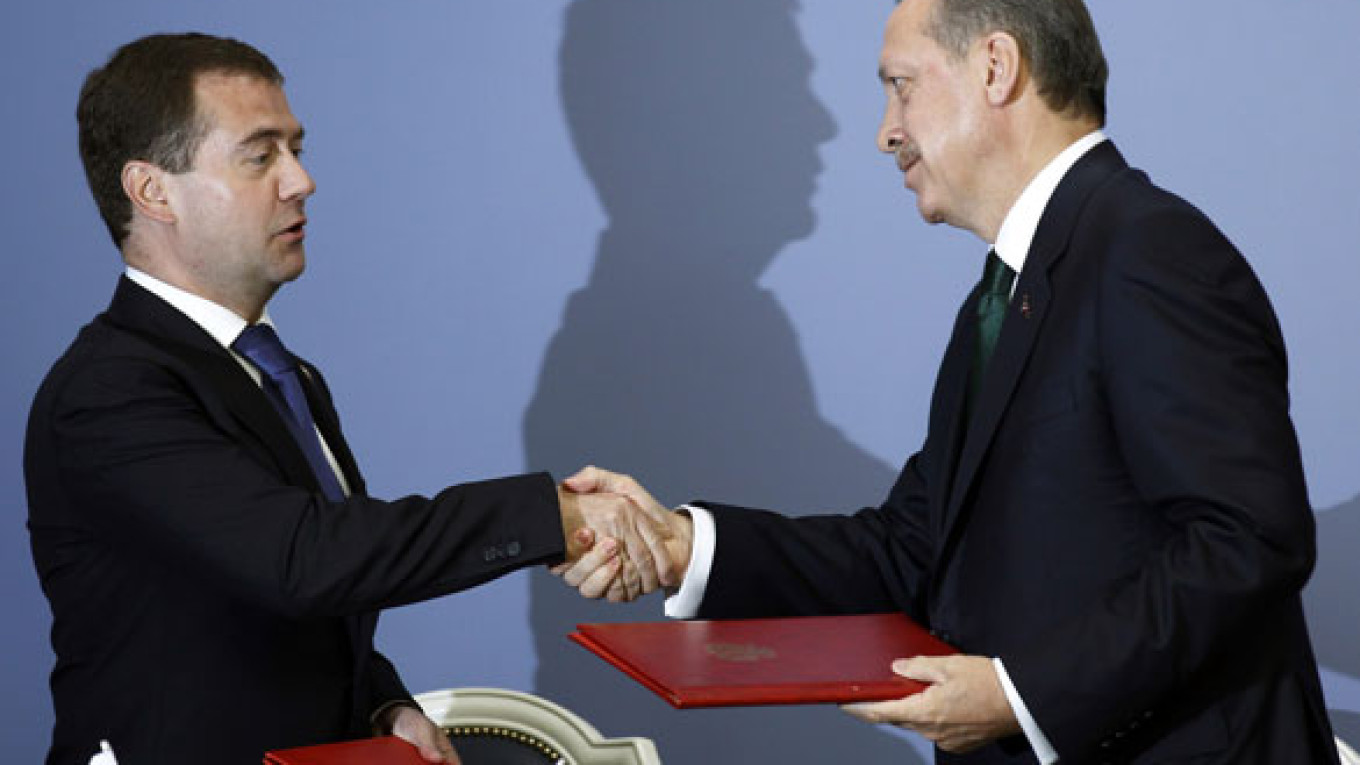
Turkey on Wednesday agreed to let Russia build and own a $20 billion nuclear power plant in a deal that opens a new page in Russia's global expansion in the industry.
Sergei Kiriyenko, head of Rosatom, the state nuclear corporation, signed the agreement to build four reactors on Turkey's southern Mediterranean coast during a visit by President Dmitry Medvedev to the country.
In a first, Rosatom will control the facilities and sell the electricity that it generates, Kiriyenko said.
“It's an extremely important contract for us. We have been craving this for a long time,” he told reporters after the signing. “It's much more interesting for us to be co-investors in such projects.”
Rosatom's other deals outside the country — most notably in places like China, India and Iran — exclude the company from any ownership or management role. Financially, the Turkish agreement is smaller than Rosatom's plan to build 16 reactors in India.
In executing the contract, which crowns years of negotiations and a contentious tender, Rosatom will initially establish a fully owned subsidiary to start the work at the Akkuyu site, Kiriyenko said. Later on, it will offer up to 49 percent of the venture to investors in and outside Turkey, he said, estimating construction costs at $20 billion.
“Turkish investors are interested. We’re also holding talks with European investors,” he said, declining to identify potential partners.
Rosatom won the bidding for the project in September 2008. Spurring the current deal, a Turkish court delayed awarding the contract because the company was the sole bidder.
“This is a smart move for Turkey … because they don’t have to pay anything upfront, just provide the site,” Kiriyenko said, referring to Wednesday's agreement.
Turkey's state electricity generating company EUAS will hand over land for the project free of charge, the Cabinet said in guidelines for the deal published Wednesday.
Rosatom expects to recoup costs 15 years after completing each reactor by selling half the electricity to Turkey's state energy company Tetas at a fixed price and offering the rest on the unregulated market, according to the contract guidelines. Afterward, Rosatom and its partners, if any, will transfer 20 percent of the profit to the Turkish government.
Rosatom has until mid-August to start creating the subsidiary to build the plant, according to the contract. Rosatom plans to open the first reactor within seven years after securing all construction permits. It will then complete one reactor every year for the next three years.
Rosatom may also set up a facility to make nuclear fuel in Turkey.
In other energy issues, Russia and Turkey will continue considering gas trade projects such as Blue Stream-2 and South Stream, Medvedev said after talks with Turkish Prime Minister Recep Tayyip Erdogan in Ankara.
In a goodwill gesture, Gazprom allowed Turkey to buy as little as 75 percent of the 16 billion cubic meters of gas that the country had originally agreed to buy this year through the Blue Stream pipeline.
Normally, the Russian gas export monopoly charges penalties if its customers buy less than 80 percent or 85 percent of contracted volumes, a condition that irritated many European energy companies after the economic downturn reduced demand.
The countries also are looking at Russia's possible involvement in the Samsun-Ceyhan oil pipeline, which is now a joint project between Turkey's Calik and Italy's Eni. If built, the pipeline will carry Russian and Kazakh oil across Turkey on a potentially safer and faster transit route than the congested straits connecting the Black Sea and the Mediterranean Sea.
Erdogan said an energy security agreement signed Wednesday made a priority of the oil link, whose cost was put at $3 billion by Deputy Prime Minister Igor Sechin on Tuesday.
Medvedev said Russia and Turkey signed deals with a combined value of $25 billion on Wednesday. Bilateral agreements included dropping visas for tourists as soon as the countries agree on the terms of readmission for illegal migrants.
Medvedev's visit to Turkey ended a Middle East trip that also took him to Syria, where he said Tuesday that Russia might build nuclear power reactors for the Arab country.
A Message from The Moscow Times:
Dear readers,
We are facing unprecedented challenges. Russia's Prosecutor General's Office has designated The Moscow Times as an "undesirable" organization, criminalizing our work and putting our staff at risk of prosecution. This follows our earlier unjust labeling as a "foreign agent."
These actions are direct attempts to silence independent journalism in Russia. The authorities claim our work "discredits the decisions of the Russian leadership." We see things differently: we strive to provide accurate, unbiased reporting on Russia.
We, the journalists of The Moscow Times, refuse to be silenced. But to continue our work, we need your help.
Your support, no matter how small, makes a world of difference. If you can, please support us monthly starting from just $2. It's quick to set up, and every contribution makes a significant impact.
By supporting The Moscow Times, you're defending open, independent journalism in the face of repression. Thank you for standing with us.

Remind me later.