

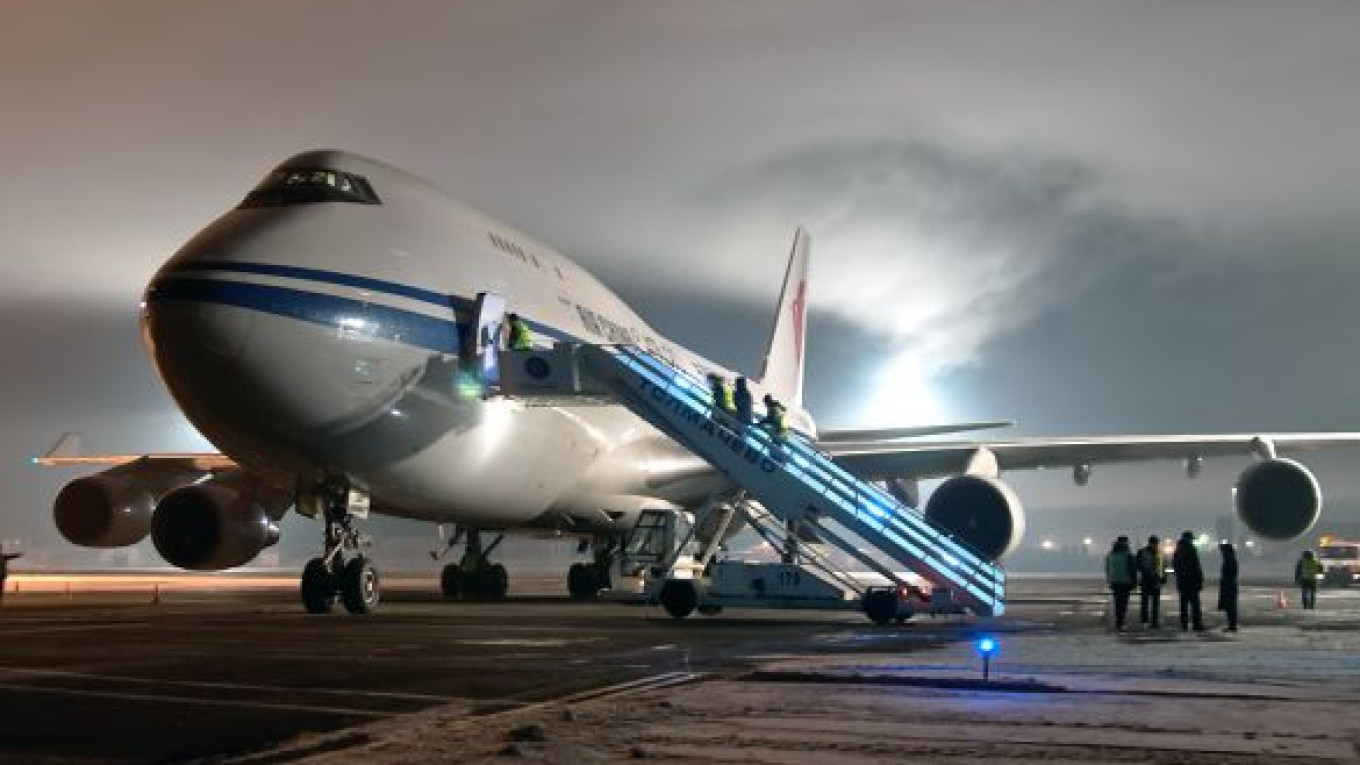
Last August, Lufthansa Cargo, the German flag carrier’s freight subsidiary, moved its stopover point on its Northeast Asia-to-Europe route from Astana, Kazakhstan, to Yemelyanovo Airport in Krasnoyarsk. The move followed a costly temporary ban on the company’s flights through Russian airspace, in what news agencies at the time reported as government intervention in the industry. After initial concerns, the transfer of the 22 flights from the Kazakh capital went smoothly. “There were no postponements during the process, and all issues were solved jointly,” said Christian Becker, Lufthansa Cargo's director for Russia and the CIS.
A runway upgrade was the company’s minimum requirement for the move. Yemelyanovo spent roughly $10 million on upgrading the approach system to CAT II, an investment that is likely to stand them in good stead for future business expansion. “It was a necessary investment in the future and will sooner or later attract other international carriers,” Becker said.
Tolmachyovo Airport, Novosibirsk’s international airport, is set to complete similar work on a second runway. “It will be certified at no less than CAT II, the International Civil Aviation Organization’s secondary category, and will be completed in the first half of 2010,” said Igor Leontyev, a spokesman for the airport’s marketing department.
As the industry picks up after a year on which the effects of the global downturn left their mark, runway infrastructure is not the key issue worrying airfreight carriers. “Infrastructure in regards to runways, taxiways and ground equipment is basically sufficient,” Becker said. “Infrastructure regarding cargo handling, however, needs major investments.”
The lack of development forces many carriers to use their own systems, Becker explained. This in turn drives up the cost for end users. “Airport infrastructure [in Russia] defines how much we can transfer between Asia and America, and Asia and Europe,” said Tatyana Arslanova, the recently appointed executive president of AirBridgeCargo, part of the Volga-Dnepr Group. At some Chinese airports, handling agents are able to complete the unloading process in about 2 1/2 hours, she explained. “In Moscow that can take 5 1/2 hours, although five planes can now be unloaded at once.”
Customs processing presents further problems for carriers. Freight handling in Russia remains unsuitable for many of the new procedures being introduced elsewhere, such as paperless e-freight systems. “Only in Russia did we need to set up a special documentation process, which is extremely costly and resource-intense,” Becker said, describing customs as the industry’s most critical issue today.
Despite this, the industry continues to develop in Russia. Novosibirsk’s Tolmachyovo Airport announced in mid-March that Air China Cargo would use the airport as its stopover point on the airline’s Shanghai-to-Frankfurt route. The first flight on this route, which is to be used three times a week, took place March 22.
The global economic downturn hit the airfreight industry, as many others in Russia, later than in other countries. “Factors relating to the economic crisis had the greatest effect in the period from April to October 2009,” said Andrei Romantsov, director of freight and postal services at Tolmachyovo, which saw a 30 percent drop in cargo turnover in the period.
However, a recovery gained momentum at the end of 2009 and the first two months of 2010. November and December saw an increase in the turnover of cargo flow, Romantsov said. “In total, we can talk of cargo turnover at the airport being comparable to cargo turnover in 2008,” he added. Cargo handling also increased at other Russian airports. In January 2010, Kazan International Airport reported a 33 percent rise in freight turnover compared with the same period last year, while cargo traffic at Domodedovo Airport grew by 24.4 percent in January and February compared with the first two months of 2009. “We are recovering from the crisis this year but less rapidly and obviously later than the rest of Europe,” Becker said.
A Message from The Moscow Times:
Dear readers,
We are facing unprecedented challenges. Russia's Prosecutor General's Office has designated The Moscow Times as an "undesirable" organization, criminalizing our work and putting our staff at risk of prosecution. This follows our earlier unjust labeling as a "foreign agent."
These actions are direct attempts to silence independent journalism in Russia. The authorities claim our work "discredits the decisions of the Russian leadership." We see things differently: we strive to provide accurate, unbiased reporting on Russia.
We, the journalists of The Moscow Times, refuse to be silenced. But to continue our work, we need your help.
Your support, no matter how small, makes a world of difference. If you can, please support us monthly starting from just $2. It's quick to set up, and every contribution makes a significant impact.
By supporting The Moscow Times, you're defending open, independent journalism in the face of repression. Thank you for standing with us.

Remind me later.