

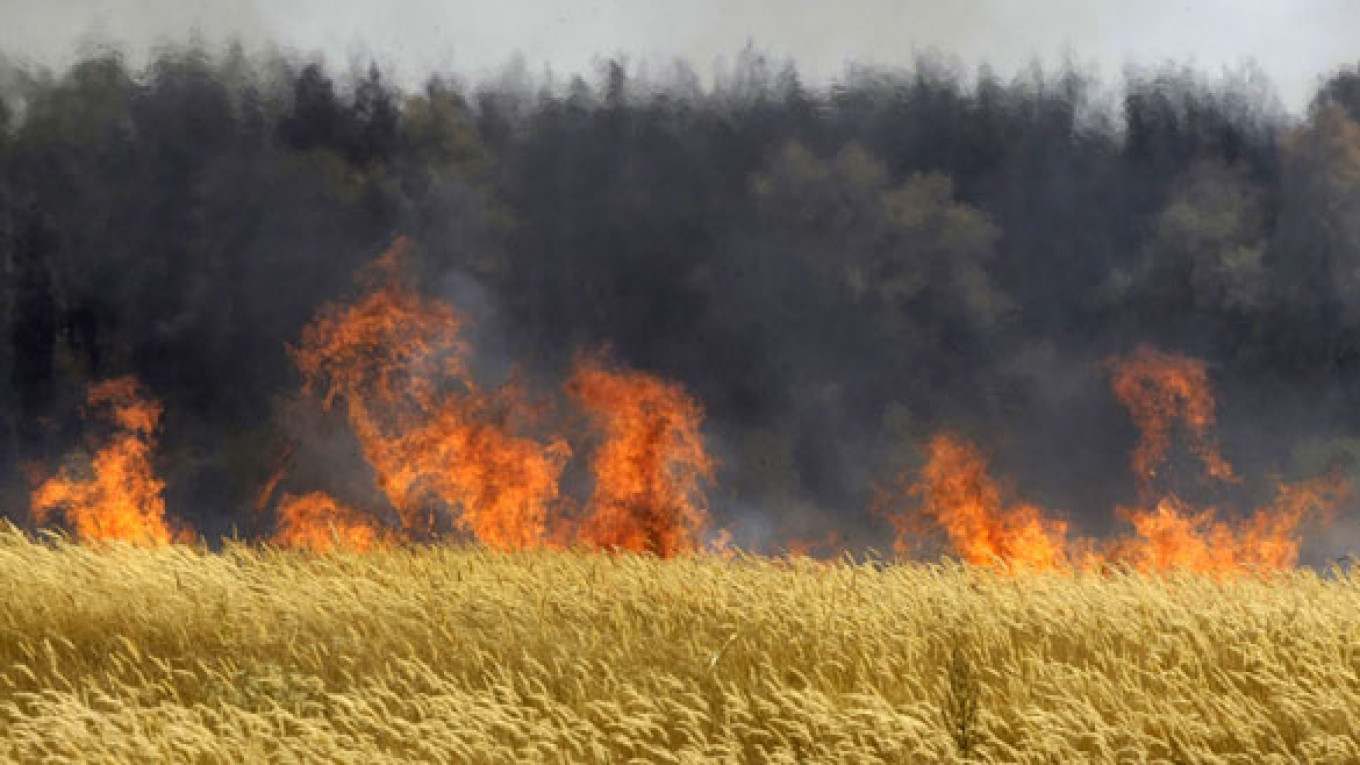
Russia, the world's fourth-largest grain exporter, will ban outbound shipments later this month in an effort to contain domestic prices as a severe drought scorches farmlands, Prime Minister Vladimir Putin said Thursday.
In another measure, the government will set aside more than $1 billion in loans and subsidies to farmers suffering from the worst drought in at least 50 years.
The ban, effective from Aug. 15 to Dec. 31, kills initial hopes to sell 21.4 million metric tones of grain — a figure that later shriveled to 15.3 million — to foreign customers including Egypt.
Wheat sharply rose to a 23-month high in Chicago following news of the ban.
The government has declared a state of emergency in 28 regions, as what is being called the worst drought in 50 years reduces crop yields by more than 20 percent, according to Agriculture Ministry data.
The decision to ban exports did not apparently come easy for the government. Deputy Agriculture Minister Alexander Belyayev and several expert groups have said shutting down grain exports would waste years of hard work to win market share.
Nevertheless, Putin ordered the ban after the Federal Anti-Monopoly Service said earlier this week that it had to step up surveillance over the explosive price growth on the domestic grain market. He said the restriction sought to prevent an increase in domestic food prices, maintain cattle stock and secure a reserve for next year — the last full year before presidential elections.
“As the saying goes, 'What's in the pocket just in case never seems to take up space,'" Putin said, again revealing his penchant for popular proverbs.
The ban covers wheat, barley, rye and corn, as well as flour made of wheat or a wheat-rye combination. The government will base plans for after December on how much harvest farmers collect, he said.
In addition to the export ban, the government plans to disburse 25 billion rubles ($840 million) in three-year low-interest loans and 10 billion rubles in subsidies, Putin said. A portion of the money will be available as early as this month, while the rest will become drawable in October and November after the harvesting season is over, he said.
What's more, the government will attempt to keep prices at bay by tapping into its reserves to supply grain to businesses, such as cattle farms and bakeries, without auctions — a step away from the usual practice. Instead of selling grain to the highest bidder, the government will provide as much as regional authorities request, Putin said.
In distributing the supplies, the regions will follow certain rules developed by the Agriculture Ministry, he said, without specifying the costs regions would have to pay.
“Our goal is not to raise more money in this case, but to help the agricultural producers that need that help,” he said.
Demand for grain from the reserves now amounts to 9.5 million tons, Putin said.
Russia will probably harvest at least 70 million tons of grain, roughly the same as the country's domestic consumption, Belyayev said in the latest official forecast Tuesday. The government has 21.5 million tons in its reserves.
Domestic wheat prices shot up 19 percent last week, according to agriculture consulting firm SovEcon.
Internationally, spot prices for the commodity spiked 8 percent on Thursday, trading at $8.15 per bushel at 1 p.m. on the Chicago Board of Trade. Wheat prices have risen 67 percent since the end of June.
Seeking to protect their margins, food producers will increase their prices too, possibly pushing up inflation to at least 7 percent this year, up from the pre-drought estimate of 6.3 percent, investment bank Renaissance Capital said in a note Thursday.
VTB Capital has said the rising prices would also increase the anticipated inflation rate next year by 1.5 percent. It did not give the total expected rate.
Putin, in his ban order, called on Belarus and Kazakhstan — fellow customs union countries that are also suffering from dry weather — to slap similar export restrictions.
A Message from The Moscow Times:
Dear readers,
We are facing unprecedented challenges. Russia's Prosecutor General's Office has designated The Moscow Times as an "undesirable" organization, criminalizing our work and putting our staff at risk of prosecution. This follows our earlier unjust labeling as a "foreign agent."
These actions are direct attempts to silence independent journalism in Russia. The authorities claim our work "discredits the decisions of the Russian leadership." We see things differently: we strive to provide accurate, unbiased reporting on Russia.
We, the journalists of The Moscow Times, refuse to be silenced. But to continue our work, we need your help.
Your support, no matter how small, makes a world of difference. If you can, please support us monthly starting from just $2. It's quick to set up, and every contribution makes a significant impact.
By supporting The Moscow Times, you're defending open, independent journalism in the face of repression. Thank you for standing with us.

Remind me later.