

Leading international firms are looking into mass production of consumer devices able to communicate with Russia's Glonass navigation system, Alexander Gurko, head of the state Glonass operator, said Wednesday.
Russia has been developing Glonass, its answer to the U.S. Global Positioning System, since 1976. Having spent $2 billion in the last 10 years, it is now in the final stages with, the system expected to be fully operational this year.
Gurko said major international companies such as Nokia, Motorola and Qualcomm were in talks with Russian chip manufacturers over mass production of handheld devices enabled with both Glonass and GPS.
"All leading international producers of mobile devices are now looking into the possibility of installing Glonass-GPS chipsets," he said.
"We are hoping that if the Russian market is interesting for these companies, they will take into account local trends of technological development," he added.
Gurko, who coordinates private firms and government agencies, said consumer chipsets needed for the mass production of Glonass-enabled handheld devices will soon be ready.
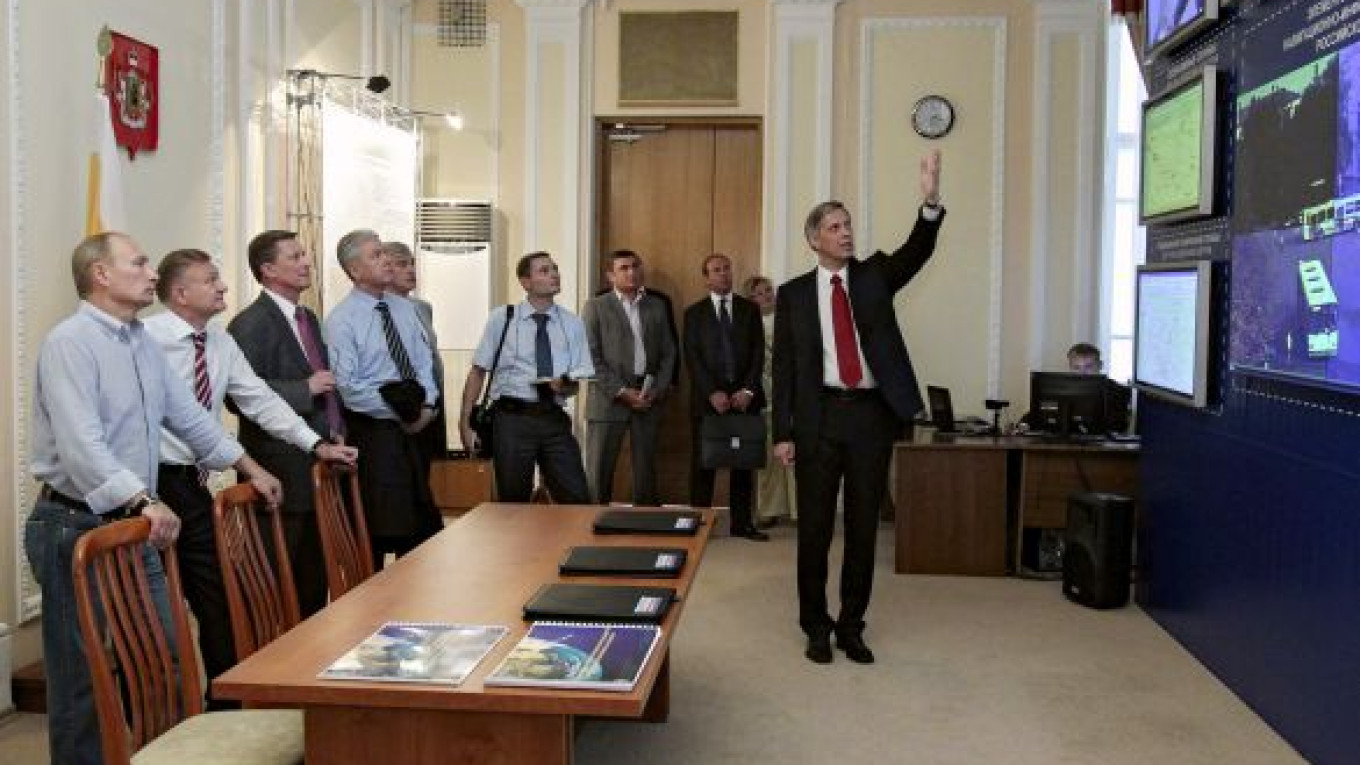
"Mass production of chipsets will start at the end of this year or the start of next year," Gurko said after a government meeting on Glonass that was chaired by Prime Minister Vladimir Putin.
Russia will spend an additional 48 billion rubles ($1.6 billion) on Glonass over the next year and a half, Putin said at the meeting.
So far, Russia has spent 60 billion rubles on developing the navigation system, but only 10 percent of Russian cars use it.
By the end of the year, Russia will also launch six more satellites, bringing the total number in orbit to 28, which Putin said will ensure that the signal from those satellites will be received beyond Russia.
At the meeting, Deputy Prime Minister Sergei Ivanov, who is in charge of Glonass development, proposed a 25 percent import duty from 2011 for navigation devices that are only able to communicate with GPS.
Putin called for ensuring "satellite navigation sovereignty" and said Russia was ahead of the European Union and China in developing its navigation system. Ivanov said the import duty would stimulate international interest in Glonass.
Gurko said several Russian firms such as Navis, GeoStar Navigation and Sitronics, part of Sistema, are developing the chipsets. Devices equipped with such chips will be imported into Russia duty free.
If successful, this move will mark Russia's most ambitious foray into the global high-tech market and will contribute to the government's cherished goal of diversifying the economy away from the energy sector.
Gurko said the Russian satellite navigation market, estimated at only $1 billion in 2010, will grow to about $10 billion in 2014. NIS Glonass will also market the technology in India, the Middle East and ex-Soviet countries.
(Reuters, MT)
A Message from The Moscow Times:
Dear readers,
We are facing unprecedented challenges. Russia's Prosecutor General's Office has designated The Moscow Times as an "undesirable" organization, criminalizing our work and putting our staff at risk of prosecution. This follows our earlier unjust labeling as a "foreign agent."
These actions are direct attempts to silence independent journalism in Russia. The authorities claim our work "discredits the decisions of the Russian leadership." We see things differently: we strive to provide accurate, unbiased reporting on Russia.
We, the journalists of The Moscow Times, refuse to be silenced. But to continue our work, we need your help.
Your support, no matter how small, makes a world of difference. If you can, please support us monthly starting from just $2. It's quick to set up, and every contribution makes a significant impact.
By supporting The Moscow Times, you're defending open, independent journalism in the face of repression. Thank you for standing with us.

Remind me later.