

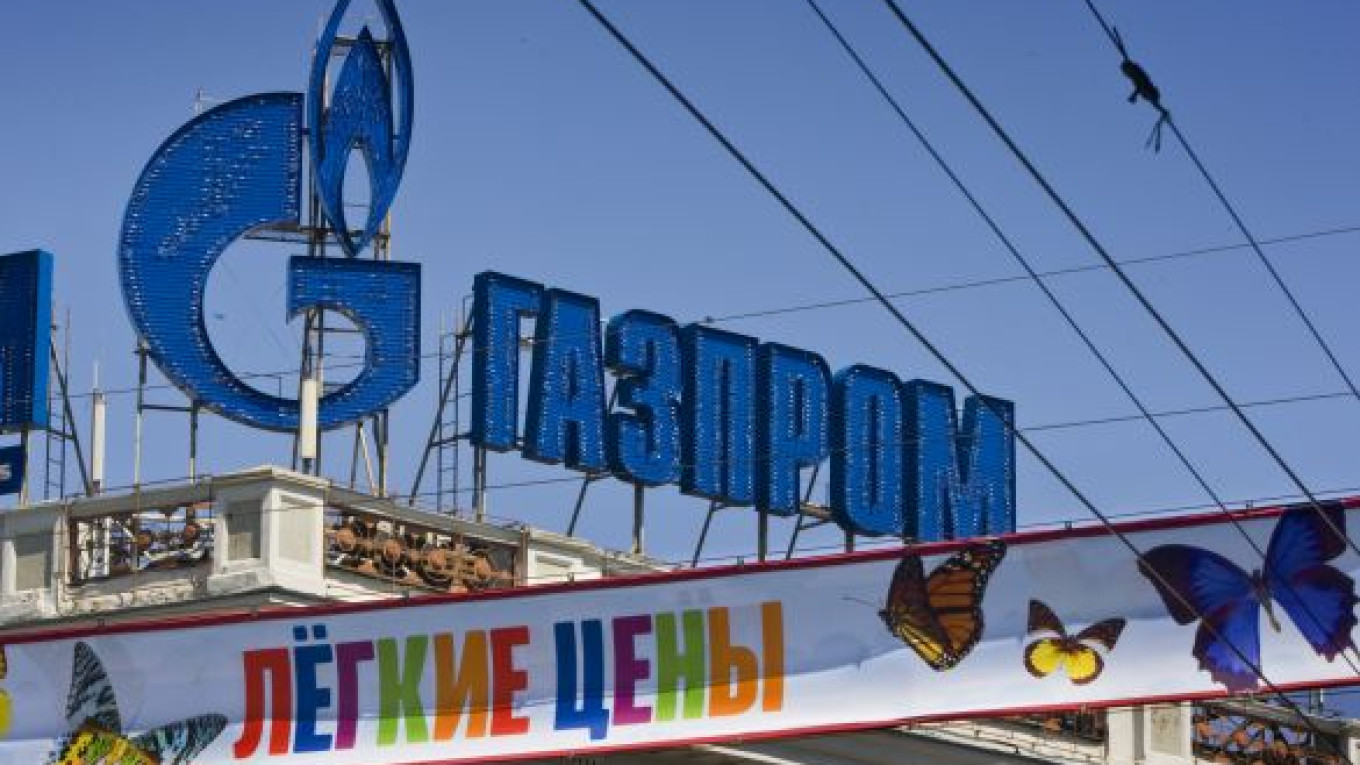
Gazprom on Monday carried out its threat to cut supplies to Belarus, ostensibly in an effort to recover a $192 million debt, in a move that closely followed a falling-out between Moscow and Minsk in their customs union talks.
The cuts will begin by reducing gas flows by 15 percent, a reduction the Russian side has said will not affect supplies to Europe. Flows may continue to be gradually reduced by as much as 85 percent.
"Belarus admits that it owes money for Russian gas but has offered to pay with cars, equipment and various surrogates," Gazprom CEO Alexei Miller told President Dmitry Medvedev at a meeting Monday. "According to our contract we are forced to limit gas exports proportionately to the size of debt," starting at 10 a.m. that day.
Belarus has contested a price hike on Russian gas supplies implemented at the beginning of the year and has continued paying at last year's price, $150 per 1,000 cubic meters, rather than at the current contract price of $174.
While the terms of the contract allow for Gazprom to gradually raise prices, the Belarussian side says the contract requires its gas prices to stay equal to Russian domestic prices, excluding tariffs and transport costs.
Belarus sent a delegation to Moscow on Sunday night to reach a settlement, but the deadline passed with no resolution.
Belarus said Monday that it planned to pay up, but that it might not be able to do so until Gazprom paid the $217 million it owes in gas transit fees.
"We'll pay. Maybe not today, but within two weeks we'll find a way. We'll borrow and pay it back," Belarussian Deputy Prime Minister Vladimir Semashko said Monday, Interfax reported. "If we are paid $217 million for transit, we are ready to pay $187 million."
Gazprom says the country owes a total of $192 million, over a four-month period. The country's next monthly bill it has to pay before June 25 amounts to $270 million.
Gazprom confirmed on Monday that Belarus' debts are comparable to the amount owed by the Russian side in transit fees. Sergei Kupriyanov, the company's spokesman, said Gazprom was unable to pay the transit fees because Belarus has refused to sign an receipt for services rendered.
Prime Minister Vladimir Putin assured Russia's European customers that their gas supplies wouldn't be interrupted because of the spat — saying that if Belarus went so far as to steal gas from its transit pipeline that Russia would be able to reroute through Ukraine.
Gazprom has to send 33 billion cubic meters via Belarus this year, and 105 bcm via Ukraine, Putin said. Ukraine can handle more than 130 bcm of transit, he added.
Deputy Prime Minister Igor Sechin said Monday that he had warned the European Commission about the risk of a cutoff, as did Gazprom with regard to its partners.
The European side said Monday that no gas shortages had been noted on its end of the pipeline.
"To our best knowledge there has not been any disruption of gas supply in any European Union member state today," Nicole Bockstaller, a press officer for the European Energy Commission, said in an e-mail Monday.
"We have strong evidence that a conflict between Russia and Belarus will be solved shortly," she said, adding that the commission "continues to closely monitor the energy situation between Russia and Belarus."
While the spat may bear some resemblance to the 2009 gas war between Russia and Ukraine, when cuts to Ukrainian supplies resulted in shortages throughout Western Europe, there is little chance of this situation happening again.
"Belarus' gas transit system has much less capacity than Ukraine's, and Germany, which gets Russian gas by way of Belarus, can get it through Poland and Ukraine," Alexander Nazarov, an analyst at Metropol, said in a note.
"Gazprom does not have as much to worry about with Belarus, and if the conflict is resolved in several weeks, the effect won't be over 1 percent of Gazprom's profit from exports," he said.
But there might be more at stake than just gas supplies. Belarussian President Alexander Lukashenko may be trying to gain leverage in another dispute with Russia — Belarus' role in the customs union, scheduled to go into effect July 1.
In May, Russia and Kazakhstan agreed to open a common customs space without Belarus, after negotiations on the topic stalled over oil tariffs.
Belarus is demanding that Russia charge no export tariffs for crude oil and refined products. Moscow has agreed to drop the tariff for the 6.3 million metric tons of oil that Belarus needs for domestic consumption but has said it will keep the tariff for any oil that Belarus plans to re-export.
The sides have since said the dispute will likely be settled before the union goes into effect, but negotiations are still ongoing.
"Lukashenko is partly bluffing, which he regularly has to do to maneuver and push for certain preferences when money is short and elections are coming," said Sergei Mikheyev, an analyst with the Center for Political Technologies.
A Message from The Moscow Times:
Dear readers,
We are facing unprecedented challenges. Russia's Prosecutor General's Office has designated The Moscow Times as an "undesirable" organization, criminalizing our work and putting our staff at risk of prosecution. This follows our earlier unjust labeling as a "foreign agent."
These actions are direct attempts to silence independent journalism in Russia. The authorities claim our work "discredits the decisions of the Russian leadership." We see things differently: we strive to provide accurate, unbiased reporting on Russia.
We, the journalists of The Moscow Times, refuse to be silenced. But to continue our work, we need your help.
Your support, no matter how small, makes a world of difference. If you can, please support us monthly starting from just $2. It's quick to set up, and every contribution makes a significant impact.
By supporting The Moscow Times, you're defending open, independent journalism in the face of repression. Thank you for standing with us.

Remind me later.