

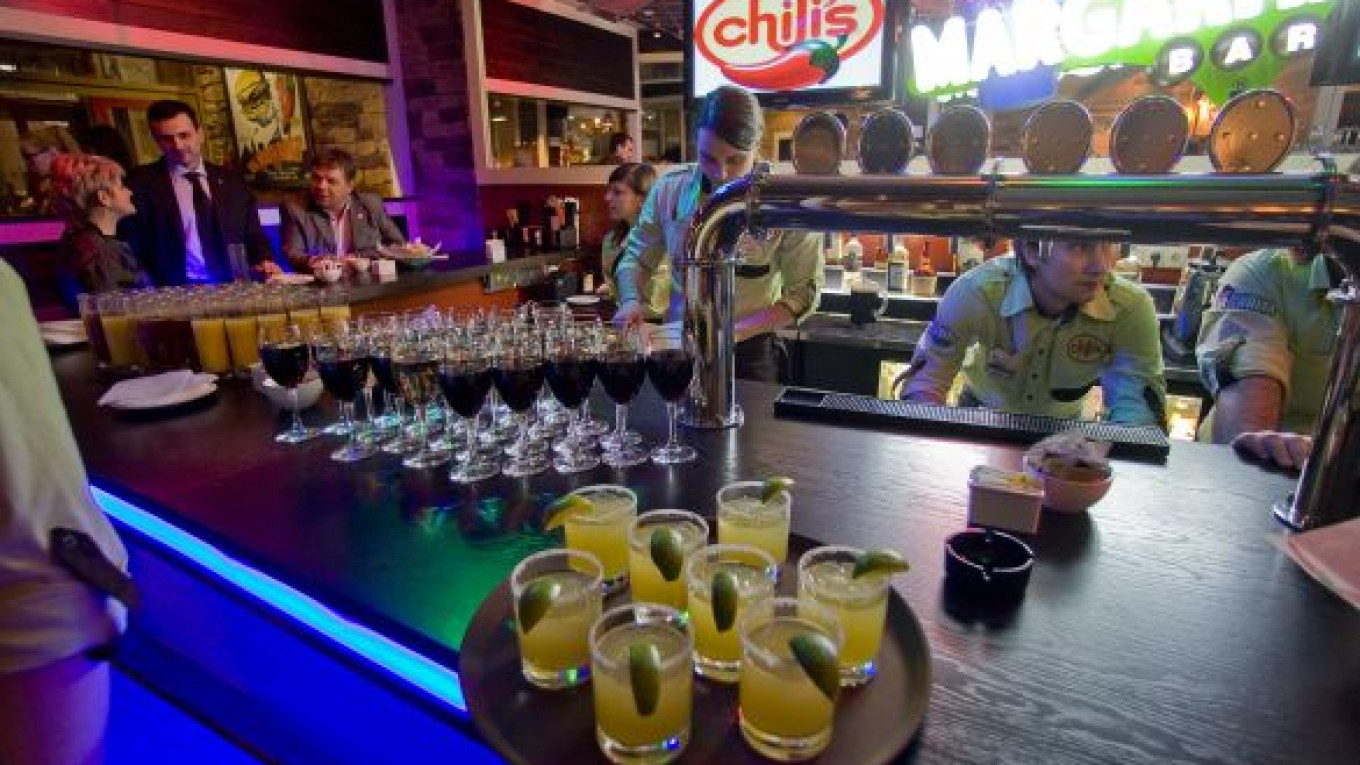
U.S. chain Chili’s opened its first Russian restaurant on Novy Arbat on Tuesday in what it called an effort to tap an underserved casual dining niche.
But while the Texas-based chain may expand the spectrum of flavor in the capital, its Moscow-style prices promise to leave room for more entrants in a niche currently covered by Moscow’s five Starlite Diners and T.G.I. Friday’s, which now operates 14 restaurants in Moscow and another 20 in other parts of Russia and Eastern Europe.
The Chili’s brand, which is represented by 1,500 restaurants in 34 countries, is known for serving up hearty Southwestern-style food at affordable prices and offering a particularly good black bean burger. The Trio Group will operate its restaurant in Russia under franchise.
Trio hopes to open 25 Chili’s restaurants in the country by 2017, with the next one being planned for Tverskaya Ulitsa in July. But Alexei Velilyev, general director of Trio, declined to comment on which cities would be targeted outside Moscow, saying only that other locations are “under consideration.”
Velilyev also declined to discuss how much has been invested in the new venture or the cost of the franchise rights.
Russia has witnessed a boom of Western-branded restaurant chains since McDonald’s opened its flagship outlet on Pushkin Square in 1990.
And franchises are still arriving. In January 2010, Burger King finally opened its first restaurants in Moscow.
U.S.-born T.G.I. Friday’s, often cited as Chili’s closest rival in terms of concept and price, arrived in 1997.
But executives from Chili’s parent company, Brinker, insist they don’t feel that they have missed the boat. “We identified a gap in the market for mid-range causal dining, and especially a lack of strong, spicy flavors from the U.S. Southwest,” said Carin Statz, president of global business development at Brinker.
If anything, understanding the experience of other U.S. franchises in Russia has been valuable to Chili’s, Statz said. “We know it’s not for the faint of heart.”
The established restaurants seem unruffled by the new arrival. “Of course, there’s still room for newcomers, why not?” a Starlite spokesman said.
Starlite co-founder Bernard Sucher said the diners have become part of customers’ personal routines, and loyalty is very high among its mostly Russian clientele. But he concedes that there are few choices on the market.
“In a country of the super-rich and the super-poor, it’s not surprising that mid-market restaurant offerings are limited. Costs to markets are aggravated by the usual uncertainties regarding property rights, the costs — direct and indirect — bureaucracy and corruption, as well as an uncompetitive supply chain,” Sucher said.
“Chili’s is a very estimable brand that we really respect,” said Valery Lee, head of communications at Rosinter, which holds the franchise for T.G.I. Friday’s. “The arrival of Western brands to the Russian restaurant market that we may witness today will positively impact the quality standards as well as service quality.”
The lack of concern about another market entrant is reflected in the segment’s pricing strategy. Chili’s has priced itself into the same niche as its competitors. While you could have a sit-down meal for two without alcohol for $20 (about 600 rubles) in the United States, Yury Begalov, owner of Trio, said he expects a single non-imbibing customer to spend close to 1,000 rubles ($33) — the same as T.G.I. Friday’s.
But the enthusiastic reaction of some of the capital’s American residents is not dampened. “There’s a Chili’s opening in Moscow? OMG!!!” one bank employee e-mailed.
It became clear at Tuesday’s opening that the initial local menu offering will not exactly mirror the full U.S. version. The signature black bean vegetarian burgers were not included in the array of fajitas, burgers and margaritas made by the U.S.-trained chefs and barmen and served to reporters during the opening.
Don Reagan, who is the Brinker group’s regional vice president of operations for Canada, the Middle East and Europe, revealed that the much-coveted veggie option would not initially be on the menu of their Russian operation.
“It just didn’t show up” on the firm’s market research, he said.
“Once we’ve introduced the traditional Chili’s menu, we’ll look at specializing it to the local market. And if the demand is there for a vegetarian option, absolutely,” Statz said.
Reagan, who has led the firm’s recent expansion to other BRIC countries, said they would be able to appease vegetarians in Moscow with items from its Indian menu, including a fajita featuring paneer cheese.
A Message from The Moscow Times:
Dear readers,
We are facing unprecedented challenges. Russia's Prosecutor General's Office has designated The Moscow Times as an "undesirable" organization, criminalizing our work and putting our staff at risk of prosecution. This follows our earlier unjust labeling as a "foreign agent."
These actions are direct attempts to silence independent journalism in Russia. The authorities claim our work "discredits the decisions of the Russian leadership." We see things differently: we strive to provide accurate, unbiased reporting on Russia.
We, the journalists of The Moscow Times, refuse to be silenced. But to continue our work, we need your help.
Your support, no matter how small, makes a world of difference. If you can, please support us monthly starting from just $2. It's quick to set up, and every contribution makes a significant impact.
By supporting The Moscow Times, you're defending open, independent journalism in the face of repression. Thank you for standing with us.

Remind me later.