

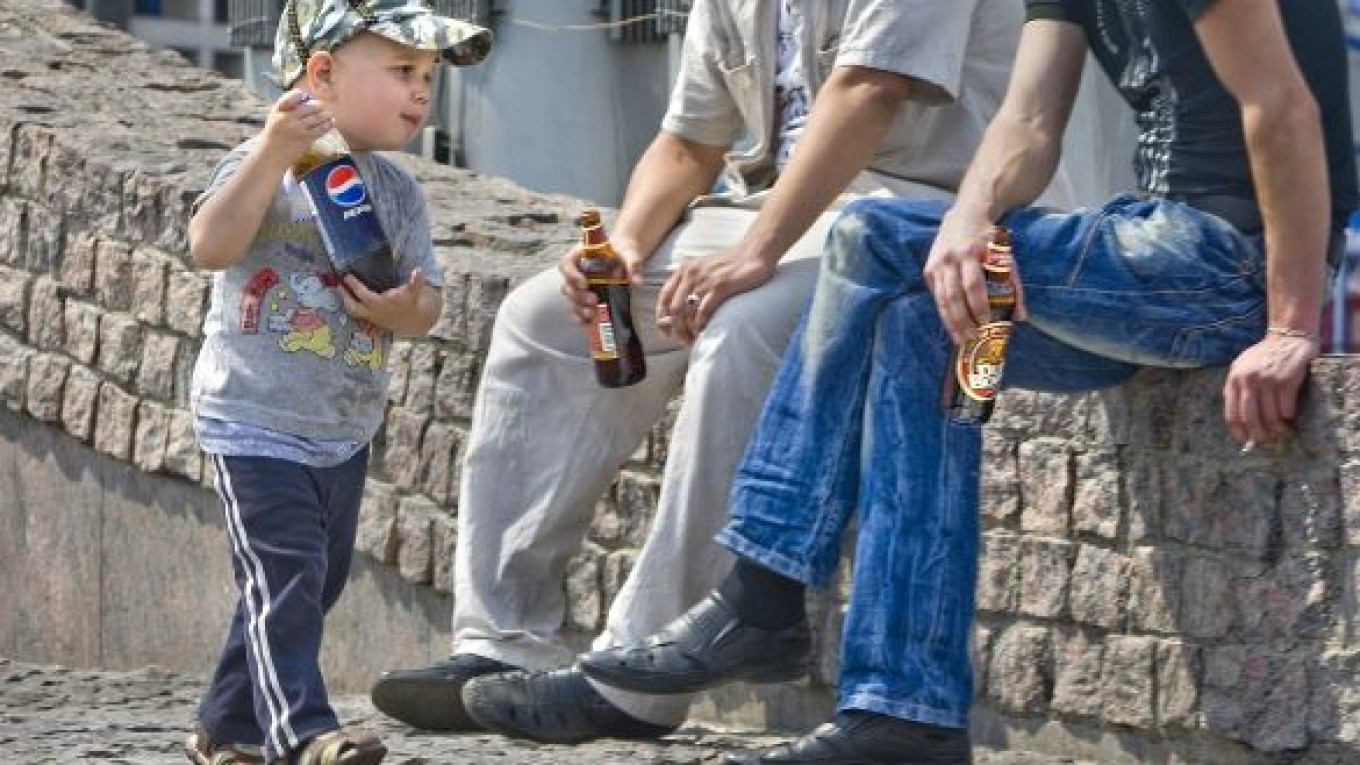
The State Duma is set to approve additional restrictions on alcohol sales in the country on Thursday that will end sales of beer at night and from kiosks.
Once passed, the law is expected to fully enter into force by January 2013, but it is already causing shock waves in the industry. Danish brewer Carlsberg, which owns local market leader Baltika, saw its stock fall to a near four-month low on Wednesday.
Under the proposed law, stores will be banned from selling drinks that contain more than 0.5 percent alcohol between 11 p.m. and 8 a.m. Currently, the threshold is beverages containing 15 percent alcohol or more.
Experts said it is unlikely that the restrictions will have an impact on alcohol consumption because people will simply buy the products earlier or illegally.
"This bill won't reduce alcoholism in the average citizen, but it won't harm the consumer and the producer either," said Vadim Drobiz, director of the Research Center for Federal and Regional Alcohol Markets. "Nighttime crime will be reduced as well as nighttime hooliganism."
The bill also expands the number of places where alcohol consumption is prohibited. These places will now include courtyards, elevators, building entryways, playgrounds, forests, parks and beaches.
Current laws punish drinking in restricted areas with a fine of 100 to 700 rubles ($3.57 to $28), while being drunk in these areas can lead to a prison stay of up to 15 days, Vedomosti reported.
Train stations and kiosks will be banned from selling any alcohol under the new bill. These semi-permanent outlets now account for one-third of Russia's beer sales — or about $6 billion, Reuters reported.
Some industry representatives welcomed the restrictions.
"Kiosks are a humiliating presence for a large city such as Moscow," said Alexander Romanov, general director of the Alcohol Manufacturers Committee. "Kiosks that sell alcohol should not exist."
"None of these kiosks has up-to-date permits for making sales if they ever had them," he said.
But other industry representatives fear that the ban on alcohol sales will make kiosks unprofitable and will force them to close. Alcohol sales account for almost half of the profits for kiosks, SABMiller's Kirill Bolmatov told Vedomosti.
Vyacheslav Kuzmin from the Union of Russian Brewers warned about the disappearance of kiosks from rural areas.
"They are often the only source where people can buy food products," Kuzmin said. "It will hit people hard."
Earlier reports indicating that kvas, which typically contains 1.2 percent alcohol, could be classified as alcoholic and also banned, sparked fears among consumers and producers. The Federal Alcohol Market Regulatory Service quickly reassured that the traditional fermented-bread drink — as well as kefir — are not covered by the new bill.
"Nobody is going to label kvas or kefir as alcoholic products," the service's press office said.
Kvas has seen a spike in demand in recent years with sales of the drink rising seven to eight times since 2005, according to an estimate by beverage company Deka.
A Message from The Moscow Times:
Dear readers,
We are facing unprecedented challenges. Russia's Prosecutor General's Office has designated The Moscow Times as an "undesirable" organization, criminalizing our work and putting our staff at risk of prosecution. This follows our earlier unjust labeling as a "foreign agent."
These actions are direct attempts to silence independent journalism in Russia. The authorities claim our work "discredits the decisions of the Russian leadership." We see things differently: we strive to provide accurate, unbiased reporting on Russia.
We, the journalists of The Moscow Times, refuse to be silenced. But to continue our work, we need your help.
Your support, no matter how small, makes a world of difference. If you can, please support us monthly starting from just $2. It's quick to set up, and every contribution makes a significant impact.
By supporting The Moscow Times, you're defending open, independent journalism in the face of repression. Thank you for standing with us.

Remind me later.