

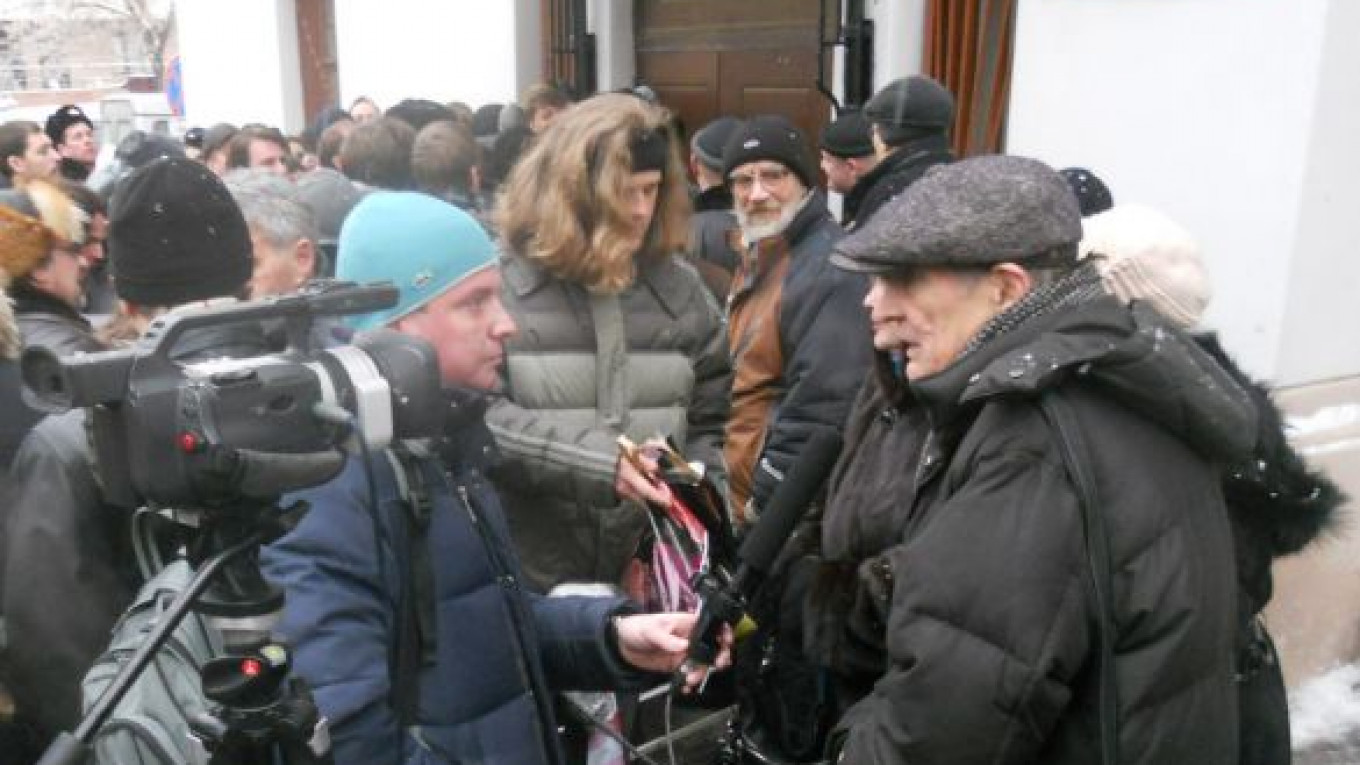
Russian playwright and director Mikhail Ugarov is convinced that artists are better off creating art and avoiding political statements.
None of that, however, is stopping Ugarov from speaking out about recent events in Russia and neighboring Belarus.
In response to the recent sentencing of Russian politician Boris Nemtsov to 15 days in jail, Ugarov publicly called for people to bring their old, unwanted chairs and leave them at the doorstep of the Tverskoi Court where the trial was held.
The reason? Because when Nemtsov was arraigned for resisting arrest at a political demonstration of opposition forces on Triumfalnaya Ploshchad on Dec. 31, he was told there were no chairs available and was made to stand for several hours.
“That is a kind of common sadism that is characteristic of our judicial system,” Ugarov said on Ekho Moskvy radio last week.
Ugarov last season staged the play ?€?One Hour Eighteen Minutes,?€? about the mistreatment of attorney Sergei Magnitsky, who was allowed to die in prison before charges of corruption were officially made.
Historically the Russian artistic community avoids politics, unless it is to side with the authorities and ensure that government financing of their work continues uninterrupted.
Dozens of prominent Russian artists signed a letter condemning Russian tycoon Mikhail Khodorkovsky following his arrest in 2003.
Nikita Mikhalkov, the Oscar-winning film director and head of the Russian Cinematographer’s Union, has made headlines repeatedly over the years with bold statements of support for Prime Minister Vladimir Putin.
Could this practice be changing?
Several events may have combined to give a wake-up call to Russian artists. These include a Nov. 25 lecture on the loss of freedom of speech in Russia by journalist Leonid Parfyonov; a nationalist rampage on Manezh Square on Dec. 11; protests in Minsk following the re-election of Belarussian President Alexander Lukashenko on Dec. 19; and the sentencing of Mikhail Khodorkovsky on a second round of charges in Moscow on Dec. 30.
The Khodorkovsky trial, during which the former oil magnate and his business partner Platon Lebedev were convicted of embezzlement in a verdict that was widely seen to be politically motivated, increasingly drew the attention of figures from the Russian entertainment world.
Film director Eldar Ryazanov, actors Liya Akhedzhakova, Natalya Fateyeva and Igor Yasulovich, artist Andrei Bilzho and others attended the trial and spoke out in interviews.
Not surprisingly, the Internet and social media played a large role in this phenomenon.
Responding to the protests in Minsk and the violence and arrests that followed, Ugarov published statements by various Russian playwrights on the web site Grani.ru.
Judging by those declarations, the authors see events in Minsk and Moscow as part of a general geographical trend.
Maxim Kurochkin, a citizen of Ukraine and one of the top Russian-language playwrights, called Putin, Lukashenko and Ukrainian President Viktor Yanukovych ?€?an unjust constellation. Stars of one school, brothers and mutual emanations.?€?
Anna Yablonskaya, one of the most talked-about new Russian playwrights, compared the leaders of Ukraine, Belarus and Russia to characters out of a bad and humorless Hollywood script.
?€?If you don?€™t live in Ukraine, Belarus or Russia, you can only relate to their leaders as to comic book heroes,?€? Yablonskaya wrote.
Mikhail Durnenkov, whose play ?€?Drunks,?€? co-written with his brother Vyacheslav Durnenkov, was a hit in London in 2009, reminisced about reading dissident authors Alexander Solzhenitsyn, Varlam Shalamov and Andrei Sinyavsky in his youth. He said he always asked himself one question after reading their books: How would he act in a similar situation?
?€?And before our very eyes this country is literally turning into that country, the one in those books, and that question I used to ask myself in my youth is growing more and more timely,?€? Durnenkov wrote on the web site.
Dissatisfaction with authorities has numerous sources.
Popular St. Petersburg actor Mikhail Trukhin grabbed international attention when he wrote an open letter lambasting St. Petersburg Governor Valentina Matviyenko for the city?€™s failure to clean the city?€™s streets of snow and ice. Unsafe roads and sidewalks in St. Petersburg led to several deaths in December.
Ugarov is skeptical, however, that Russia?€™s creative community is ready to rise up in protest. He told Ekho Moskvy that he suspects 90 percent of the people working in Moscow?€™s theaters are little more than ?€?theatrical livestock,?€? who only want to be left alone to ply their trade.
Indeed, famed Taganka Theater director Yury Lyubimov met with Putin days before the Khodorkovsky verdict in late December and gratefully accepted the Prime Minister?€™s promise to build him a new international theater center. ?
It seemed a far cry from 1982 when Lyubimov was stripped of his Soviet citizenship by the Kremlin for daring to disagree with the authorities.
A Message from The Moscow Times:
Dear readers,
We are facing unprecedented challenges. Russia's Prosecutor General's Office has designated The Moscow Times as an "undesirable" organization, criminalizing our work and putting our staff at risk of prosecution. This follows our earlier unjust labeling as a "foreign agent."
These actions are direct attempts to silence independent journalism in Russia. The authorities claim our work "discredits the decisions of the Russian leadership." We see things differently: we strive to provide accurate, unbiased reporting on Russia.
We, the journalists of The Moscow Times, refuse to be silenced. But to continue our work, we need your help.
Your support, no matter how small, makes a world of difference. If you can, please support us monthly starting from just $2. It's quick to set up, and every contribution makes a significant impact.
By supporting The Moscow Times, you're defending open, independent journalism in the face of repression. Thank you for standing with us.

Remind me later.