

Konstantin Raikin has evolved a solid working relationship with Alexander Ostrovsky of late. His interpretation of a play he calls “Money” is the fourth time he and his Satirikon Theater have turned to the seminal 19th-century playwright in recent years.
As he did with “A Profitable Post,” the most successful of the previous Ostrovsky productions, Raikin shook the original up, dressed it in modern clothes, and filled its hoods, eccentrics and victims with a contemporary sensibility.
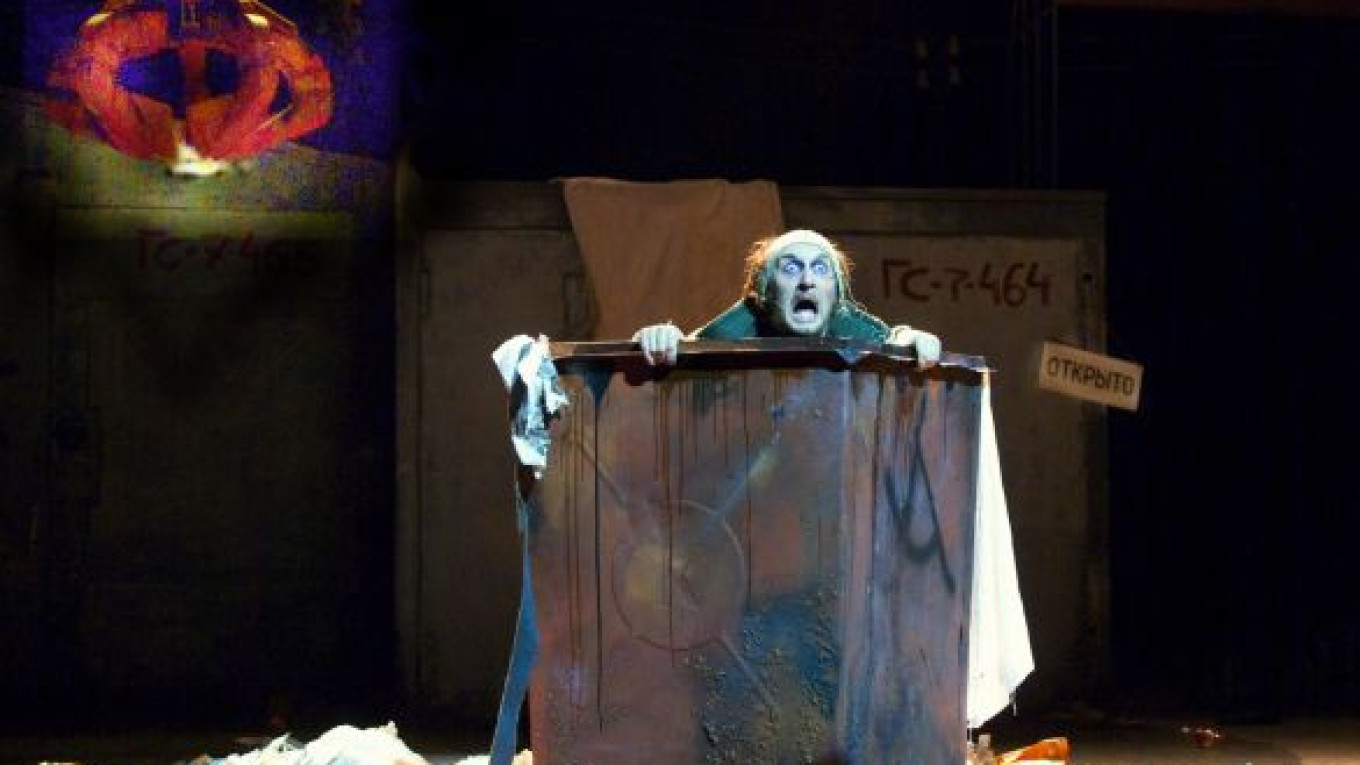
Dmitry Razumov created a set that anyone who has ever taken a commuter train through the outskirts of Moscow will recognize readily: graffiti-covered tin box garages; bad electrical wiring on crumbling walls; a burned-out, abandoned automobile; rusty trash cans; discarded scraps of paper flying whichever way the wind blows.
The people here are as common as a 5 kopek coin. One man runs a fruit stand. Another lives in squalor with his wife and niece. One woman lives alone with her son in a dilapidated building. A family with a daughter has pretensions of class and demonstrates that through belligerent behavior and the daughter’s penchant for dressing up glamorously in totally inappropriate ways.
All have big, though obscure plans, and most are suspicious or covetous of their neighbors.
Raikin’s “Money” proves again that Ostrovsky, who wrote his plays more than 130 years ago, captured the spirit of the Russian experience as precisely as any writer ever has in any genre. Ostrovsky had no idea what people would look and sound like in 2010, but he sure knew what they would be like.
“Money” is the adaptation of a play whose original title, drawn from a folk saying, might be rendered as “Rags to Riches.” It tells the story of the miser Krutitsky, his innocent, impressionable and sensitive niece Nastya, and the people around them who jockey for position and status in a crowded, low-ceilinged world.
Raikin added a bevy of nameless and almost faceless thieves and thugs who bring color to the story with stylish songs and dances. Yelizaveta Martines stands out in this group as the head songstress.
Things get moving slowly with an extended bit of exposition.
We learn about Domna Migacheva (Yelena Butenko-Raikina), in this interpretation a railway worker who loves to talk and adores her son Yelesya (Anton Yegorov). Living next to them are the uppity neighbors with the fruit stand — Yepishkin (Anton Kuznetsov), his lusciously pompous wife Fetinya (Lika Nifontova) and their snooty, sex-bomb daughter Larisa (Yekaterina Malikova).
Not surprisingly in this grungy corner of town, Larisa is about the most exciting thing Yelesya has ever set his eyes on. And since she is always on the lookout for something to do, they quickly find their way into each other’s arms.
But the gist of the story is what transpires around Krutitsky (Denis Sukhanov). Grumpy and stingy, he secretly keeps wads of money sewed in his jacket, although he claims to be flat broke. This complicates things for his niece (Nina Guseva), who is embarrassed to confess her poverty to her suitor Modest (Alexei Koryakov).
Sukhanov plays Krutitsky as something of a subhuman. Irritable, shrill, devious and distrustful of everyone, he slinks around with a snake-like gait. It is no wonder that people don’t like him and suspect that there is something dangerous about him.
That is where the tables are turned, however, for in a moment of weakness, when Krutitsky loses the money sewn in his coat, he breaks down painfully as only a vulnerable, sensitive person can.
Here we see in his frightened eyes and furtive gestures the justification for his eccentric, conniving behavior. He knows that he lives among predators who will swallow him in a minute if he gives them the chance.
Indeed, that moment of reckoning is not long in coming. Yepishkin — out of everyone’s view, of course, including ours — has the crew of thugs all over Krutitsky’s back when the spooked miser wanders into a dark park at night.
It’s not entirely clear what happens there, although Krutitsky is no more to be seen, and Yepishkin is seen quietly handing out cash payments to each thug returning from the wood.
Raikin’s production is a sometimes-odd mix of musical theater, situation comedy, social satire and bloody crime thriller. In fact, those chaotic stylistics match well the variegated texture of modern Russian life.
If this production is sometimes slow in revealing the story it tells, it is always right on target. You would expect nothing less from Ostrovsky, or from Raikin, for that matter.
“Money” (Dengi) plays Thursday, June 24, at 7 p.m. at the Satirikon Theater, located at 8 Sheremetyevskaya Ulitsa. Metro Rizhskaya. Tel. 689-7585, 689-7844. www.satirikon.ru. Running time: 3 hours, 30 minutes.
A Message from The Moscow Times:
Dear readers,
We are facing unprecedented challenges. Russia's Prosecutor General's Office has designated The Moscow Times as an "undesirable" organization, criminalizing our work and putting our staff at risk of prosecution. This follows our earlier unjust labeling as a "foreign agent."
These actions are direct attempts to silence independent journalism in Russia. The authorities claim our work "discredits the decisions of the Russian leadership." We see things differently: we strive to provide accurate, unbiased reporting on Russia.
We, the journalists of The Moscow Times, refuse to be silenced. But to continue our work, we need your help.
Your support, no matter how small, makes a world of difference. If you can, please support us monthly starting from just $2. It's quick to set up, and every contribution makes a significant impact.
By supporting The Moscow Times, you're defending open, independent journalism in the face of repression. Thank you for standing with us.

Remind me later.