

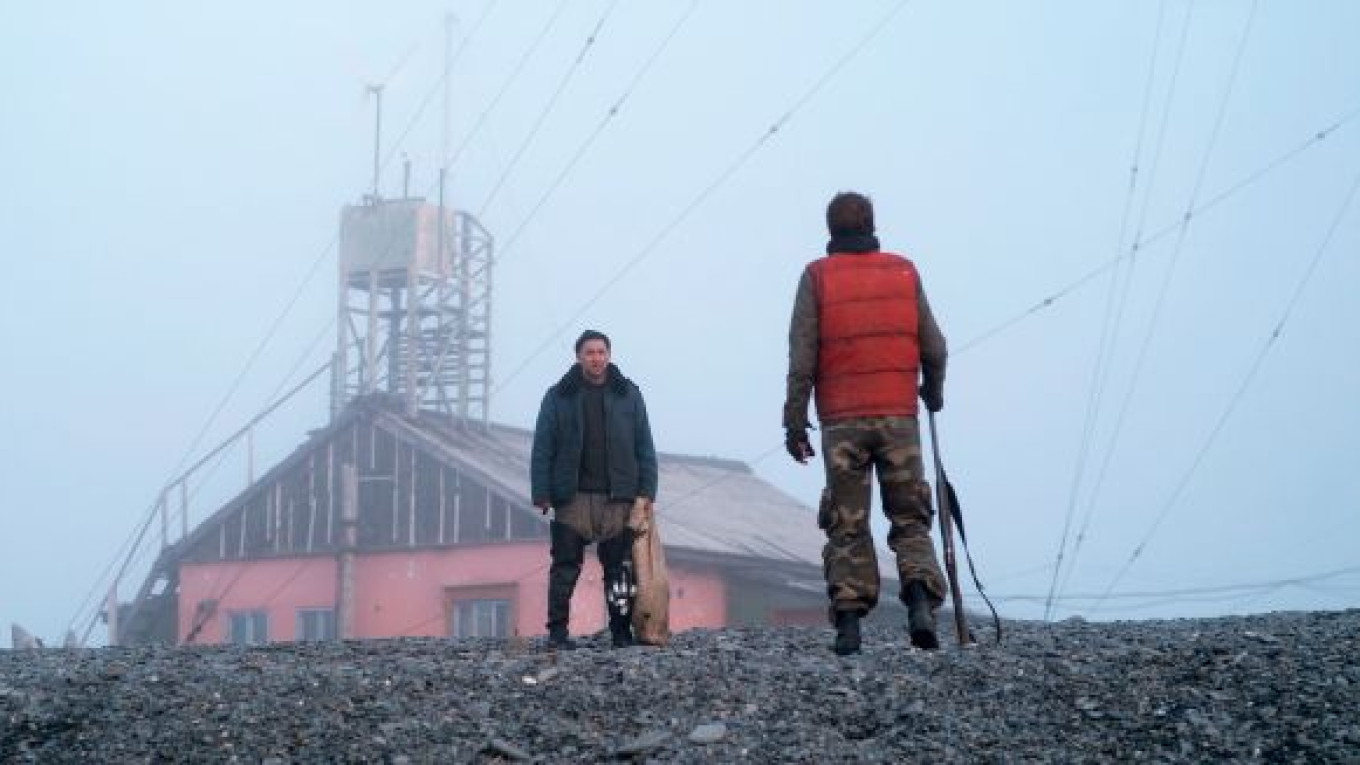
Alexei Popogrebsky, director of the much-admired film “How I Ended This Summer,” has a big scraggly beard that, like his film, is linked to the Arctic. Speaking recently in a central Moscow cafe, the filmmaker told of how his childhood reading brought him to Chukotka, of what it was like to spend three months there and of an encounter with a polar bear that ran the wrong way.
“How I Ended This Summer” is about a middle-aged researcher and a student intern on watch at a polar station on an island in Chukotka, Russia’s northeastern-most tip. In long, poetic shots, a tense thriller unfolds when the intern learns by radio that the researcher’s family has suffered a grave accident and delays informing him.
Popogrebsky has been drawn to the Arctic since reading the diaries of Arctic explorers many times in his childhood.
“Every winter I was so utterly depressed. I hated winter, I hated this darkness most of the day, this lack of freedom,” he said, “Those people stayed in that for years.”
Born in 1972 to the family of screenwriter Pyotr Popogrebsky, Alexei Popogrebsky studied psychology at Moscow State University. He began to collaborate on films with his friend and film theory student Boris Khlebnikov in 1994. They premiered their debut feature “Koktebel,” about a father and son on a journey to Koktebel in the Crimea, in 2003, and the film drew much admiration on the festival circuit.
After writing and directing his second film “Simple Things,” in 2007 about a corrupt doctor who is asked to help an elderly patient die in exchange for a valuable painting, Popogrebsky began work on the Arctic thriller.
“I realized that two men stuck at a polar station would be an ideal crystallization of human experience and character,” he said.
Critics have noted how well Popogrebsky uses locations in his films. A genuine gunshot hole in the ceiling of the polar station in “How I Ended This Summer,” for example, fit perfectly into the story of the insanity of polar isolation.
The director found the polar station through a geographer at Moscow State University, and the trip to survey the location was his first visit to the Arctic.
“I had a romanticizing view of these special people living here. That came mostly from the Soviet idealization of pilots and polar explorers. What I saw basically was a bunch of guys — older guys or guys my age — and a few women, the wife of the head of the station. They were normal people, like people I would meet on a construction site, basically.”
The film crew got a taste of isolation and had to tend to many basic tasks to survive, like building their own stoves out of metal barrels.
“The word that I find that best describes everything is ‘essential.’ Everything we did was essential. Things that we do in the city are not essential,” he said. When he returned to Moscow after shooting, he found that he had to cut himself off from the Internet, television and city life. He kept the beard that had grown in the Arctic.
The pace of life at the polar station is felt in the slow and thoughtful pace of the film.
“We felt that as we submerged into life there, the style shaped itself, with our help,” he said. “It would be very, very wrong to make a fast-paced film about life there because that would be fake, that would be untrue. If you look at the guys there, they are living in slow motion.”
Reviewers have criticized the film’s pace and the lack of clear motivation for the young intern’s delay in informing the older researcher of his family’s tragedy. Popogrebsky laughed with agreement that the film is indeed slow, but he was firm about his work.
“Motivation is rationalization post factum of what we did. There are a lot of things that we do without realizing why, and only afterward we make justifications … Motivation is never as clear-cut as it is in films.”
The crew themselves also saw the dangers of living in the Arctic.
Popogrebsky eagerly told the most vivid story of the crew’s three months in Chukotka. While shooting a polar bear running toward the camera — a crew member had frightened the bear to run that way with a gun shot — the bear veered away from the crew that was filming and unexpectedly ran straight into the rest of the crew, who were drying their clothes on the shore. The crew then chased the bewildered bear into the Arctic sea with burning wood.
Coming off his Arctic adventure, Popogrebsky plans to shoot his next film on what he sees as an equally challenging location: a sound stage.
“A sound stage is something that I have not really had a chance to tackle. To me it should be even more difficult because it can be claustrophobic and demoralizing. Everything is fake, and I’m used to shooting in grim settings, on the street or in actual apartments.”
The new film will include original music and a first for Popogrebsky’s work — a female protagonist.
“It will be a quest that entirely happens in one apartment, an apartment to which you never find an end in the film. It goes from one chamber to another chamber to another chamber, and the story takes you from chamber to chamber,” he said.
Popogrebsky has only just begun developing the new film, and as we ended, his eyes glimmered with excitement about it.
A Message from The Moscow Times:
Dear readers,
We are facing unprecedented challenges. Russia's Prosecutor General's Office has designated The Moscow Times as an "undesirable" organization, criminalizing our work and putting our staff at risk of prosecution. This follows our earlier unjust labeling as a "foreign agent."
These actions are direct attempts to silence independent journalism in Russia. The authorities claim our work "discredits the decisions of the Russian leadership." We see things differently: we strive to provide accurate, unbiased reporting on Russia.
We, the journalists of The Moscow Times, refuse to be silenced. But to continue our work, we need your help.
Your support, no matter how small, makes a world of difference. If you can, please support us monthly starting from just $2. It's quick to set up, and every contribution makes a significant impact.
By supporting The Moscow Times, you're defending open, independent journalism in the face of repression. Thank you for standing with us.

Remind me later.