

More than 40 years after his death, Kornei Chukovsky remains one of the country’s best-loved children’s authors, and his classic books such as “Doctor Aibolit,” about a doctor who speaks to animals, are still widely read.
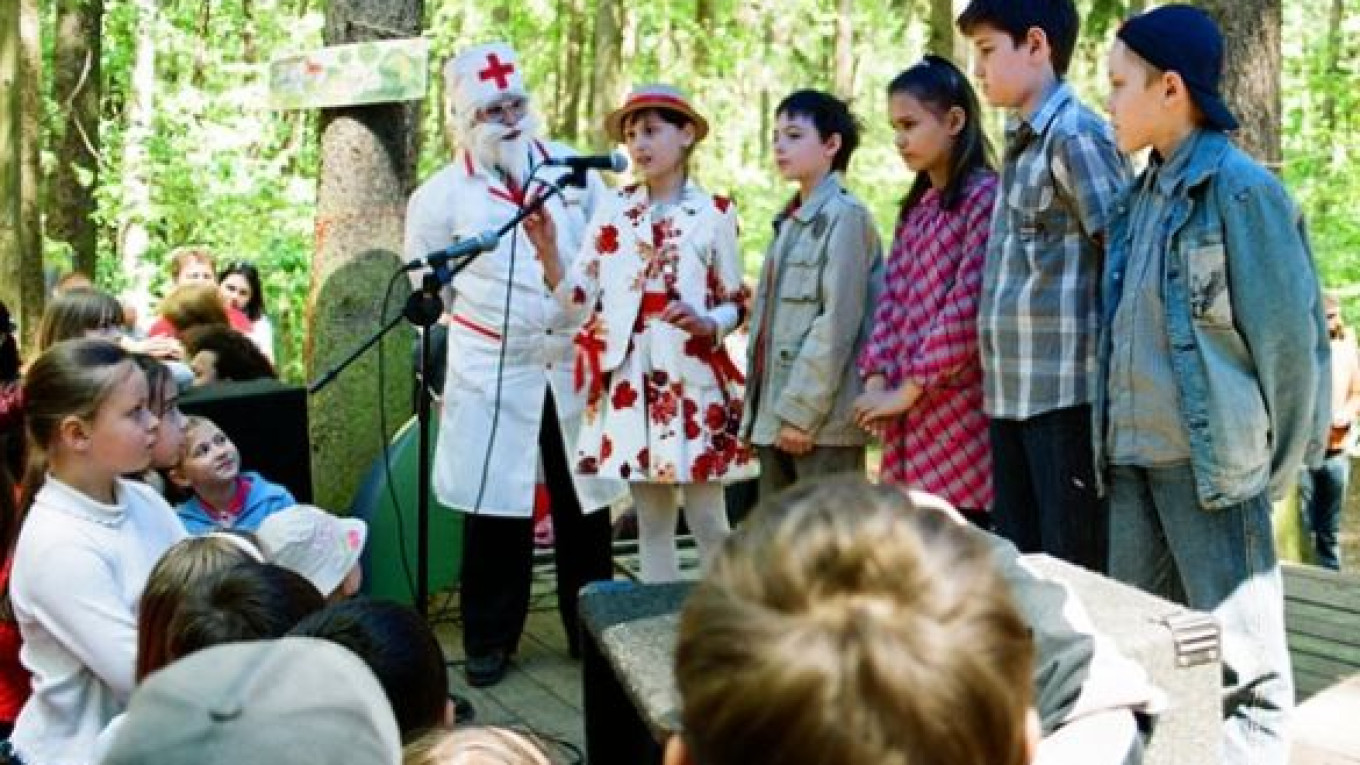
Fans of the author, who was born Nikolai Korneichuk and took Kornei Chukovsky as his pen name, can take part in a tradition started by the author himself as the “Goodbye Summer” party for children takes place at his dacha just outside Moscow on Sept. 12.
“The campfires at Chukovsky’s house were set up by the author in 1955,” said Sergei Belorusets, head of the Chukovsky children’s festival and one of the organizers of the end-of-summer event. “His house was always full of children; he invented different games to play with kids.”
Chukovsky set up two annual festivals at his dacha: the “Welcome Celebration of Summer,” in June, and the “Goodbye Summer” party, where children gather around a campfire on the second weekend in September to listen to stories and sing songs at the dacha in the writers’ village of Peredelkino, just outside Moscow.
The tradition was revived 10 years ago, and this year organizers are celebrating the 55th anniversary of the first campfire.
Chukovsky wrote short stories and poems, whose “clockwork rhythms and air of mischief and lightness,” as one critic wrote, have captivated children — although not always parents.
One of his most famous poems is “The Crocodile,” which he told to his son on a train journey. His son remembered the tale, and that was how the poem got written down when they returned.
“I like reading Chukovsky to my daughter Arina, who is 3 years old,” said Valentina Shadrina, 34, a housewife. “She enjoys the rhythm of the verses and memorizes them very quickly.”
“Some very little children seem to be actually afraid of the characters. You have to be very careful when reading Chukovsky to a child — some very sensitive listeners might not like it,” said Tatyana Stupnikova, a speech therapist for preschoolers. Poet Anna Akhmatova once said Chukovsky’s children’s verse was sadistic, a charge that has been made about many children’s authors, including English writer Roald Dahl.
Apart from being a children’s author, Chukovsky was also a professional reporter, translator and psychologist, who had a great impact on the issue of childhood education. His most famous work about children — rather than for children — is “From Two to Five,” which came out in 1933, about children’s speaking abilities.
He was also a writer, who, according to his diaries, tried to help other Soviet writers when they fell afoul of the authorities.
When Boris Pasternak, who lived not far from Chukovsky in Peredelkino, won the Nobel Prize, Chukovsky was the only official writer to congratulate him.
After Chukovsky’s death in 1969, his dacha was turned into a museum, and visitors can take tours around the old wooden house that contains his vast book collection.
Many of the books are in English. Before the Revolution, Chukovsky worked as a reporter in London, where he met writers H.G. Wells and Arthur Conan Doyle. He would later translate American poet Walt Whitman, as well as Daniel Defoe and Rudyard Kipling.
This year, the “Goodbye Summer” party will be attended by a number of famous children’s poets, such as Eduard Uspensky and Gennady Gladkov. As usual, there will also be a campfire and songs.
The “Goodbye Summer” party takes place on Sept. 12 at noon. Kornei Chukovsky House Museum, 3 Ulitsa Serafimovicha. Peredelkino, Moscow region. Tel. 593-2670. Free entrance.
A Message from The Moscow Times:
Dear readers,
We are facing unprecedented challenges. Russia's Prosecutor General's Office has designated The Moscow Times as an "undesirable" organization, criminalizing our work and putting our staff at risk of prosecution. This follows our earlier unjust labeling as a "foreign agent."
These actions are direct attempts to silence independent journalism in Russia. The authorities claim our work "discredits the decisions of the Russian leadership." We see things differently: we strive to provide accurate, unbiased reporting on Russia.
We, the journalists of The Moscow Times, refuse to be silenced. But to continue our work, we need your help.
Your support, no matter how small, makes a world of difference. If you can, please support us monthly starting from just $2. It's quick to set up, and every contribution makes a significant impact.
By supporting The Moscow Times, you're defending open, independent journalism in the face of repression. Thank you for standing with us.

Remind me later.