

Russian musicians, Russian artistic direction and Russian money have combined forces for the past two Augusts to present a lavish festival of classical music in the French Alpine resort town of Annecy.
Russian musicians are no strangers to the rest of the world these days and play an important part in musical life on every continent. A few Russians also provide artistic direction to foreign festivals. But to find a wealthy Russian individual acting as principal sponsor of a music festival outside of Russia is probably unique.
What is called the Annecy Classic Festival had its genesis two summers ago, when pianist Denis Matsuev appeared at another French festival not far from Paris. The festival director, pianist and teacher Pascal Escande, mentioned that he was closing down a smaller-scale festival that he had run for a decade in Annecy. Matsuev, who had played in Annecy and thought it particularly beautiful place to make music, expressed his regret and offered to introduce Escande to a friend who might be willing to support a festival there on a larger scale.
The friend in question was Moscow businessman Andrei Cheglakov, a Russian pioneer in computer software now engaged in developing a luxury-class Russian automobile. And the introduction took place later in 2009, following a concert by Matsuev in Geneva. Cheglakov knew Annecy well and a few years earlier had acquired a chalet not far from the town. With little hesitation, he agreed to give the proposed festival his backing.
With Matsuev and Escande as its co-artistic directors, and additional support from the Department of Haute-Savoie, of which Annecy serves as capital, and other French government sources, the first festival came into being during the final days of August last year. Matsuev, of course, was one of its stellar attractions, together with violinist Vladimir Spivakov, violist Yury Bashmet and the St. Petersburg Philharmonic Orchestra, under the baton of its long-time artistic director Yury Temirkanov.
The Russian contingent on hand for this year’s second Annecy Classic Festival once again included the Temirkanov and the St. Petersburg Philharmonic, as well as their hometown rival, the Mariinsky Orchestra, with Valery Gergiev on the podium, violinist Sergei Krylov, pianist and composer Sergei Dreznin and four very talented young string players of Moscow origin. Among the musicians joining them were two noted French sibling pairs, the duo piano team of Katia and Marielle Labeque and the violinist and cellist brothers Renaud and Gautier Capucon, plus the dean of French organists, Jean Guillou.
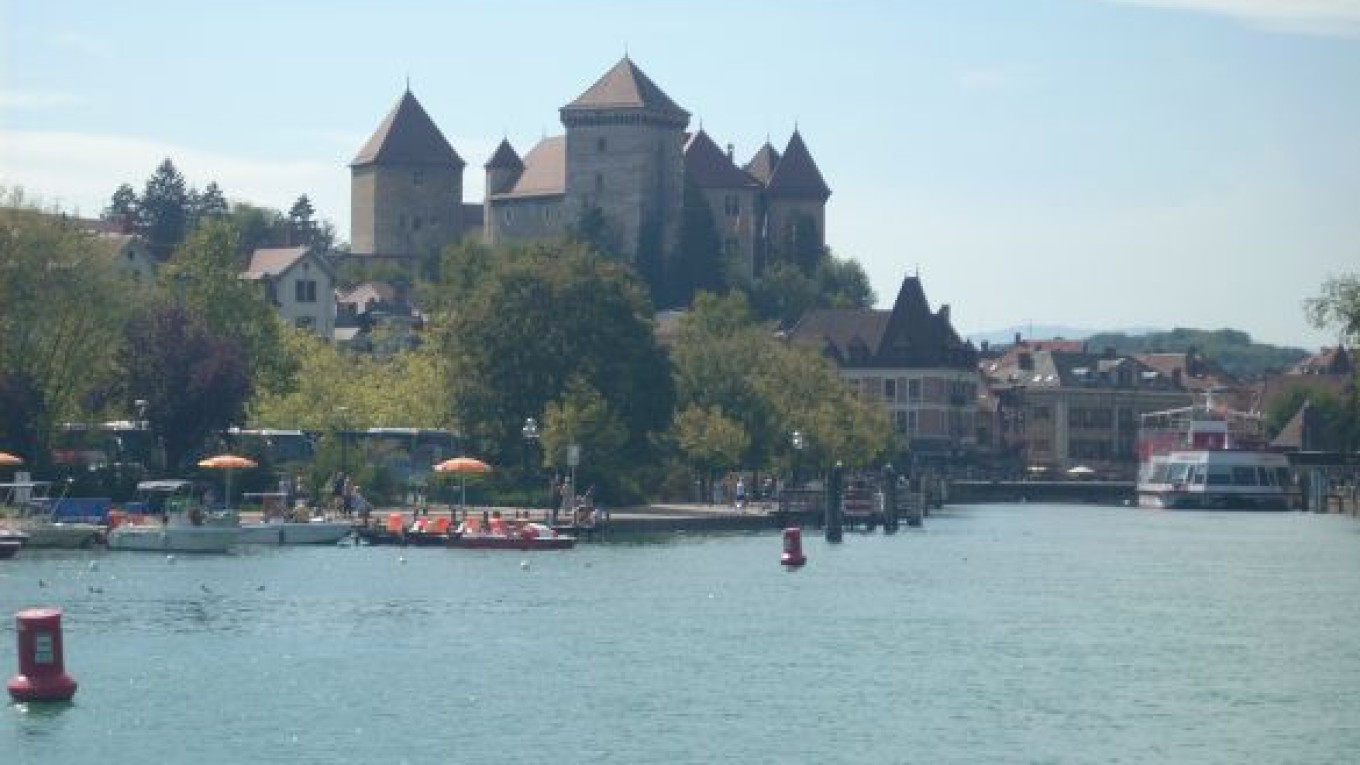
Annecy has no shortage of venues for staging a music festival, including, among its antiquities, the early 16th-century Cathedral of Saint Pierre and the Chateau-Museum, dating from the 12th to 16th centuries, that towers above the town and, of modern origin, the posh L’Imperial Palace hotel and enormous Church of Sainte Bernadette. In all cases, the acoustics are superb.
I managed to catch the last five festival concerts and each of them brought music-making of exceptionally high quality. Matsuev gave his usual dazzling performance of Pyotr Tchaikovsky’s Piano Concerto No. 1 and displayed a sensitivity I had never before heard from him in a concert of chamber music by Tchaikovsky, Sergei Rachmaninov and Bela Bartok. Temirkanov led his orchestra in sterling performances of symphonies by Tchaikovsky and Johannes Brahms. And a marathon evening of recitals by four widely hailed young pianists proved particularly memorable for the elegant playing of Japan’s Kotaro Fukuma in seldom-performed etudes by Franz Liszt and the wonderfully impetuous reading given the same composer’s familiar Sonata in B minor by Georgian Khatia Buniatishvili.
A 45-minute drive from Geneva, Annecy sits at the northern end of a jewel-like 14-kilometer-long lake that bears its name. The Lake of Annecy, flanked by jagged Alpine peaks to the east and gentler slopes to the west, is dotted along its shores with picturesque villages and the occasional chateau. Founded at the beginning of the 12th century, some four decades earlier than Moscow, Annecy boasts a carefully preserved old town, intersected by a series of canals for which it has been somewhat extravagantly dubbed the “Venice of the Alps.” A year-round sports and holiday center, the town and its surrounding region are also something of a gastronomical paradise, featuring the famous Haute-Savoie cheeses, fresh-water perch and other fish from the lake and remarkably fine local wine.
Annecy made news earlier this year as a finalist in contention to host the 2018 Winter Olympic Games. Along with Munich, Germany, it eventually lost out to South Korea’s Pyeongchang — and perhaps all for the best, in the opinion of many, as hosting the Olympics might well have caused irreparable damage to Annecy’s distinctive beauty and charm.
The third Annecy Classic Festival is due to take place at the end of next August, possibly with a major orchestra in residence throughout and undoubtedly with Matsuev and other eminent Russian musicians continuing to play a leading role.
A Message from The Moscow Times:
Dear readers,
We are facing unprecedented challenges. Russia's Prosecutor General's Office has designated The Moscow Times as an "undesirable" organization, criminalizing our work and putting our staff at risk of prosecution. This follows our earlier unjust labeling as a "foreign agent."
These actions are direct attempts to silence independent journalism in Russia. The authorities claim our work "discredits the decisions of the Russian leadership." We see things differently: we strive to provide accurate, unbiased reporting on Russia.
We, the journalists of The Moscow Times, refuse to be silenced. But to continue our work, we need your help.
Your support, no matter how small, makes a world of difference. If you can, please support us monthly starting from just $2. It's quick to set up, and every contribution makes a significant impact.
By supporting The Moscow Times, you're defending open, independent journalism in the face of repression. Thank you for standing with us.

Remind me later.