

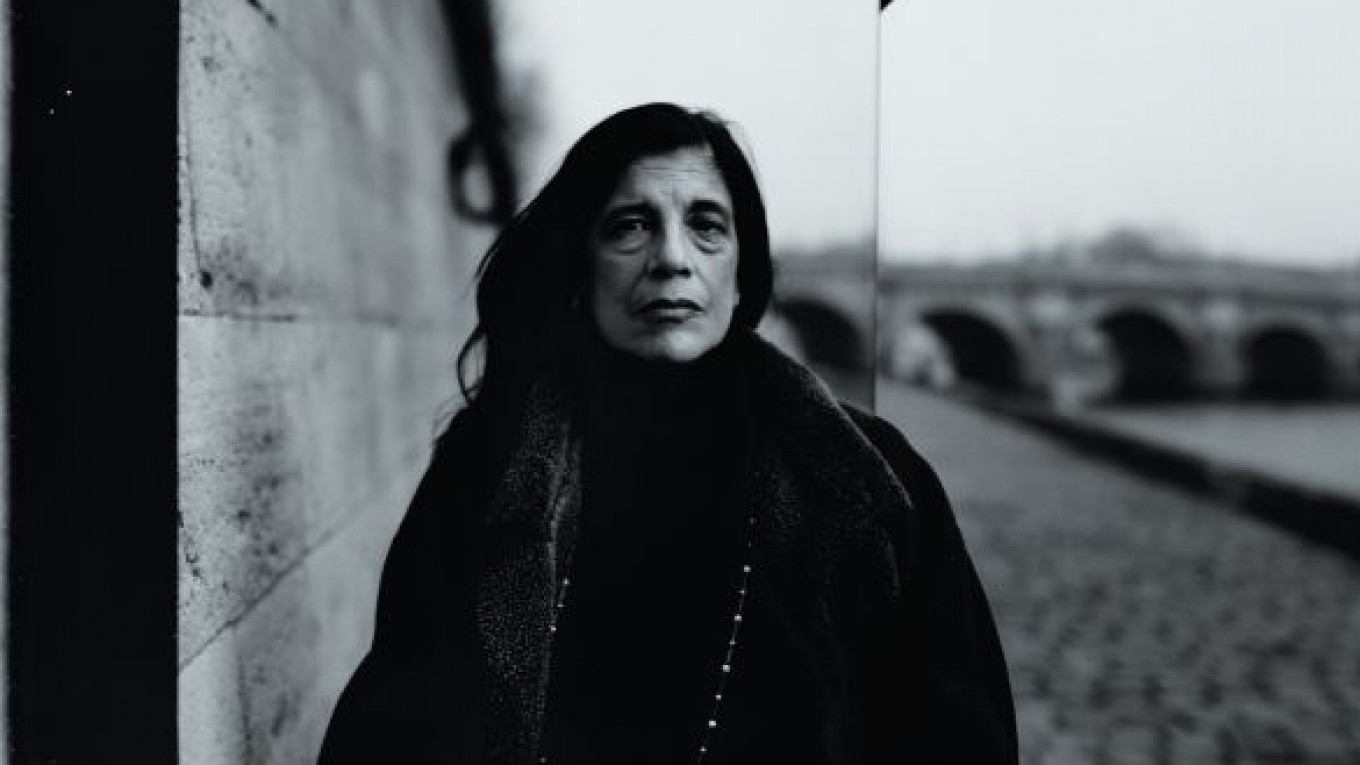
ST. PETERSBURG — Sitting in the apartments of Tsar Alexander I in the State Hermitage Museum, Annie Leibovitz is a generous presence in an otherwise daunting stateroom. At 62, she is possibly the world's most famous photographer, and during the past four decades has trained her lens on the great and the good — and on a fair share of monsters, too. It wouldn't be an exaggeration to say that few photographers can lay claim to quite as much psychic real estate as Leibovitz. From the Rolling Stones to the Clintons, she has photographed just about anyone who is anybody, creating some of the 20th century's most memorable portraits in the process.
The exhibition now on view at the Hermitage brings together a selection of Leibovitz's photography from 1990 to 2005 — 15 years that saw important changes in her personal life. "It was a book before it was a show, and that's probably the reason I felt comfortable with the imagery going into it," she said in an interview.
"Some of the images makes it seem like, 'are we trespassing?' But in the shelter of the book covers, it felt protected. So it was interesting to translate it into a show."
Now out in the world, and hung against the pastel walls of the Winter Palace, it becomes clear that the body of work is held together by the sheer force of her personality, her distinctive voice, a relentless pursuit of the telling moment, and a deep, almost melancholic, understanding of the transience of life.
"On some level I like the book more," she says. "But on another level it's exciting to see it come to life. And the show changes wherever it's mounted."
The personal work is printed far smaller than the assignment works, she explains, "because it was designed to be intimate."
The Connecticut-born, New York-based artist began her journey in the crucible of late 1960s San Francisco and has been at the epicenter of the entertainment industry ever since. Her uniquely American vision has made her one of the most important chroniclers of what fascinates the nation.
Leibovitz started out at Rolling Stone magazine in 1970, where she created portraits of a generation that still resonate today. In the '80s she moved to Vanity Fair, going on to define that decade and the next with her take on everything from the O.J. Simpson murder trial to a portrait of a naked and very pregnant Demi Moore. Most recently, her photographs for Vogue have taken fashion photography from the merely glamorous to the downright operatic.
"I try to do what's appropriate," she says. "The fashion for Vogue I've done is a really great outlet for a lot of those more story-like setups. With the cover shoots, they are really trying to sell magazines and they want glamour. The portrait has kind of been lost along the way."
With the change in focus from straight reportage to over-the-top fashion shoots, Leibovitz's working methods have also changed — but perhaps not all that much.
"A portrait session is a kind of performance. Even in the most un-setup looking situations, it's still a setup." These days, however, she's more likely to be found creating elaborate tableaux that require meticulous preparation, a small army of assistants and the latest technology.
"I only work with digital now. I love it," she says. "I never was a technical photographer, although I eventually had to learn to get better. I'm more about content. The biggest problem for me right now with digital is that I love what I see on the screen and I can't get it to translate onto paper. I think in the long run it's going to end up on the screen. You're not going to see it on paper."
One thing that will probably never change is her bravery in facing the world head on, and the need to bear witness — whether at the final moments in power of disgraced U.S. President Richard Nixon, on assignment in Sarajevo, or documenting the final days of her long-term partner Susan Sontag, one of America's greatest intellectuals.
"It's how I started," Leibovitz says. "And you only have a few places that you can do it. What's interesting is that, after Susan died, I started to look through some pictures for a memorial book, and I saw all these other pictures and started to dig it all out. And you start to realize that you won't stop taking pictures."
The rapport she builds with her subjects is an important aspect of Leibovitz's practice and often results in pictures that seem to uncover hidden aspects of the sitters.
"I think it depends a lot on the subject. You know, you leave the door open and sometimes they walk through it."
The significance of relationships continues to this day with her photographs — especially those of loved ones and her extended photo essays — being a record of that truth. "If I was forced to pick out a favorite, it would probably be a picture of my mother. And one of the reasons it is so good is that the camera is not there. And all of her complexities come out in that picture. It's a good picture."
Of the multiple pleasures on offer at the exhibition, possibly the most refreshing is the chance to contemplate Leibovitz's work isolated from the distraction of language. And with the images allowed room to breathe and interact, they take on a life beyond illustration, offering a unique glimpse into this photographer's life.
"Annie Leibovitz. A Photographer's Life 1990–2005" is on view through Sept. 21 at the State Hermitage Museum, 34 Dvortsovaya Naberezhnaya. St. Petersburg. Tel. (812) 571 3420, .
A Message from The Moscow Times:
Dear readers,
We are facing unprecedented challenges. Russia's Prosecutor General's Office has designated The Moscow Times as an "undesirable" organization, criminalizing our work and putting our staff at risk of prosecution. This follows our earlier unjust labeling as a "foreign agent."
These actions are direct attempts to silence independent journalism in Russia. The authorities claim our work "discredits the decisions of the Russian leadership." We see things differently: we strive to provide accurate, unbiased reporting on Russia.
We, the journalists of The Moscow Times, refuse to be silenced. But to continue our work, we need your help.
Your support, no matter how small, makes a world of difference. If you can, please support us monthly starting from just $2. It's quick to set up, and every contribution makes a significant impact.
By supporting The Moscow Times, you're defending open, independent journalism in the face of repression. Thank you for standing with us.

Remind me later.