

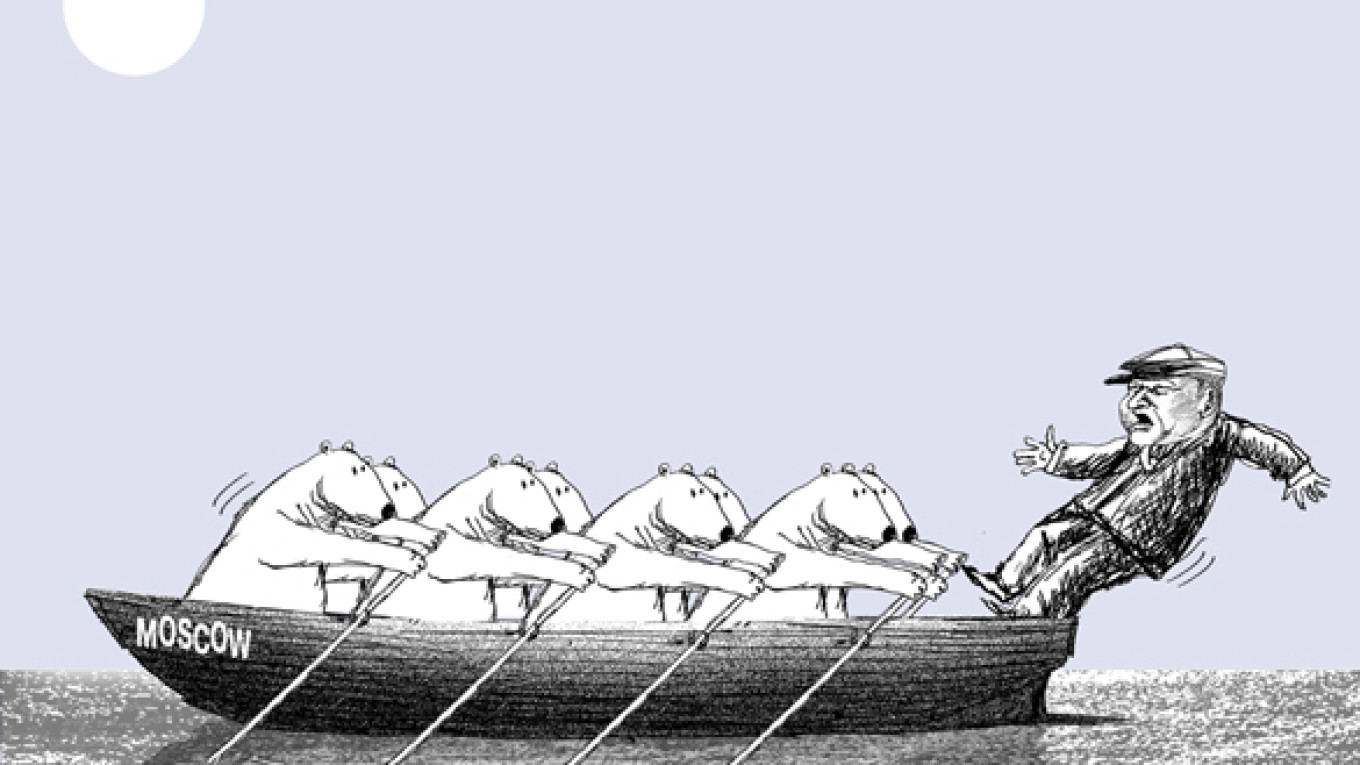
The biggest news story by far last week was the scandal surrounding Mayor Yury Luzhkov. After NTV aired its “Delo v Kepke” program on Sept. 10, which included serious allegations of corruption against him and his wife, Yelena Baturina, there were more anti-Luzhkov reports in the following days on Channel One, Rossia One and NTV.
Many had expected that there would be attacks on Luzhkov in one form or another, particularly after two other heavyweight governors — Sverdlovsk Governor Eduard Rossel and Tatarstan President Mintimer Shaimiyev ?€” were removed last year. Luzhkov now is the very last of the Mohicans.
But why did the attacks occur at this particular moment? When someone as important as Luzhkov is publicly targeted, the exact timing of these hunting campaigns is usually tied to the political calendar. It would have been too early to target Luzhkov prior to what turned out to be the dirty Moscow City Duma elections in October 2009. And once the campaigning begins soon for State Duma elections in 2011, it will be too late. This explains why the authorities set the dogs on Luzhkov last week instead of any other time.
The most-cited reason for the timing was that it was in retaliation for Luzhkov’s supposed attempt to drive a wedge in the ruling tandem by voicing critical comments in a Sept. 7 interview with Rossiiskaya Gazeta against President Dmitry Medvedev?€™s. In the article, Luzhkov criticized Medvedev?€™s decision to suspend construction of the Moscow-St. Petersburg highway through the Khimki forest. But this explanation for the timing of the anti-Luzhkov attacks is not the most compelling.
Although a similar campaign was unleashed two months ago against Bashkortostan President Murtaza Rakhimov, the anti-Luzhkov campaign is much larger in scale and severity. In a typical Russian region, only one or two local business groups want to put their man in the governor?€™s seat, but in Moscow, all of the country?€™s top business groups have a direct vested interest in who is the mayor.
To be sure, there is no shortage of influential business groups that are itching to replace Luzhkov and, most surprisingly, Prime Minister Vladimir Putin apparently gave them the green light to initiate the media campaign against Luzhkov ?€” or at the very least, he did not object. At the same time, however,? it easier for Putin to keep the controversial mayor in place than to search for a replacement.
But now the stakes are too high. Too much effort has been made attacking and defending Luzhkov for the scandal to simply evaporate over time. It is possible that Luzhkov will be actually replaced when the affair settles down and immediately after his 74th birthday on Tuesday. Or he might be given the pink slip shortly after the regional elections on Oct. 10. After these elections, the model for the next election campaign will become clear: Either the authorities will tighten the screws by stepping up administrative pressure on elections, or they will strengthen United Russia?€™s allies.
All the forces that Luzhkov mobilized to fight the attacks against him were not very effective. He used the Moscow branch of United Russia and the Moscow City Duma ?€” both fully under his control ?€” as well as veterans?€™ organizations and the aging Communists, including Communist Party leader Gennady Zyuganov. None of these forces is willing to follow Luzhkov to his political grave, but as long as United Russia and government leadership remain silent, they are willing to defend Luzhkov.
United Russia, of which Luzhkov is one of the founding fathers, has been an important but absolutely paralyzed factor in the conflict. At the outset, the party promised to sort out all of the problems, but it has offered nothing but empty words. This demonstrates the complete bankruptcy and failure of the so-called party of power.
The most difficult task in this whole affair will be to find Luzhkov?€™s replacement. His successor will have to meet at least three main requirements. One, he must be lacking in ambition or have some limiting factor, such as old age or political obscurity, that would prevent him from being too aggressive. Second, he must lack direct ties to any of the powerful business groups. Third, he must have a good working knowledge of the Moscow political machine and the ability to assume command quickly. Of all the candidates currently under discussion, none fulfill these requirements except perhaps Nizhny Novgorod Governor Valery Shantsev, who also served as deputy mayor to Luzhkov before his gubernatorial appointment.
The Luzhkov affair underscores how the current leadership is unable to build a consensus or reach a compromise among the leading business groups. But more important, this scandal delivered a heavy blow to the legitimacy of both the mayor and to the entire system of governance under Medvedev and Putin.
Nikolai Petrov is a scholar in residence at the Carnegie Moscow Center.
A Message from The Moscow Times:
Dear readers,
We are facing unprecedented challenges. Russia's Prosecutor General's Office has designated The Moscow Times as an "undesirable" organization, criminalizing our work and putting our staff at risk of prosecution. This follows our earlier unjust labeling as a "foreign agent."
These actions are direct attempts to silence independent journalism in Russia. The authorities claim our work "discredits the decisions of the Russian leadership." We see things differently: we strive to provide accurate, unbiased reporting on Russia.
We, the journalists of The Moscow Times, refuse to be silenced. But to continue our work, we need your help.
Your support, no matter how small, makes a world of difference. If you can, please support us monthly starting from just $2. It's quick to set up, and every contribution makes a significant impact.
By supporting The Moscow Times, you're defending open, independent journalism in the face of repression. Thank you for standing with us.

Remind me later.