

If anyone in the Kremlin is hoping that the protesters would disband and give up the struggle after the long New Year's holiday, they will probably be disappointed. The protesters' fighting spirit not only remains strong, but appears to be gaining speed, as attested by the hot level of discussion on the Internet.
This is only the tip of the iceberg in the country's heated political arena. The presidential election is just seven weeks away. The first major milestone comes on Jan. 18, the deadline for candidates to collect 2 million signatures from at least 40 of the country's regions, a requirement to run in the race. Of course, this is impossible to accomplish through honest means in such a short time.
There are only three candidates who claim to have collected 2 million signatures. One of them is the unpopular Irkutsk Governor Dmitry Mezentsev. He is the quintessential dummy candidate whose role in the race is only to ensure that the elections will be held in the event that all of the other candidates were to pull out of the race.
As for Yabloko leader Grigory Yavlinsky and billionaire Mikhail Prokhorov, they are largely interchangeable from the Kremlin's point of view, and their participation gives the elections respectability in the eyes of the West.
It would be an unaffordable luxury to retain both candidates if the Kremlin is banking on Putin winning during the first round of voting. In that case, excluding Prokhorov would be simpler and would lead to fewer negative consequences than eliminating Yavlinsky, a tried and true presidential candidate who will be running for president for the third time.
In addition, this will be the fifth presidential election for Liberal Democratic Party leader Vladimir Zhirinovsky, the fourth for Communist Party leader Gennady Zyuganov and the second for Just Russia leader Sergei Mironov.
In the end, however, Putin is faced with the greatest challenge in this election. In March there will surely be a large protest vote against Putin, much like there were millions of voters who voted during the December State Duma elections for the three other minority parties on the ballot only because they opposed United Russia. It is highly unlikely that Putin's political machine, despite its huge administrative resources, will be able to convince voters who have grown tired and dissatisfied with Putin to vote for him.
Putin would feel much safer if the rational-choice model defined voter behavior in Russia. But given the country's history of election fraud, it's hard to convince voters that their choice will decide the fate of elections. That is why the same model of protest voting can work in the March presidential election as it did during the Duma elections.
By replacing his first deputy chief of staff Vladislav Surkov with Vyacheslav Volodin, Putin showed that he is determined to win the election in the first round of voting, even if this entails more electoral violations. By all indications, Volodin is more willing and able than Surkov to use crude methods to achieve the desired electoral results.
For Putin, a second round is unacceptable because it would weaken his position as the country's national leader — or, to put it more correctly, his illusion that he is still a popular national leader. What's more, time is working against Putin, and prolonging the struggle by allowing a second round would expose him to even more political risk. If Putin is unable to stop the negative trend and the rapid decline of his popularity, his only hope of retaining power is take pre-emptive administrative and other measures to make sure that he wins at least 50 percent of the vote in the first round.
The presidential election promises to be interesting, not only in terms of the final distribution of votes, but for the substance of the political battle now underway. We can expect to see serious proposals from the candidates. Putin has already spent the holidays working on what his spokesman, Dmitry Peskov, called an extensive political program, which will be unveiled on Feb. 12. It is also expected that Putin will, for the first time, participate in public, televised debates against opposing candidates. This will add an additional spark to the presidential race, even if Putin's opponents have been hand-picked by the Kremlin.
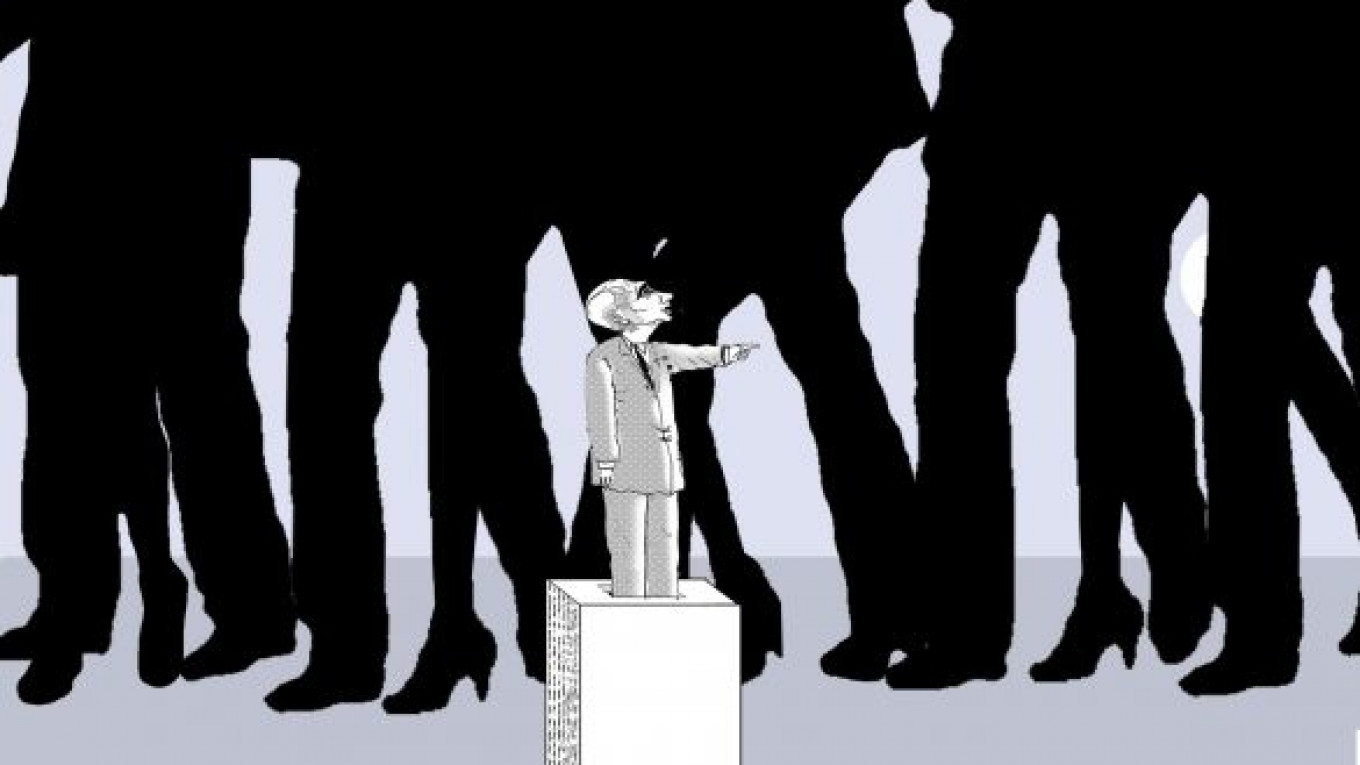
On the great chessboard of Russian politics, Putin now finds himself in a position of zugzwang: No matter which move he makes, the situation only gets worse. He has only two options: escalate the conflict — an approach that, thankfully, he seems unwilling to take, at least in the short term — or simply hope that the opposition will fail to achieve its goals using protests and other means in the limited time it has before the election.
In either case, since Putin will be a far weaker president in his third term, this will create serious problems for him and his inner circle. Is Putin ready to play such a role? It would seem not. After all, he is used to playing only one role — a combination of "alpha dog" and tsar. He is fundamentally unable to adapt to a constitutional monarchy, much less a democracy. He made this clear during his televised call-in show on Dec. 15. As hard as he tried to appear democratic, tolerant and compromising, he couldn't help reverting back to his autocratic style and condescending tone toward the people who oppose his course.
After more than a decade in power without political competition, Putin has lost the ability to adapt to rapidly changing conditions. As a result, he has become less effective and less popular, and this is bound to get worse the longer he stays in power. This creates a huge dilemma for Putin's inner circle who have no need for a leader who is ineffective, unpopular and out of touch with reality. If things get bad enough, they may feel impelled to replace Putin with another candidate from among their ranks — one who would guarantee their privileged status and rule the country more effectively.
Nikolai Petrov is a scholar in residence at the Carnegie Moscow Center.
A Message from The Moscow Times:
Dear readers,
We are facing unprecedented challenges. Russia's Prosecutor General's Office has designated The Moscow Times as an "undesirable" organization, criminalizing our work and putting our staff at risk of prosecution. This follows our earlier unjust labeling as a "foreign agent."
These actions are direct attempts to silence independent journalism in Russia. The authorities claim our work "discredits the decisions of the Russian leadership." We see things differently: we strive to provide accurate, unbiased reporting on Russia.
We, the journalists of The Moscow Times, refuse to be silenced. But to continue our work, we need your help.
Your support, no matter how small, makes a world of difference. If you can, please support us monthly starting from just $2. It's quick to set up, and every contribution makes a significant impact.
By supporting The Moscow Times, you're defending open, independent journalism in the face of repression. Thank you for standing with us.

Remind me later.