

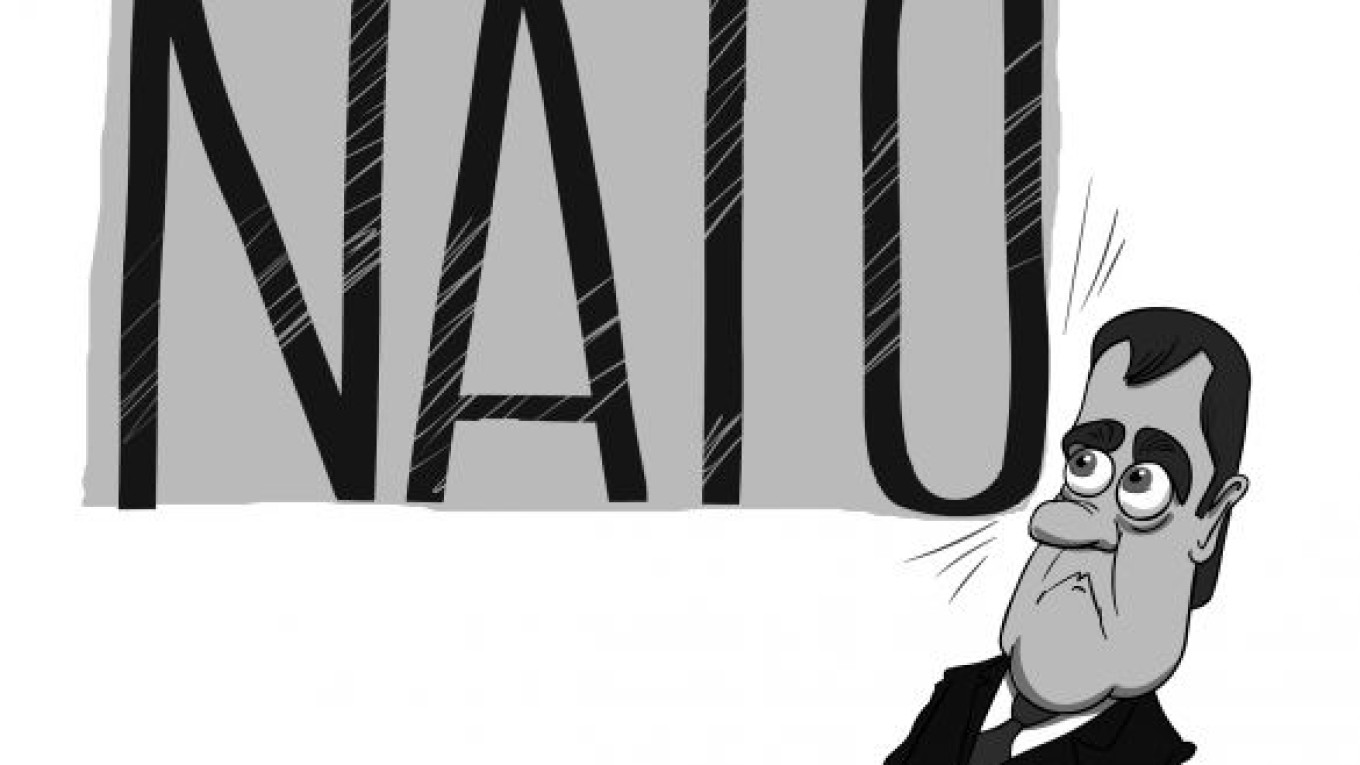
In June 2008, President Dmitry Medvedev first floated the idea for a new, broader structure for European-Atlantic security. The Kremlin turned the idea into a concrete proposal Nov. 29 when its web site posted a 14-article draft document titled “The European Security Treaty.” Under the motto of “From Vancouver to Vladivostok,” Medvedev’s treaty attempts to encompass, among others, NATO, the Organization for Security and Cooperation in Europe and the Collective Security Treaty Organization.
Not surprisingly, the West has reacted to the security treaty skeptically at best. At worst, many in the West interpret Medvedev’s proposal as an attempt to restore its lost global influence, if not its empire.
Medvedev’s initiative was the logical continuation of the Kremlin’s foreign policy that was sharply articulated by then-President Vladimir Putin at the Munich Conference on Security Policy in February 2007. During his speech, Putin said, “Security for each is security for all,” and that the model of a unipolar world in the 21st century is not only unacceptable but impossible. In Moscow’s opinion, any unilateral action — whether in the former Yugoslavia or Iraq — only creates new problems.
Every country — especially a totalitarian one — defends its most fundamental national security concern: self-preservation. For the past 60 years, nuclear weapons have proven to be one of the most reliable guarantors of security for those countries that are part of the official and nonofficial nuclear club. But as a rule, those countries have complex and difficult relations with neighboring states and are burdened with historical, ideological, religious, territorial, ecological and other problems. The result is a nuclear domino effect. If, for example, Iran develops nuclear weapons, this will inevitably lead to the uncontrolled proliferation of nuclear arms throughout the Middle East and beyond.
Moscow is extremely concerned about attempts by the United States and some of its allies to reach decisions affecting regional as well as global security outside the framework of the United Nations. NATO, the European Union and the Group of Eight do not have the global mandate to make these decisions by themselves.
Thus, Medvedev is trying to build a much broader structure for global security. The basic idea is that “no single state and no single international organization in the Euro-Atlantic region can strengthen its security at the expense of the security of other countries and organizations.” Medvedev’s draft treaty has already been sent to NATO, the European Union, the Collective Security Treaty Organization, the Commonwealth of Independent States and the Organization for Security and Cooperation in Europe. It was also presented and discussed at the latest NATO-Russia Council meeting, held Friday in Brussels.
Of course, there is a large discrepancy in terms of resources among the members of these organizations. For example, NATO’s military potential far exceeds that of the CSTO. In addition, NATO’s zone of operations has expanded so much that every former Soviet republic now participates in its Partnership for Peace program. What’s more, Georgia, Azerbaijan, Armenia, Kazakhstan and Moldova are in the initial stages of one day joining the alliance.
But NATO’s future is uncertain, and this underscores the importance of finding alternatives to provide European-Atlantic security. The more that NATO tries to expand, the more diluted, cumbersome and ineffective the organization becomes. Moreover, NATO suffers from a lack of mission and common cause. The Russian menace is greatly exaggerated, and international terrorism is too diffuse a threat to unite alliance members. What’s more, with Washington’s security guarantees becoming more unreliable, European states have been forced to consider creating their own security structures. Recall the EU proposal to form its own security structure — a “NATO without the United States,” of sorts. Further, apart from the largely decorative NATO-Russia council, NATO has not included Russia and its closest allies in the European security structure. This not only weakens NATO, but gives it a certain anti-Russia character.
In addition to NATO’s inherent weaknesses, there are also serious problems with the OSCE. The OSCE member states have never resolved a major interstate conflict, such as Nagorno-
Karabakh. The OSCE, which lacks sufficient unity among its member states, has not worked effectively with the CIS to form a unified security structure
Therefore, there is an urgent need to redesign the old and ineffective European-Atlantic security structure to meet new threats and challenges. Medvedev’s European Security Treaty offers a new architecture for the post-Soviet era, and the West should treat it seriously. It provides an excellent opportunity for Russia, the CIS, Europe and the United States to work together toward strengthening security from Vancouver to Vladivostok.
Vladimir Yevseyev is a senior associate at the Institute for World Economy and International Relations.
A Message from The Moscow Times:
Dear readers,
We are facing unprecedented challenges. Russia's Prosecutor General's Office has designated The Moscow Times as an "undesirable" organization, criminalizing our work and putting our staff at risk of prosecution. This follows our earlier unjust labeling as a "foreign agent."
These actions are direct attempts to silence independent journalism in Russia. The authorities claim our work "discredits the decisions of the Russian leadership." We see things differently: we strive to provide accurate, unbiased reporting on Russia.
We, the journalists of The Moscow Times, refuse to be silenced. But to continue our work, we need your help.
Your support, no matter how small, makes a world of difference. If you can, please support us monthly starting from just $2. It's quick to set up, and every contribution makes a significant impact.
By supporting The Moscow Times, you're defending open, independent journalism in the face of repression. Thank you for standing with us.

Remind me later.