

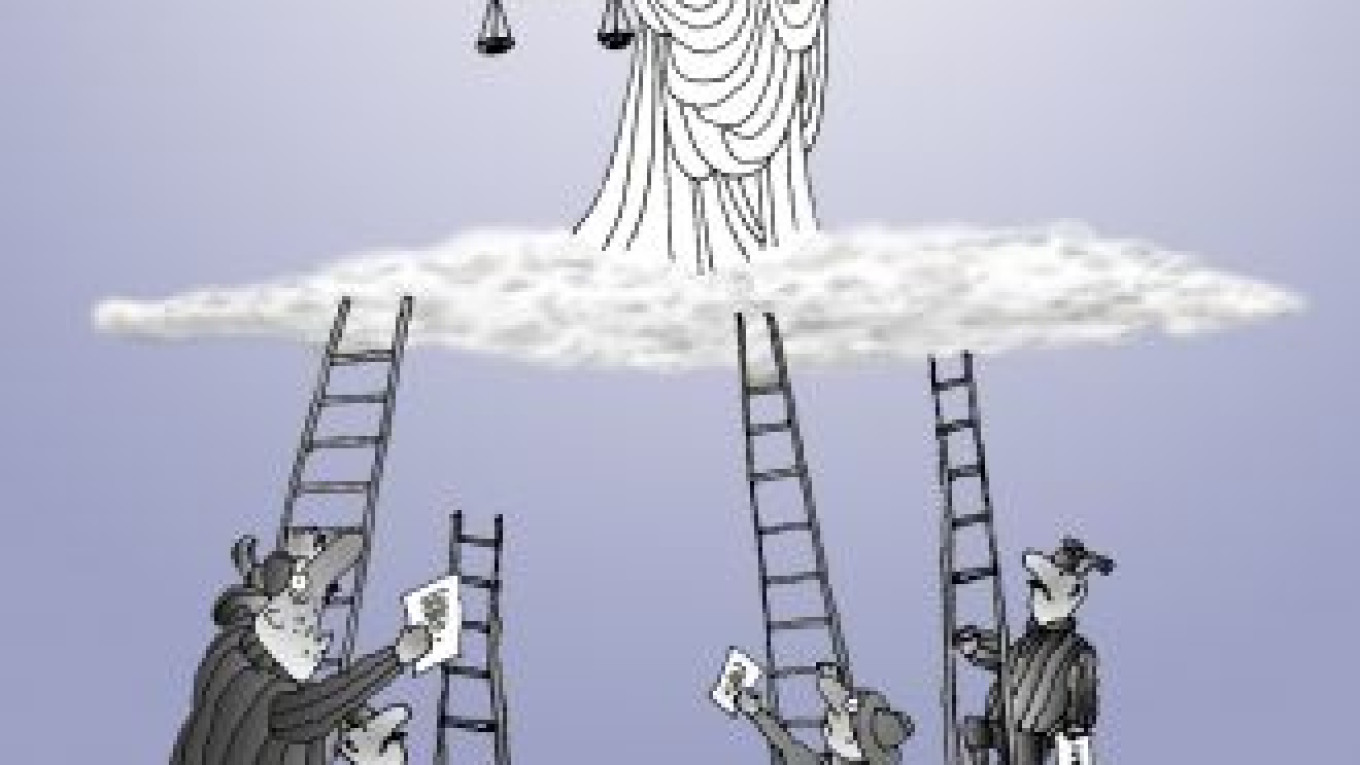
Ever since Kremlin first deputy chief of staff Vladislav Surkov introduced the term “sovereign democracy” in 2006, senior government officials have claimed that the West does not have a right to meddle in Russia’s domestic affairs, particularly regarding human rights issues. But according to the post-World War II paradigm governing international law, gross human rights abuses are a global concern, regardless of where they occur.
Russia’s interpretation of national sovereignty is back in the spotlight after the Western coalition started bombing Libya last month. Although the military intervention was approved by United Nations Security Council Resolution 1973, with Russia abstaining, Prime Minister Vladimir Putin likened it to medieval crusades and said the West should not interfere in “internal political conflicts.”
This view directly contradicts a foundation of international law that is enshrined in the UN Charter. Article 42 of the charter allows the Security Council to approve military actions against sovereign states if peaceful means such as economic sanctions prove inadequate and if military intervention is “necessary to maintain or restore international peace and security.” ?
Why is the Libyan conflict an issue of “international peace and security”?
First, Libyan leader Moammar Gadhafi has been accused of hiring mercenaries, using land mines against civilians and sanctioning the torture and deliberate killing of civilians in the current conflict. UN Security Council Resolution 1970, which was approved unanimously by Russia and the other 14 members of the council last month, recommended that the International Criminal Court investigate charges that Gadhafi committed war crimes and crimes against humanity. These allegations bring the seemingly internal Libyan conflict into the global jurisdiction, a priori making it an issue of international peace and security.
Second, more than 100,000 Libyan refugees have fled or are trying to flee to other countries, creating a humanitarian crisis.
Third, given Gadhafi’s past criminal and terrorist record over his brutal 40-year reign, as well as his promise in February to “join forces with al-Qaida and declare a holy war,” the Libyan conflict is clearly a threat to international peace and security. ?
The post-World War II paradigm defining a country’s sovereignty is clear: The global community under the auspices of the UN has the right to intervene under international law and the Responsibility to Protect doctrine when a county commits war crimes, crimes against humanity, genocide or ethnic cleansing. It was in this context that former UN Secretary-General Dag Hammarskjöld famously said, “The UN was not created to take mankind to heaven but to save humanity from hell.”
Russia is correct, however, when it points out the U.S. double standard regarding this paradigm — particularly, the laws that protect U.S. military personnel and public officials from prosecution for war crimes in non-U.S. courts and Washington’s nonmembership in the International Criminal Court, although Russia hasn’t joined the court either.
Indeed, limited sovereignty cuts both ways, and Russia has the same right to criticize the United States, for example, for its purported human rights abuses in Guantanamo, Iraq and Afghanistan.
Putin and other critics are also correct about the selective application of the UN-sanctioned military operation in Libya, officially classified as a humanitarian intervention. Where was the global “responsibility to act” in Darfur, Congo, Somalia, Ivory Coast or Rwanda, for example, where more than 800,000 civilians were killed during the 1994 genocide? As columnist Nicholas Kristof wrote in The New York Times, the West loves to cherry-pick its humanitarian interventions.
Strangely enough, there is even an uncanny resemblance between Gadhafi and jailed former Yukos CEO Mikhail Khodorkovsky in terms of the selective application of the law: Gadhafi was singled out largely for geopolitical reasons, and Khodorkovsky for political and economic ones.
But the issue of sovereignty and human rights abuses is much broader than war crimes and genocide. This is an ongoing subject of debate — and source of irritation — in Russia, particularly when the West protests Moscow’s failure to properly investigate and prosecute government-linked killings, arbitrary detentions and human rights violations. The Sergei Magnitsky and Khodorkovsky cases, of course, are only the tip of the iceberg when it comes to rights abuses and the selective application of the law.
Under Surkov’s interpretation of “sovereign democracy,” the West should not meddle in Russia’s domestic affairs. Russia, we are told, is building its own type of democracy and doesn’t need lectures from the West about human rights.
“Don’t poke your noses in our internal affairs,” is how Putin succinctly put it during his December interview with CNN’s Larry King. It is no wonder that Russia’s leaders, so intolerant of dissension within the country, are so sensitive to criticism from the West.
Strangely enough, Surkov’s and Putin’s views on sovereignty directly contradict Russia’s own official policy. When Russia joined the Council of Europe and by extension the European Court of Human Rights during Boris Yeltsin’s presidency in 1996, it forfeited a significant part of its legal sovereignty to the European court, located in Strasbourg. In fact, every time Moscow pays compensation to a Russian citizen who wins a human rights case against the Russian government in the European court, the Kremlin confirms the modern concept of limited national sovereignty.
One can assume that Putin and Surkov — as well as Constitutional Court chief justice Valery Zorkin, an outspoken critic of the European Court of Human Rights’ decisions against Russia — deeply regret Yeltsin’s decision to surrender part of the country’s legal sovereignty to the European court, considering that claims from Russia now make up about 30 percent of all cases brought before the court — more than any other country — and the government loses about 95 percent of these cases. The real sovereignty showdown will occur if the European court rules in favor of Yukos in its $98 billion suit against the government, in which case Russia may seriously consider withdrawing its membership from the Council of Europe.
But there is one large group of people who are surely grateful to Yeltsin — the nearly 40,000 Russians who have been able to file their claims in Strasbourg because they couldn’t get justice at home. This shows that limiting Russia’s “sovereign democracy” is a moral imperative.
Michael Bohm is opinion page editor of The Moscow Times.
A Message from The Moscow Times:
Dear readers,
We are facing unprecedented challenges. Russia's Prosecutor General's Office has designated The Moscow Times as an "undesirable" organization, criminalizing our work and putting our staff at risk of prosecution. This follows our earlier unjust labeling as a "foreign agent."
These actions are direct attempts to silence independent journalism in Russia. The authorities claim our work "discredits the decisions of the Russian leadership." We see things differently: we strive to provide accurate, unbiased reporting on Russia.
We, the journalists of The Moscow Times, refuse to be silenced. But to continue our work, we need your help.
Your support, no matter how small, makes a world of difference. If you can, please support us monthly starting from just $2. It's quick to set up, and every contribution makes a significant impact.
By supporting The Moscow Times, you're defending open, independent journalism in the face of repression. Thank you for standing with us.

Remind me later.