

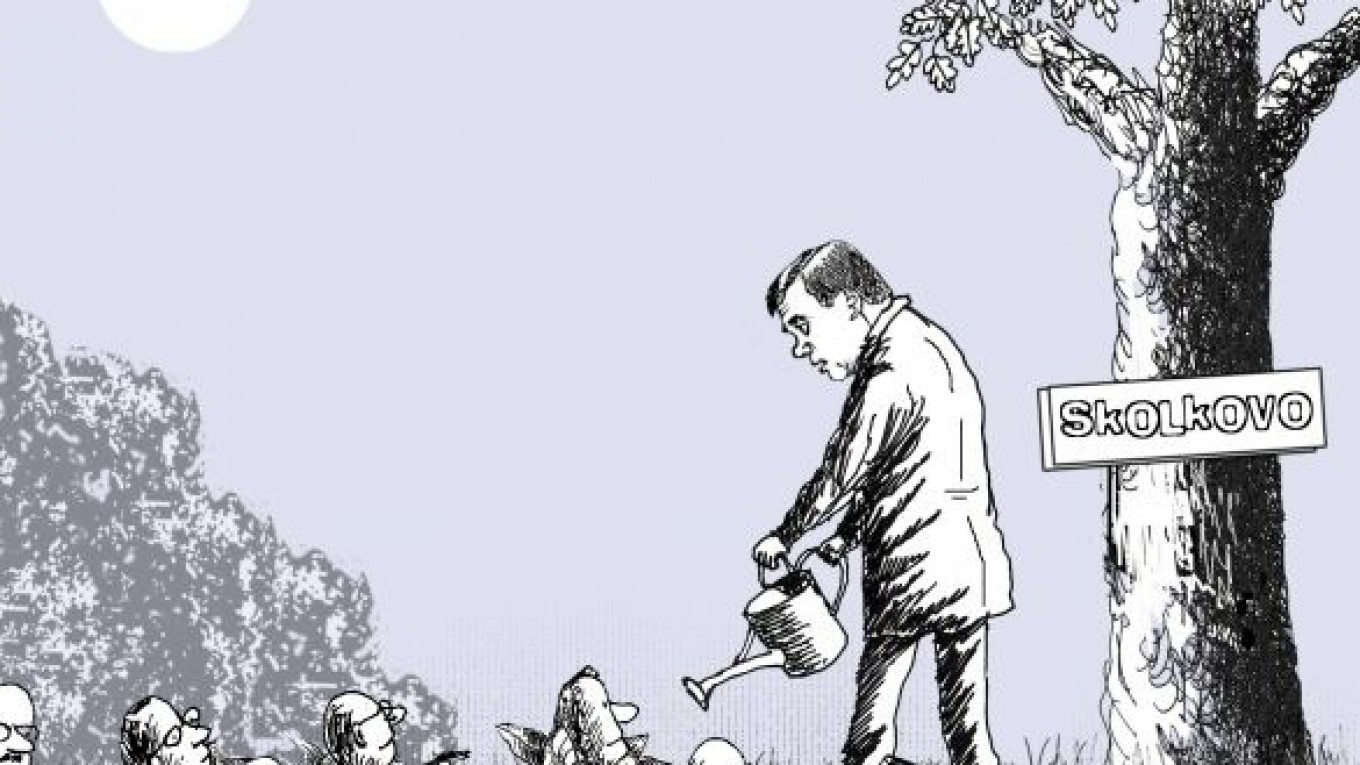
Is it possible to build a Silicon Valley in Russia? With President Dmitry Medvedev’s visit to Silicon Valley on Wednesday and his ambitious plans to build “Innovation City” in Skolkovo, just outside of Moscow, this is the question that so many people are asking.
The short answer is “no.” But with enough political will and oversight, Russia can create the conditions in which a smaller version of Silicon Valley can grow by itself. Think of the project as a garden rather than a construction site.
For this garden to grow, Russia must create the following conditions:
1. No killer weeds. Entrepreneurs must be free from blackmail, expropriations and other shakedowns.
2. Healthy seeds. Russia needs to attract and reward technical talent and scientists for good ideas.
3. Nutrients in the soil. There must be a steady source of good managers, businesspeople, and marketing and sales talent.
4. Careful gardeners and consumers. There must be mentors for entrepreneurs, as well as customers who buy the products and services on the basis of quality and price rather than bribes.
5. Cross-fertilization. There must be critical mass so that people can learn from and compete with each other.
6. Sunshine. There must be maximum transparency.
Right now, the Russian Silicon Valley project is still very much a mystery. The location has been selected, and a number of large companies are being invited to set up incubation, and research and development facilities. That’s a start, but what will be most important is the people and the culture they establish. Entrepreneurs need to be encouraged to take sensible risks, and they need support and mentoring to build sustainable companies that can make useful products and services from their inventions and market them successfully.
There has also been talk of a “virtual Skolkovo.” Why should entrepreneurs have to move to Skolkovo, where prices are likely to be high and access restricted, to get benefits such as special tax treatment and favored access to capital that should be available anywhere in Russia to high-tech entrepreneurs with good ideas?
The advantage of the Silicon Valley concept, regardless of where it is located, is a high concentration of innovative people who can interact with each other — whether it is techies hiring salespeople, inventors sharing some expertise with each other or investors meeting startups. These kinds of interactions can be fostered by business-plan contests, boot camps and conferences for entrepreneurs. But constant day-to-day interactions over coffee are even more valuable. ?
In a Silicon Valley, people fill multiple roles at the same time — student, researcher, entrepreneur, professor, angel investor and full-fledged venture capitalist investing other people’s money. That kind of creative ecosystem and cross-fertilization leads not just to innovation, but to successful commercial implementation. ?
If all goes well, Skolkovo will be set up transparently, with the terms of participation clear to everyone. Skolkovo should be a money-making enterprise, but how and by whom the money is made should be visible. Beyond that, its activities should be seen to benefit Russian society as a whole, not just a few entrepreneurs and large companies and their foreign customers. ?
In the long run, Russians need to think of innovation-driven enterprises as not simply a source of profits for the owners (or the government officials who allow them to prosper), but also something that brings tremendous benefits to consumers and the population at large. ?
Much of the rhetoric surrounding Skolkovo centers on making Russian startups competitive in the global market. That’s fine, but it would be better if they focus on serving Russia first and improving the lives of Russians. One of my favorite examples is the payment terminals on virtually every corner that allow people to add money to their cell phone accounts. In the near future, these terminals will allow people to pay traffic fines without standing on lengthy lines. Several companies are competing to offer such services, which means that they will only get more convenient and cheaper over time. ?
The most important concept that serves as the foundation for building Innovation City in Skolkovo is that individuals have the power to create value for themselves and for others with giant institutions playing only a initial role.
Esther Dyson sits on the advisory boards of Yandex, IBS Group, SUP/Live Journal and TerraLink and is the founder of the RusTechDel Meetup.
A Message from The Moscow Times:
Dear readers,
We are facing unprecedented challenges. Russia's Prosecutor General's Office has designated The Moscow Times as an "undesirable" organization, criminalizing our work and putting our staff at risk of prosecution. This follows our earlier unjust labeling as a "foreign agent."
These actions are direct attempts to silence independent journalism in Russia. The authorities claim our work "discredits the decisions of the Russian leadership." We see things differently: we strive to provide accurate, unbiased reporting on Russia.
We, the journalists of The Moscow Times, refuse to be silenced. But to continue our work, we need your help.
Your support, no matter how small, makes a world of difference. If you can, please support us monthly starting from just $2. It's quick to set up, and every contribution makes a significant impact.
By supporting The Moscow Times, you're defending open, independent journalism in the face of repression. Thank you for standing with us.

Remind me later.