

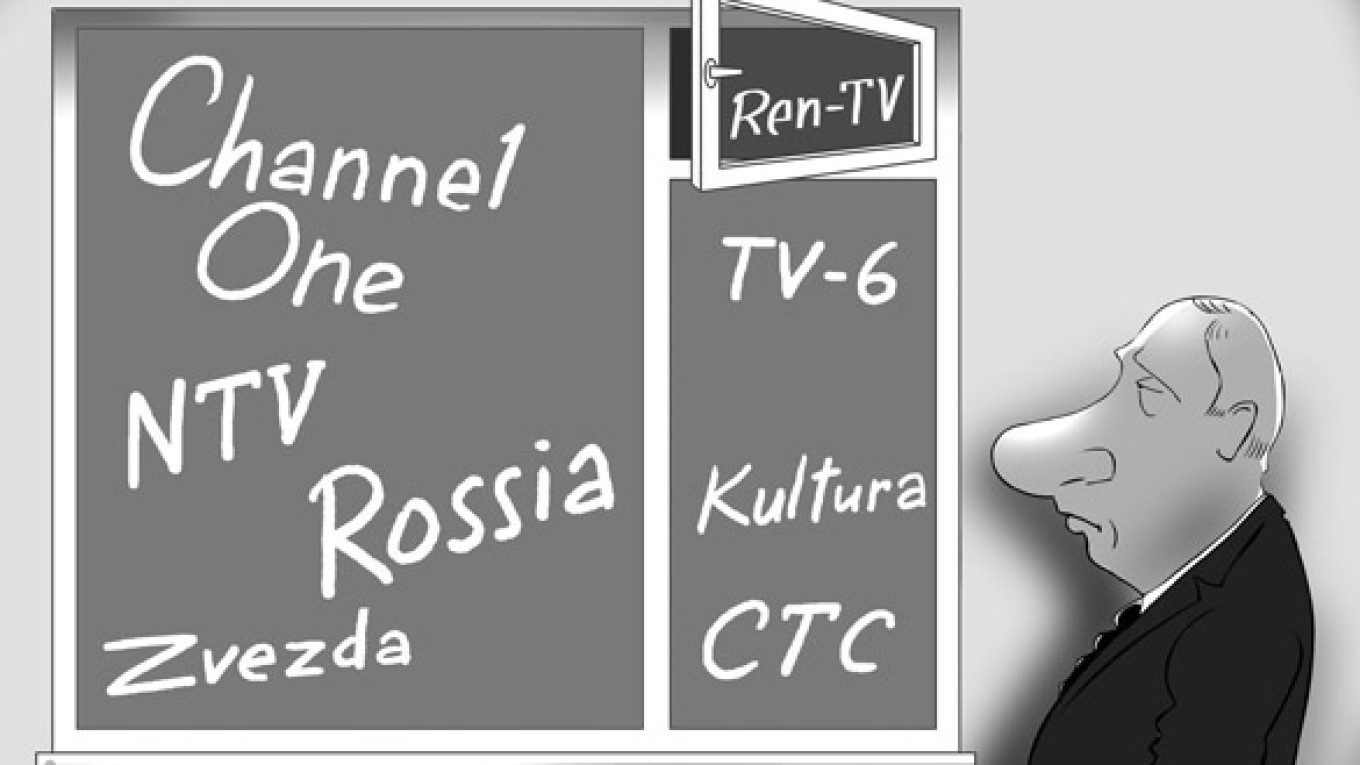
There are two types of media in Russia: influential and independent. The influential media — read: state-controlled — cannot be independent. Conversely, independent media, whose numbers are getting smaller and smaller, cannot be influential. The moment the authorities suspect that an independent publication or broadcaster that is critical of the government is influencing public opinion in a significant way, the chances that the media outlet will be forced to change its orientation and political views become very high.
Ren-TV is Russia’s last remaining national television channel that airs the critical views of members of the political opposition, who present facts and give opinions that are terribly “inconvenient” for the authorities. Not surprisingly, the station’s ratings have continued to grow over the past few years. Television viewers in search of objective and unbiased coverage regularly rate Ren-TV news and analytical programs as being some of the best in the country. Consistent with this, over the past several years the station’s news anchor, Mikhail Osokin, and the host of the weekly analytical show “Nedelya,” Marianna Maximovskaya, have regularly received the TEFI award, the most prestigious prize in the country’s television industry for journalistic quality and integrity. And it is precisely because these highly professional and talented journalists continue to investigate the abuses, weaknesses and ineffectiveness of government institutions and bureaucrats under Prime Minister Vladimir Putin and President Dmitry Medvedev that Ren-TV may be forced to change its editorial position.
National Media Group, which is owned by Putin’s friend and fellow St. Petersburg native Yury Kovalchuk, controls both Ren-TV and Petersburg Channel 5. Last week, National Media Group announced a restructuring of its top management. Ren-TV announced that its new general director will be Mikhail Kontserev and that it will soon move to new premises — the same building on Moscow’s Zubovsky Bulvar that is occupied by state-owned RIA-Novosti and the Kremlin-friendly RT cable news channel.
Most important, however, is the prospect that Ren-TV’s editorial policy will undergo a fundamental change. To be sure, there have been contradictory statements on this account: First, it was reported in Kommersant on Oct. 16 and in other media outlets that RT would will take over the news programming for Ren-TV. Two days later, that report was refuted by Ren-TV spokesman Anton Nazarov, who announced that Ren-TV would continue producing its own news and that RT would be offering only “technical assistance.”
Matters are far worse for Petersburg Channel 5. Staff members sent an open letter to Medvedev and Putin promising to stage a protest if the proposal to lay off 1,300 employees is carried out. Petersburg Channel 5 commands only 2 percent of the national television audience, but it broadcasts critical news and analysis, as well as a live political talk shows with independent analysts and opposition members as guest speakers.
Ren-TV was the only station to provide full coverage of the Dissenters’ Marches held in Moscow and St. Petersburg, airing incriminating footage of riot police beating peaceful demonstrators and interviewing political opposition members on the scene. The station also ran a critical story on the Sayano-Shushenskaya hydroelectric plant tragedy that explained the real causes behind the accident and who was really responsible for it. And when the Communist Party, the Liberal Democratic Party and A Just Russia staged a protest on Oct. 14 in the State Duma, Ren-TV was the only television channel to report it as a serious political crisis that was directly related to the blatant, widespread falsification of regional election results on Oct. 11. This was in stark contrast to the distorted language that state-controlled television used to describe the walkout — as a “political demarche and intrigue” and a “provocation caused by outside forces.”
National Media Group management is quick to explain that the underlying reasons for managerial — and possibly editorial — changes at Ren-TV and Petersburg Channel 5 are dictated by economic circumstances and not political ones, claiming that advertising revenues have fallen off sharply during the crisis. Everyone remembers how state-controlled Gazprom-Media in 2001 forced NTV, once Russia’s most-popular television station, to push out the channel’s top management and completely overhaul its news and editorial coverage, citing the same “economic” reasons. As a result of Gazprom-Media’s takeover of NTV, Russia’s most critical and most popular television programs — such as Yevgeny Kiselyov’s “Itogi” and Savik Shuster’s “Svoboda Slova” political talk shows, as well as Viktor Shenderovich’s “Kukly” puppet show that lampooned Russia’s top leaders — were kicked off the air despite their high ratings. Will the current reorganization at Ren-TV and Petersburg Channel 5 cause the two channels’ most critical informational programs to be cancelled as well under the same pretext of a “cost-cutting measure”?
Unfortunately, everything that has happened on the television media front since Putin became president in 2000 suggests that the last vestige of independent television will be muzzled as well.
Vladimir Ryzhkov, a State Duma deputy from 1993 to 2007, hosts a political talk show on Ekho Moskvy radio.
A Message from The Moscow Times:
Dear readers,
We are facing unprecedented challenges. Russia's Prosecutor General's Office has designated The Moscow Times as an "undesirable" organization, criminalizing our work and putting our staff at risk of prosecution. This follows our earlier unjust labeling as a "foreign agent."
These actions are direct attempts to silence independent journalism in Russia. The authorities claim our work "discredits the decisions of the Russian leadership." We see things differently: we strive to provide accurate, unbiased reporting on Russia.
We, the journalists of The Moscow Times, refuse to be silenced. But to continue our work, we need your help.
Your support, no matter how small, makes a world of difference. If you can, please support us monthly starting from just $2. It's quick to set up, and every contribution makes a significant impact.
By supporting The Moscow Times, you're defending open, independent journalism in the face of repression. Thank you for standing with us.

Remind me later.