

The more I cover global affairs, the more it takes me back to the 1980s when I wrote for the main Soviet military newspaper, Krasnaya Zvezda.
For example, for the past decade Russia has claimed that the U.S. missile defense system is a threat to Russia's national security. In response, the Kremlin threatens a "symmetrical response," including a new arms race. I remember the 1986 Reykjavik Summit, when Soviet leader Mikhail Gorbachev and U.S. President Ronald Reagan were on the brink of signing a historic agreement to eliminate all ballistic missiles, but the talks broke down over three words — Strategic Defense Initiative —the U.S. missile defense system otherwise known as "Star Wars." And what a shame, because Star Wars was nothing more than a huge bluff. Nonetheless, Gorbachev, having scared himself into a frenzy over Star Wars, walked away from the bold U.S. disarmament proposal.
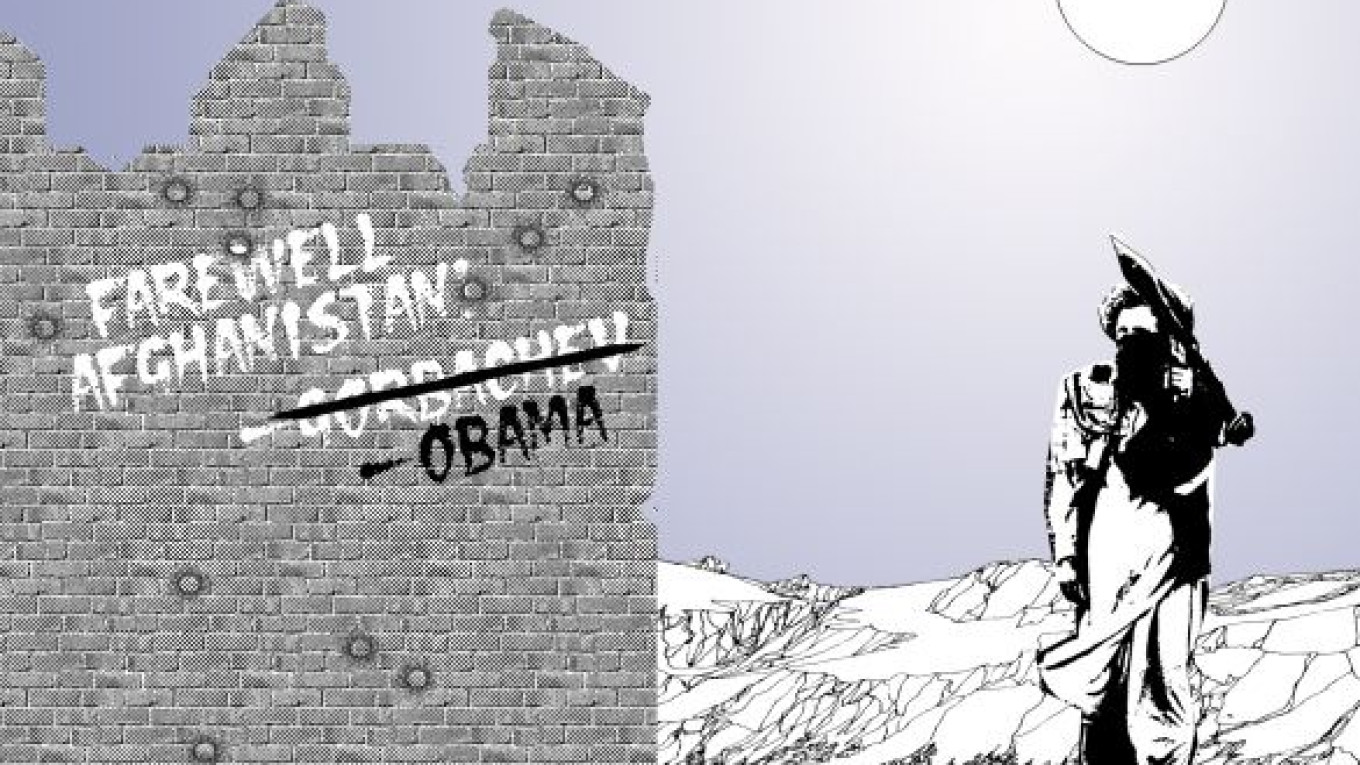
Now U.S. President Barack Obama is announcing the start of his exit strategy from Afghanistan. "It is time to focus on nation building here at home," Obama said in his address to the nation a week ago. Gorbachev basically said the same thing in 1989 when he announced the withdrawal of Soviet forces from Afghanistan.
In early October 2001, during the first days of the U.S. invasion of Afghanistan, retired Soviet commanders flooded me with calls, offering to explain to my readers why the U.S. military has no chance of winning in Afghanistan. But the phone calls stopped abruptly when the Taliban started running for the hills amid a massive U.S. bombing campaign.
But the U.S. success did not last longer than a month. Officials in the Pentagon and White House realized what Soviet leaders eventually understood during their Afghan War: It is impossible to build a nation by military force alone. Like the Soviets, U.S. forces got bogged down in a guerrilla war, which a civilized nation cannot win by definition. The only way to win a guerrilla war is to resort to genocide. This also explains why the Vietnam War from the start was unwinnable.
The attempt to build a democracy by force in Afghanistan was doomed from the beginning. This is why it is in the United States' best interest to leave Afghanistan as quickly as possible. Unfortunately, the withdrawal of U.S. and allied troops dooms the region to an extended period of unrest and military conflict.
When Obama says he is beginning the Afghan exit strategy from a position of strength and that al-Qaida is all but defeated, he is being disingenuous. Al-Qaida remains an effective matrix organization. Its supporters are best mobilized into action when a given Muslim country is at its weakest. It is true that al-Qaida transferred its operations to Pakistan, but there is no doubt that they will return to Afghanistan when U.S. forces leave. Even now, when 100,000 U.S. soldiers are fighting the Taliban, coalition forces cannot reach a turning point in their favor. The 25,000 or so U.S. soldiers who will remain in Afghanistan after 2014 will not be able to defend the country from guerrilla forces, which will only increase in strength and numbers in the next three years. As a result, we are sure to see a repeat of what happened after Soviet forces withdrew in 1989. Islamist extremists — the Taliban — took over the country.
But when Islamist extremists take over Afghanistan, it will be much more of a Russian problem than a U.S. one, particularly when they set their sights on the former Soviet Central Asian republics. Without a joint U.S.-Russian security strategy to prevent instability in Central Asia, it will be impossible to stop the flow of extremists and militant groups that want to expand in these weak, poor and vulnerable countries.
Both Russia and the United States need to refocus their priorities. Washington should spend less attention and energy on hypothetical missile threats from the Middle East, and Moscow should stop bickering endlessly about the imaginary threat of missile defense systems on its borders. Instead, both sides should come together and agree on the much larger threat — the threat of instability and resurrection in Central Asia after U.S. forces leave Afghanistan. Now is the time to take pre-emptive, preventative measures to secure the region before it is too late. Moscow and Washington should devote resources to build economic projects that would overcome the appalling poverty in the region. For its part, Russia could provide specialists who know the local conditions well.
The best way to not only lower tensions in U.S.-Russian relations, but to boost the reset is to come together to fight a shared enemy and threat. The sooner we join forces to prevent instability in Central Asia, the better.
Alexander Golts is deputy editor of the online newspaper Yezhednevny Zhurnal.
A Message from The Moscow Times:
Dear readers,
We are facing unprecedented challenges. Russia's Prosecutor General's Office has designated The Moscow Times as an "undesirable" organization, criminalizing our work and putting our staff at risk of prosecution. This follows our earlier unjust labeling as a "foreign agent."
These actions are direct attempts to silence independent journalism in Russia. The authorities claim our work "discredits the decisions of the Russian leadership." We see things differently: we strive to provide accurate, unbiased reporting on Russia.
We, the journalists of The Moscow Times, refuse to be silenced. But to continue our work, we need your help.
Your support, no matter how small, makes a world of difference. If you can, please support us monthly starting from just $2. It's quick to set up, and every contribution makes a significant impact.
By supporting The Moscow Times, you're defending open, independent journalism in the face of repression. Thank you for standing with us.

Remind me later.