

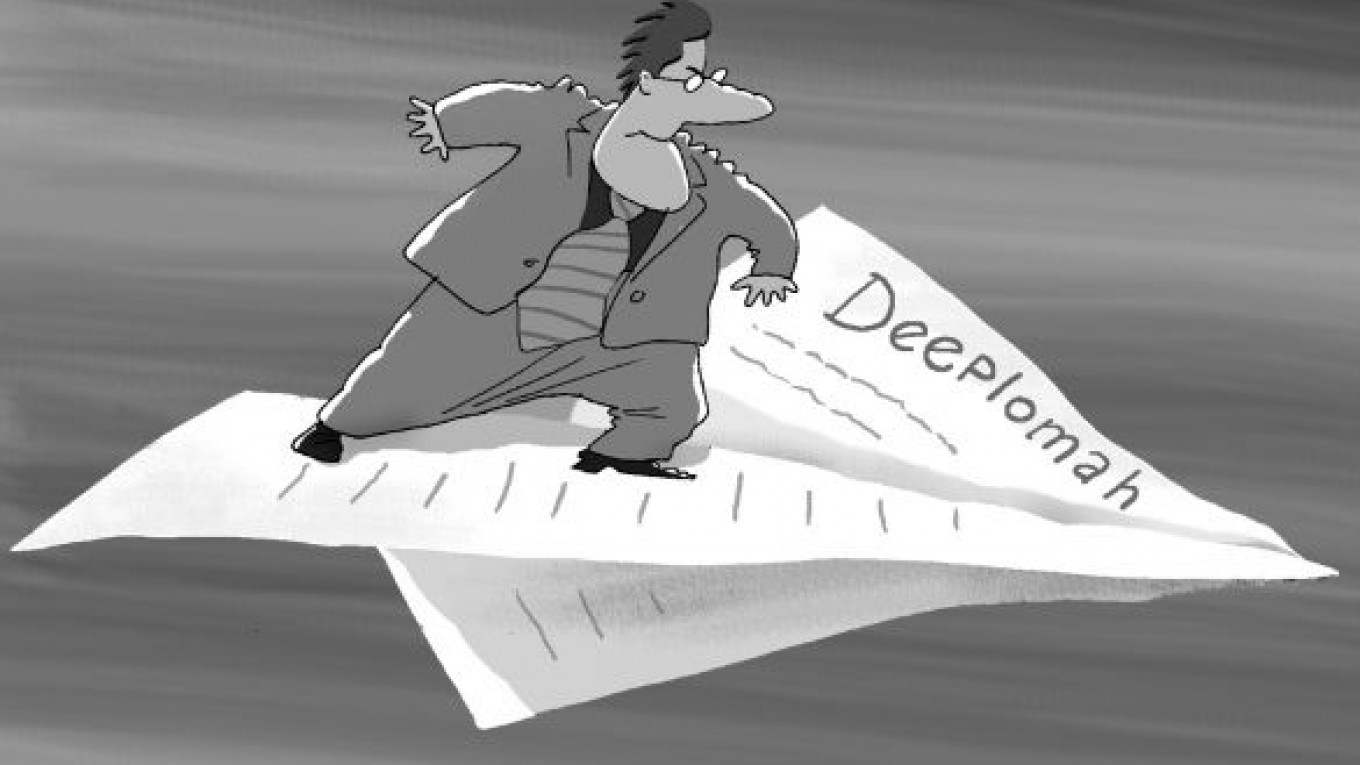
Three weeks ago, NTV television reported that more than 70 engineers working at a Komsomolsk-on-Amur airplane factory in the Khabarovsk region had obtained fake engineering degrees from a local technical college. The high-security military plant, which belongs to state-owned Sukhoi, assembles the Su-27, Su-30 and Su-35 fighter jets, as well as the much-anticipated Superjet 100 passenger plane. The trade in fake diplomas is nothing new, of course, but the sheer number of employees involved was mind-boggling.
Sukhoi management took a nonchalant attitude toward the scandal and refused to fire the employees, referring to a company rule that employees can be dismissed only for “grave crimes.” (According to the Criminal Code, knowingly purchasing a fake diploma carries a maximum punishment of an 80,000 ruble [$2,600] fine and two years of “correctional labor.”) Sukhoi management also explained that the diplomas were a mere formality since the engineers had been employed at the plant for years and assured that no engineers with fake diplomas had been employed in actual plane production.
This is a classic case of self-deception. Sukhoi pretended that it had “raised worker qualifications” by instantly turning dozens of employees with only a high school education into engineers with college degrees. Until they got caught, everyone seemingly gained from the scheme. The plant reported to Sukhoi headquarters in Moscow that it fulfilled its plan for the number of degree-holding engineers on staff, the workers received a small bonus for their new skill level, and everyone pretended that they were making better airplanes.
The fake-diploma scandal at the Sukhoi plant was also unique in that an investigation was initiated. These schemes almost always go unnoticed — with the exception of show cases like when authorities wanted to discredit then-Archangelsk Mayor Alexander Donskoi in 2006 by exposing that he had purchased his diploma. There are also plenty of ridiculous cases that get public exposure — for example, in October, when a group of counterfeiters tried to sell fake diplomas from Harvard University to Russians for $40,000 each, or when it became known that Marina Petrova, who was awarded the title of “Best Teacher in Russia-2007,” had purchased a false university diploma.
The most popular fake diplomas are legal degrees, followed by medical degrees, Izvestia reported July 20.
Although the problem is rampant, employers rarely check the validity of applicants’ diplomas. The Federal Security Service, Interior Ministry and other government organizations related to security and defense are supposed to check every diploma, but they are quite lackadaisical about this, as the Sukhoi scandal showed. Roughly every third policeman has a fake diploma, Alexander Yudin, former head of the Interior Ministry’s personnel department, said in the Izvestia report.
In the private sector, most Russian companies don’t even bother checking candidates’ diplomas, but the few that do are invariably turned down by universities for the reason that the information is “confidential.” (Interestingly enough, completely different rules are applied to foreigners who apply for Russian work permits. They must present to Russian authorities apostille seals that prove the validity of their foreign diplomas.)
For years, the government has vowed to establish a single database that employers could use to verify diplomas with a single click of the mouse, but there has been little political will to jump-start the project. Even if the database were established, it would be useless against those who pay to have their fake diplomas officially registered at a university with the rector’s approval.
Students who study honestly get the short end of the stick. No matter how conscientiously they study, their diplomas will be inevitably devalued by widespread corruption within the country’s higher education system. Amid this nationwide devaluation, too many people view a university degree as a mere formality, as the Sukhoi case shows.
For those who cringe a bit at buying a diploma outright, there is a more “respectable” way of essentially accomplishing the same thing: paying someone to write your dissertation for a Ph.D. degree or candidate’s degree (something roughly between a master’s degree and a Ph.D. in the West).
The number of postgraduate degrees has skyrocketed since the collapse of the Soviet Union. About 30 percent of the holders purchased their dissertations, said Mikhail Kirpichnikov, head of the Higher Attestation Commission, the government agency that regulates the granting of postgraduate degrees, Newsru.com reported in 2006. In 2008, Oleg Kutafin, former rector of the Moscow State Law Academy, put the figure at 50 percent.
Advanced degrees obtained through purchased dissertations are particularly popular among top managers and the bloated army of mid- and upper-level bureaucrats. They are also popular among mayors, governors and their aides, as well as State Duma deputies, for whom a new academic title is a respectable status symbol that goes nicely with the dacha, Mercedes, driver and flashing blue light.
For this segment, cheap semblance counts as much as substance. During the early 1990s, it was considered prestigious among the elite to buy false certificates showing that they were descendents of Russian nobility. Now it has become prestigious to place the words “Candidate of Sciences” or “Doctor of Sciences” on business cards.
Roughly half of State Duma deputies have postgraduate degrees. The remaining half are actively recruited by enterprising dissertation-writers who try to hawk their services for $25,000 a pop, according to Russian Newsweek.
Among Duma deputies with graduate degrees is Liberal Democratic Party leader Vladimir Zhirinovsky. In 1998, at age 52, he received his Ph.D. in philosophy from Moscow State University for a dissertation titled “The Past, Present and Future of the Russian Nation” — remarkably, while serving as a deputy and skipping the candidate level entirely. Communist Party leader Gennady Zyuganov received his Ph.D. in philosophy in 1995, at age 51, while also serving as a Duma deputy. Among Cabinet ministers, you might be surprised to learn that Sergei Shoigu has a candidate’s degree in economics, which he received in 1996, at age 41, while serving as emergency situations minister.
Questions have been raised about Prime Minister Vladimir Putin’s Candidate of Sciences degree, which he received in June 1997 from the St. Petersburg Mining Institute while serving in Moscow as? deputy head of the presidential? administration? under? President Boris Yeltsin. In 2006, Clifford Gaddy, a senior fellow at Brookings Institution, compared Putin’s dissertation with a management study published by two University of Pittsburgh professors and found that 16 pages from Putin’s work, including tables, matched word for word or with only slight changes. Putin has never commented on Gaddy’s findings.
Unfortunately, the Kremlin doesn’t seem to care too much about how academic plagiarism has corrupted the education system. During Wednesday’s State Council meeting, President Dmitry Medvedev and Education Minister Andrei Fursenko gave detailed reports on the largest problems in the education system and how they impede the country’s modernization. Remarkably, not a single word was said about fake diplomas or academic plagiarism.
Of course, there are no easy solutions. Academic fraud, like corruption in general, is a systemic problem in Russia. But one good place to start would be to force the country’s top universities at least to adopt an honor code that every student — and faculty member as well — would be required to uphold, or face expulsion.
Today, the real question is how Russia will be able to resolve its most-pressing problems — above all, modernization — with so many fake managers, engineers, economists, doctors, lawyers, bureaucrats and politicians.
Michael Bohm is the opinion page editor of The Moscow Times.
Editor's note: This comment has been amended to say Vladimir Putin defended his Candidate of Sciences degree at the St. Petersburg Mining Institute while working in? Moscow? as the deputy head of the presidential administration under President Boris Yeltsin in June 1997. A previous version incorrectly said Putin was working in the St. Petersburg Mayor's Office.
A Message from The Moscow Times:
Dear readers,
We are facing unprecedented challenges. Russia's Prosecutor General's Office has designated The Moscow Times as an "undesirable" organization, criminalizing our work and putting our staff at risk of prosecution. This follows our earlier unjust labeling as a "foreign agent."
These actions are direct attempts to silence independent journalism in Russia. The authorities claim our work "discredits the decisions of the Russian leadership." We see things differently: we strive to provide accurate, unbiased reporting on Russia.
We, the journalists of The Moscow Times, refuse to be silenced. But to continue our work, we need your help.
Your support, no matter how small, makes a world of difference. If you can, please support us monthly starting from just $2. It's quick to set up, and every contribution makes a significant impact.
By supporting The Moscow Times, you're defending open, independent journalism in the face of repression. Thank you for standing with us.

Remind me later.