

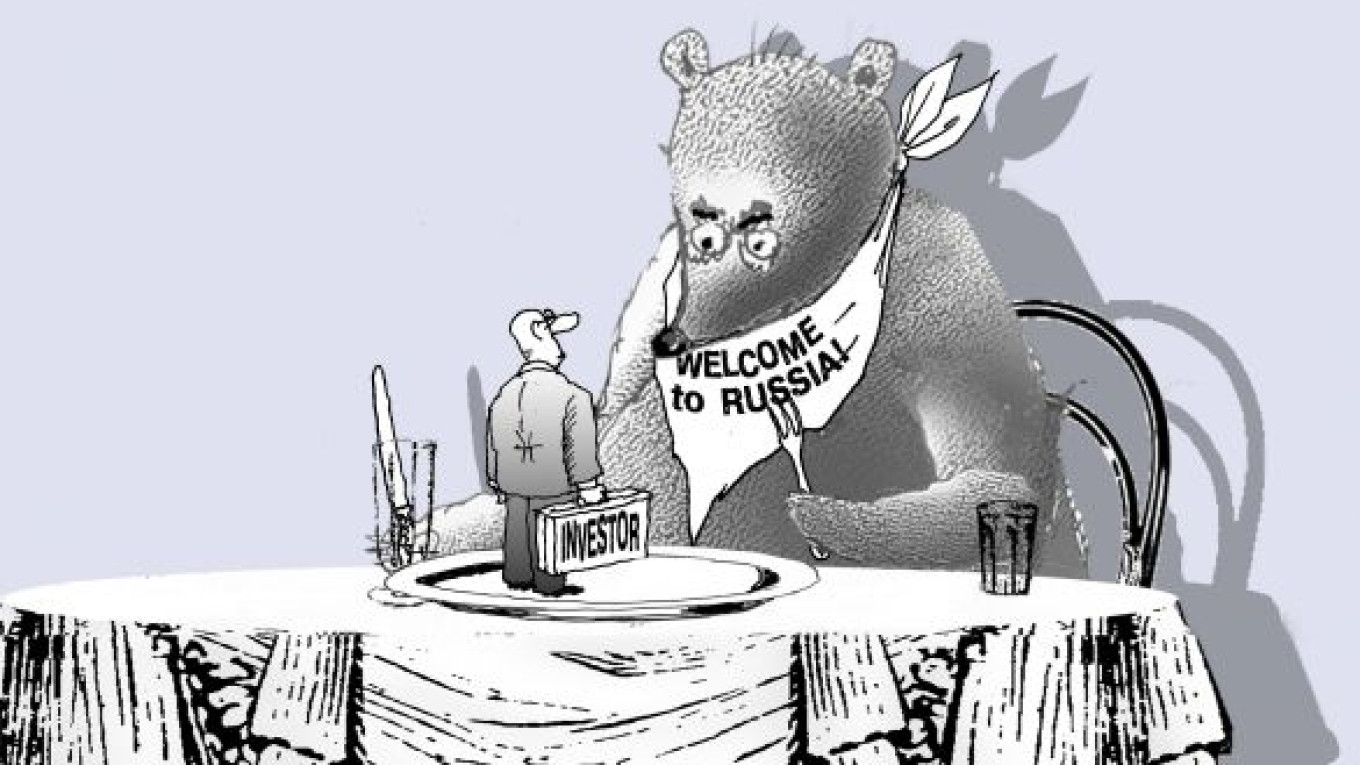
The government approved on Thursday the sell-off of an estimated $29 billion in state assets over three years in what promises to be the country’s biggest privatization since the controversial loans-for-shares auctions in the mid-1990s. But investors beware. Russia’s legal system, including its protection of property, remains weak, as illustrated by a case unfolding at our company, Prosperity Capital Management. It involves the nonpayment of hundreds of millions of dollars by an entity controlled by a member of the Federation Council.
Prosperity Capital Management, or PCM, has endured blatant legal abuses in its dealings with TGK-2 — one of the generation companies spun off during the wholesale privatization and restructuring of the country’s power sector after Unified Energy System was broken up in July 2008. The abuses are among the worst since the Yukos affair.
In March 2008, Kores Invest, controlled by Federation Council Senator Leonid Lebedev, bought majority control of TGK-2 during the final privatization auctions. Kores was required under mandatory laws to offer to buy out minority shareholders at the same price. PCM tendered its shares, along with other minority shareholders. But by the time the proceeds were due, prices had fallen significantly because of the economic crisis. Ever since, Kores has created legal diversions to avoid meeting its obligations.
Kores owes PCM and other minority shareholders more than $300 million. But Kores effectively sued itself, obtaining an injunction blocking the previously agreed buyback. Appeals have since been repeatedly adjourned on flimsy technicalities.
Kores also prevented Sberbank from meeting a guarantee to pay buyback receipts to TGK-2 minority shareholders if the principal owner failed. Sberbank’s involvement would have amounted to official recognition of Kores’ default. So Kores obtained a second injunction.
Kores then opened up a third front of legal obfuscation, claiming that the buyout obligation was invalid under the country’s strategic investment law — a connection it made based on TGK-2’s small involvement with the treatment of radioactive material. This is clearly an arbitrary application of the law.
Moreover, Kores argues that because it has affiliated companies based offshore, it should never have been able to take majority control of TGK-2 in the first place, seeing that “foreign entities” need prior state permission for “strategic” transactions.
This is an absurd argument. At the time of the buyback, the TGKs were excluded from the strategic investment law precisely because Russia wanted to attract foreign investors. Kores is domiciled in Russia and controlled by Russian citizens. Its offshore affiliates had absolutely no involvement in the TGK share offer.
For more than two years, PCM and other minorities have campaigned against Kores’ legal subversions, taking the case through Moscow’s arbitration court and several appellate courts. PCM is now appealing to the Supreme Arbitration Court. If the court decides to hear our appeal, it would be the first time that litigation involving the strategic investment law has been heard at this level.
Many leading Russian companies, including Gazprom, Rosneft and Novotek, have offshore affiliates. All these firms, of course, are treated as “domestic” for the purposes of the strategic investment law. If the Supreme Court fails to overturn successive rulings in favor of Kores, many of Russia’s most important commercial entities will be in breach of the law. Some of the most significant transactions in Russia’s recent history could be rendered null and void.
President Dmitry Medvedev has made the fight against “legal nihilism” a priority, but our case shows that corporate governance risks remain high, even though the business environment has improved in recent years As a result, many potential investors continue to be scared off.
This is a shame because Russia offers huge economic potential. Total consumer, corporate and state debt amounts to 50 percent of gross domestic product, compared with 300 percent or more in many Western countries. Russia contracted for the first time in a decade last year, but it has since bounced back, soaring by 5.4 percent during the first half of 2010. Commodities now account for 20 percent of national revenues, down from 40 percent in 2003. Russia also boasts a stock market that, while volatile, is underrated and capable of generating enormous shareholder gains.
But, as our case shows, blatant corporate governance abuses are still too frequent and remain a major impediment to commercial progress.
Liam Halligan is chief economist and Denis Spirin is director of corporate governance at Prosperity Capital Management.
A Message from The Moscow Times:
Dear readers,
We are facing unprecedented challenges. Russia's Prosecutor General's Office has designated The Moscow Times as an "undesirable" organization, criminalizing our work and putting our staff at risk of prosecution. This follows our earlier unjust labeling as a "foreign agent."
These actions are direct attempts to silence independent journalism in Russia. The authorities claim our work "discredits the decisions of the Russian leadership." We see things differently: we strive to provide accurate, unbiased reporting on Russia.
We, the journalists of The Moscow Times, refuse to be silenced. But to continue our work, we need your help.
Your support, no matter how small, makes a world of difference. If you can, please support us monthly starting from just $2. It's quick to set up, and every contribution makes a significant impact.
By supporting The Moscow Times, you're defending open, independent journalism in the face of repression. Thank you for standing with us.

Remind me later.