

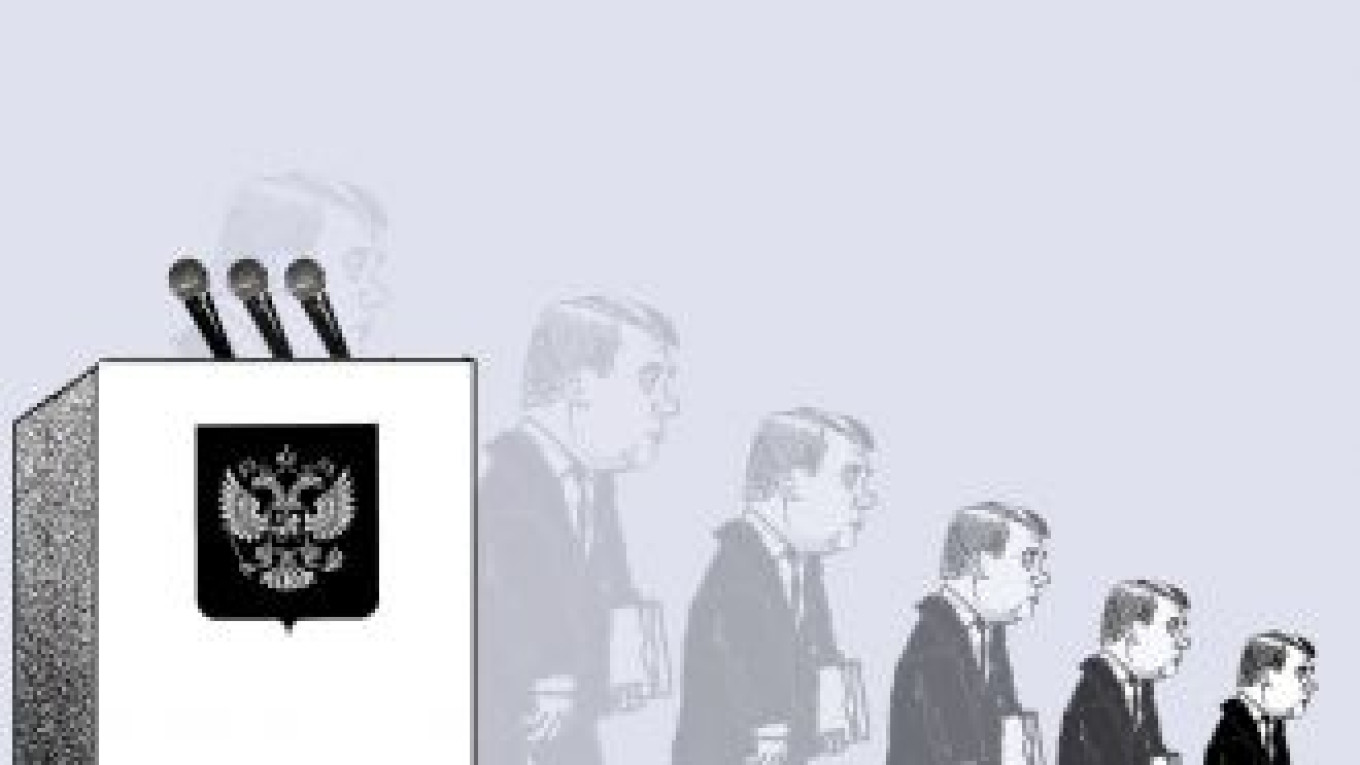
President Dmitry Medvedev’s annual state-of-the-nation address could be held up as an exceptional illustration of his recent musings on how, without political competition, Russia’s leadership runs the risk of “becoming bronzed,” like a statue, and “degrading like any living organism that remains motionless.”
The country’s lack of a political opposition capable of challenging the acuity of decisions made by the authorities, including through the delivery of a parallel address in rebuttal, has clearly taken a toll on the quality of the proposals coming out of the Kremlin. Even more problematic, apparently, is the creeping paralysis within the leadership itself, both structurally, as a result of the dual leadership, and temporally as the 2012 presidential elections approach. What kind of strategy could be expected, then? Just campaign promises to voters.
Medvedev’s address did not have a pivot, not even a “conditional” one, like in past years when he focused on modernization of the economy, fighting corruption and political reforms. The words were all still there, but they rang hollow, like a child’s rattle. There was no sense of purpose behind what he said, as if everything substantial had already been decided and accomplished. Speaking of which, that was also evident in the weak structuring of the address, which lacked any sense of organization within topics or internal logic. As a result, Medvedev was forced to rattle off a near-endless list of points and subpoints: five on Russia’s demographic decline as a call to action for the nation; six on education; four on effective management of the environment; 10 relating to improving the state’s efficiency; and eight about providing national security and defense.
Thus, the address is a collection of fairly random and awkwardly assembled topics plus a handful of proposals on specific industries, with a particular focus on issues handled by the Health and Social Development Ministry. That’s not to say that children in general or encouraging families to have a third child are not relevant issues for Russia. They are. But it does mean that the president is operating without a clear system of priorities, or at least that he is unwilling to share them with the public.
The speech also lacked any analysis of the real challenges facing the country. He didn’t talk about the North Caucasus, which is essentially caught up in a low-intensity civil war, nor did he propose a solution to the collapsing Soviet-era infrastructure beyond a passing nod to the degradation of public utilities. He skipped over the country’s rapidly degrading system of governance. Consequently, Medvedev also failed to provide any information on the status of the measures he proposed in his two previous state-of-the-nation addresses: a presidential envoy to the North Caucasus, a reserve of talented young personnel, changes to the country’s system of time zones, and so on. Instead, of nurturing the seeds he planted in years past, the president is focused only on new ideas.
While insignificant — or even nonexistent — successes related to domestic policy or the economy are inflated however possible, foreign policy achievements, which on the surface seem far more obvious and concrete, were simply passed over. But even here, many major challenges remain, including with Afghanistan, Iran, North Korea. There is even confusion in Russia’s union state with Belarus.
Regional policy was a noticeably prominent component in this year’s address; as the elections approach, the federal center is reaching back out to the regions. And yet, if I were a member of the regional elite somewhere, I wouldn’t be too excited about the two important proposals he made: on the need to reconsider how much money is sent back to regional and municipal governments and the importance of stimulating regions that are increasing their revenue base. Medvedev’s phrasing was too general, and the idea of sending more money back to regions and municipalities runs absolutely contrary to the numerous promises to boost spending and his call to reduce the federal budget deficit. It’s nothing more than a typical, pre-election campaign trick.
Meanwhile, the idea of finding the best regional policies to stimulate business is interesting. It’s too bad, however, that the Kremlin is looking for policies that will best help it illustrate the point of the initiative, rather than those that will do the most to stimulate regional economies.
Medvedev’s public speeches often seem somehow removed from time and space, but never more so than in this state-of-the-nation address. He could have given the exact same address a year ago, or two years ago; at most, he would have needed to fire a police chief from a different region. This year it was Krasnodar. The text was thoroughly cleansed of the specific names and events that most effected the country this year: Kaliningrad, Katyn, the Khimki forest, Luzhkov’s firing. Instead, we got euphemisms and sidesteps.
The timing of the address is also important. Former President Boris Yeltsin used to give them in February, at the start of the year, like in most other countries. Under Vladimir Putin, the annual presidential address was pushed forward to the spring, while Medvedev has moved it all the way back to late autumn. We’ve gone from spring to fall plantings, all while hoping for the same harvest. That means the state-of-the-nation addresses are not setting out an agenda for the government, but rather trying to keep up with the decisions that have been made and implemented by the government. As a result, Medvedev’s next address might not even take place. What would it be about? On the eve of the elections?
If anyone had any doubts about whether Medvedev would do something to stay on for a second term, this address should put them to rest. Not because the president didn’t look stately enough while delivering his speech, and in fact, just the opposite. He looked like a talking portrait, with the equally pale podium and background running together visually. Medvedev’s time appears to be up because this was not the address of a president, the leader of a country, but rather a report by a first deputy prime minister responsible for the government’s priority national projects. A first deputy prime minister who is now also responsible for modernization in five specific areas.
The president does have a strong voice, but he is not showing any political ambitions for the future, at least not publicly. That doesn’t mean that he couldn’t somehow end up as president for a second term. It just means that he still would not be a self-made president.
Nikolai Petrov is a scholar in residence at the Carnegie Moscow Center.
A Message from The Moscow Times:
Dear readers,
We are facing unprecedented challenges. Russia's Prosecutor General's Office has designated The Moscow Times as an "undesirable" organization, criminalizing our work and putting our staff at risk of prosecution. This follows our earlier unjust labeling as a "foreign agent."
These actions are direct attempts to silence independent journalism in Russia. The authorities claim our work "discredits the decisions of the Russian leadership." We see things differently: we strive to provide accurate, unbiased reporting on Russia.
We, the journalists of The Moscow Times, refuse to be silenced. But to continue our work, we need your help.
Your support, no matter how small, makes a world of difference. If you can, please support us monthly starting from just $2. It's quick to set up, and every contribution makes a significant impact.
By supporting The Moscow Times, you're defending open, independent journalism in the face of repression. Thank you for standing with us.

Remind me later.