

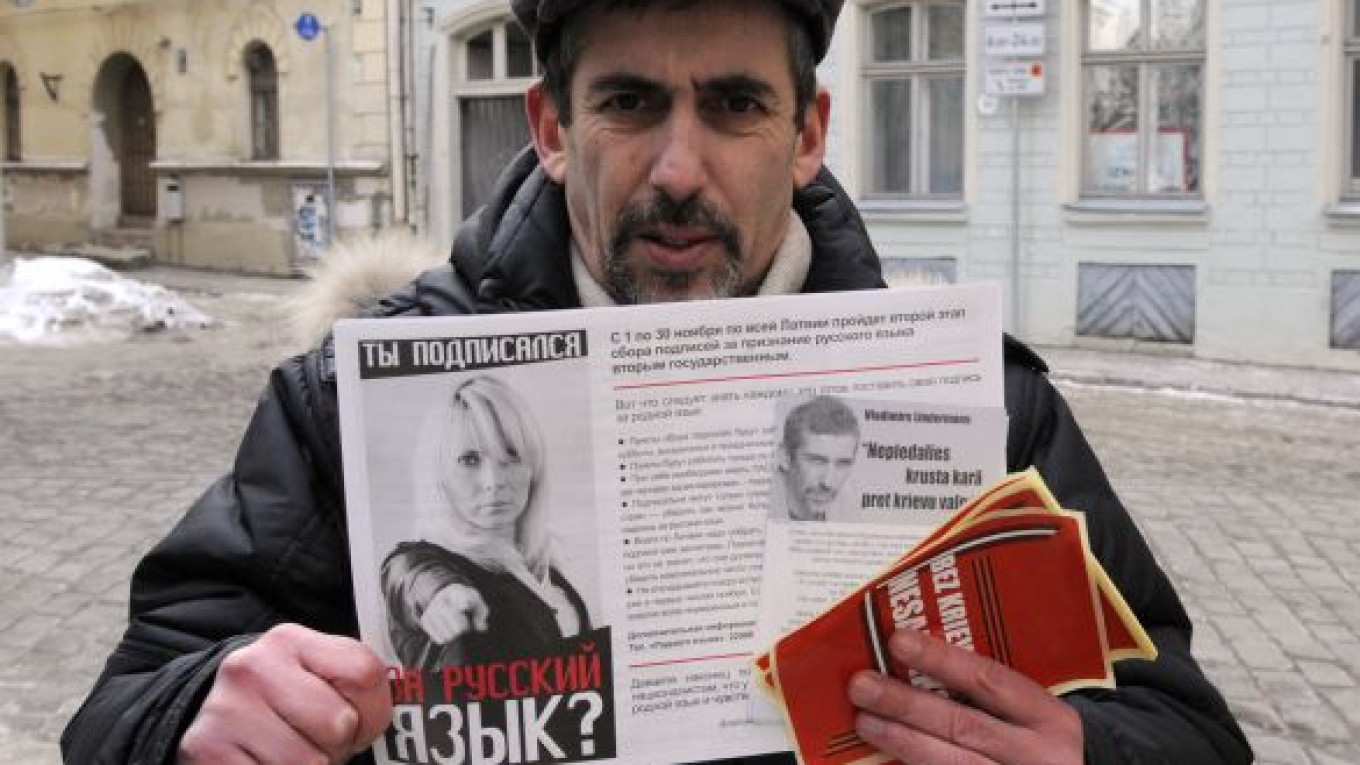
RIGA — Latvian voters resoundingly rejected a proposal to give official status to Russian, the mother tongue of their former Soviet occupiers, though the referendum defeated Saturday is expected to leave scars on an already divided society.
Russian is the first language for about one-third of the Baltic country's 2.1 million people, and many of them would like to accord official status to the language to reverse what they claim has been 20 years of discrimination.
But for ethnic Latvians, the referendum was a brazen attempt to encroach on Latvia's independence, which was restored two decades ago after a half-century of occupation by the Soviet Union following World War II.
Many Latvians still consider Russian, the lingua franca of the Soviet Union, to be the language of the former occupiers. They also harbor deep distrust toward Russia and worry that Moscow attempts to wield influence in Latvia through the ethnic Russian minority.
"Latvia is the only place throughout the world where Latvian is spoken, so we have to protect it," said Martins Dzerve, 37, in Riga, Latvia's capital. "But Russian is everywhere."
With more than 93 percent of ballots counted, 75 percent of voters said they were against Russian as a national language, according to Central Elections Commission results.
However, in the eastern region of Latgale, which straddles the border with Russia, a majority of voters approved changing the constitution to make Russian a national language. The region is Latvia's poorest and has a high percentage of ethnic Russians and other minorities.
"Society is divided into two classes. One half has full rights, and the other half's rights are violated," Aleksejs Yevdokimovs said. "The Latvian half always employs a presumption of guilt toward the Russian half so that we have to prove things that shouldn't need to be proved."
Voter participation was high. More than 70 percent of registered voters cast ballots, making the turnout considerably higher than in previous elections and referendums.
Long lines were seen at many precincts both in Latvia and abroad. Voters in London reportedly endured a three-hour wait.
In Chicago, Mara Varpa, 57, said she voted against the proposal since Latvian is an integral part of the national identity and should therefore remain the sole official language.
"I don't think there should have been a referendum to begin with because it's already in the constitution, but since there was I had to vote," Varpa said.
Though the Russians who spearheaded the referendum admitted that they had no chance of winning the plebiscite, they at least hoped the approximately 25 percent support would force Latvia's center-right government to begin a dialogue with national minorities.
Hundreds of thousands of Russians, Belarussians and Ukrainians moved to Latvia and the neighboring Baltic republics during the population transfers of the Soviet regime.
Many of them never learned Latvian and were denied citizenship when Latvia regained independence, meaning that they don't have the right to vote or work in government.
According to the current law, anyone who moved to Latvia during the Soviet occupation or was born to parents who moved there is considered a noncitizen and must pass the Latvian language exam in order to become a citizen.
There are approximately 300,000 noncitizens in Latvia.
Politicians and analysts said the plebiscite will widen the schism in society and that the government will have to undertake serious efforts to consolidate the country's two groups.
Many fear the disgruntled minority will keep up the pressure by calling for more referendums to change Latvia's constitution for minorities' benefit.
Resentment also rose among Russian speakers after the Harmony Center party, which has its roots in their community, won an election last year, but was left out of the coalition government.
Nil Ushakov, 35, head of Harmony Center and also mayor of Riga, said he hoped the vote would start a debate.
"What we need, tomorrow, the next day after the referendum, is to start a dialogue that hopefully will result in at least better understanding and more mutual respect," he said.
Vote organizer Vladimir Linderman, who speaks Latvian but has not been naturalized as a Latvian and could not vote, said he planned more actions.
His For the Mother Tongue group collected more than 187,000 signatures to force a referendum to be held.
"I think the dialogue has already started," he said. "Yes, it started with hysteria and a little panic, but even hysteria is better than the silence that has lasted for 20 years."
(AP, Reuters)
A Message from The Moscow Times:
Dear readers,
We are facing unprecedented challenges. Russia's Prosecutor General's Office has designated The Moscow Times as an "undesirable" organization, criminalizing our work and putting our staff at risk of prosecution. This follows our earlier unjust labeling as a "foreign agent."
These actions are direct attempts to silence independent journalism in Russia. The authorities claim our work "discredits the decisions of the Russian leadership." We see things differently: we strive to provide accurate, unbiased reporting on Russia.
We, the journalists of The Moscow Times, refuse to be silenced. But to continue our work, we need your help.
Your support, no matter how small, makes a world of difference. If you can, please support us monthly starting from just $2. It's quick to set up, and every contribution makes a significant impact.
By supporting The Moscow Times, you're defending open, independent journalism in the face of repression. Thank you for standing with us.

Remind me later.