

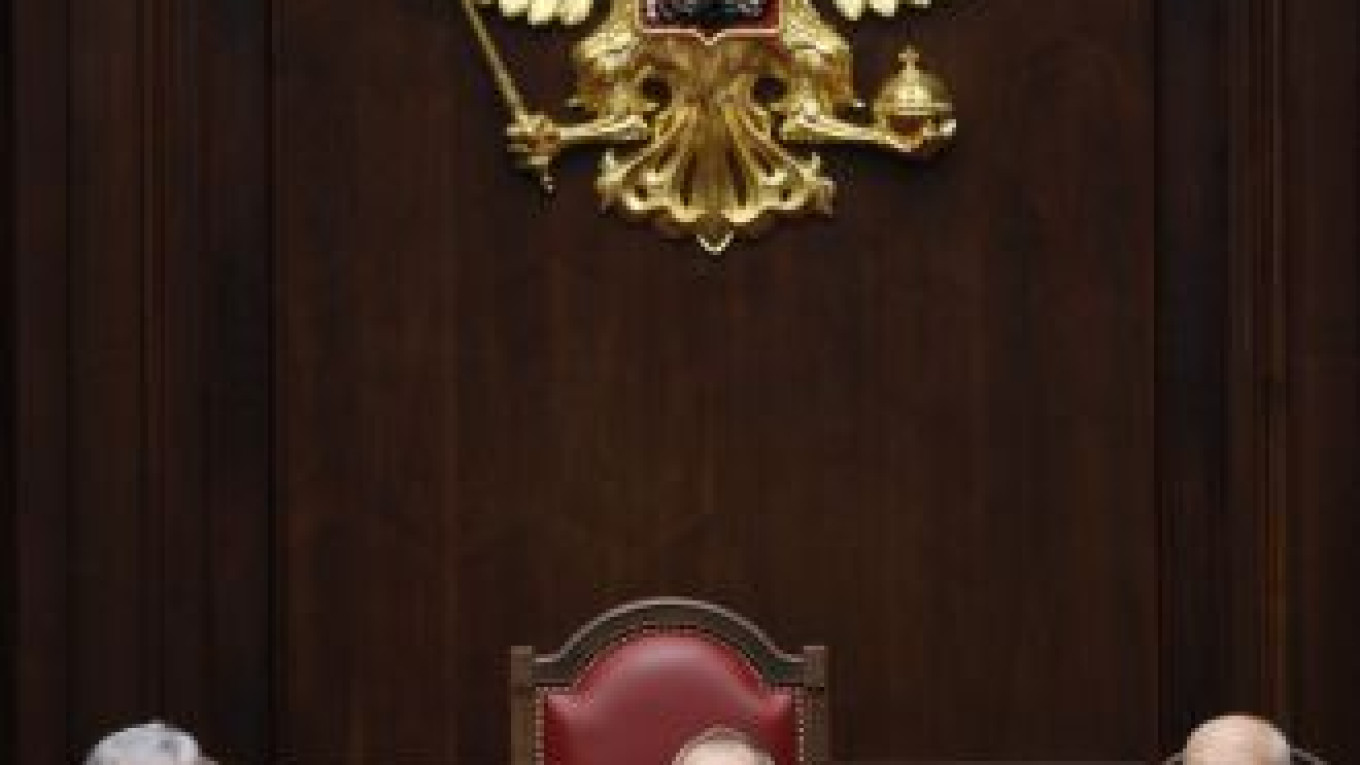
The Constitutional Court ruled Thursday that capital punishment could not resume in January, when the last of Russia’s regions begins jury trials, effectively extending a moratorium on the death penalty indefinitely.
“The introduction of jury trials Jan. 1, 2010, does not open the way for the possible use of the death penalty,” the court said in statement. Chairman Valery Zorkin told RIA-Novosti after the ruling that the “decision was final and cannot be appealed.”
The Constitutional Court’s decisions must be followed by all Russian courts.
The ruling, posted on the court’s web site, came after the Supreme Court asked last month for guidance on the death penalty. While public opinion on the matter remains mixed, the Kremlin and government have both said they do not want executions to resume, and praise flooded in from human rights groups.
The Criminal Code guarantees that a person accused of a crime punishable by death has a right to be tried by a jury. Currently, the code allows executions for genocide, murder or the attempted murder of a policeman or state prosecutor.
In a February 1999 ruling, the Constitutional Court stated that the death penalty cannot be used in Russia until jury trials are available everywhere. The republic of Chechnya, the only remaining region without jury trials, will have them beginning in January.
In its Thursday decision, the court cited Russia’s own pledge not to use capital punishment when it became a member of the Council in Europe in 1996. It also said the decade of established legal tradition without executions should be respected.
“The Russian Federation is bound … not to do anything that would violate the essence of Protocol No. 6 before it officially announces that it will not be a participant,” the court said, referring to the remote possibility that Russia might not ratify a key protocol that it signed to join the Council of Europe.
Then-President Boris Yeltsin signed a decree in 1996 ordering his government to prepare a bill to ratify Protocol No. 6 of the European Convention on Human Rights, which bans capital punishment except in war. The measure died in the State Duma, however, amid opposition from the Communists.
The situation has remained unresolved, although the court’s ruling and growing support from top politicians could now lead the Duma to ratify the protocol.
Prime Minister Vladimir Putin recently called the death penalty “senseless and counterproductive” and President Dmitry Medvedev has regularly said he is against executions. Earlier this week, he told Justice Minister Alexander Konovalov that punishment for criminals should be “modern, not medieval.”
Mikhail Margelov, head of the Federation Council’s Foreign Affairs Committee and a senior member of United Russia, said the country should ratify the protocol, adding that the Constitutional Court has “prolonged the moratorium, but it is not yet the final abolishment.
“A killing blessed by the law is still preserved by our justice system for any case,” Margelov told reporters Thursday.
United Russia Deputy Andrei Klimov, a deputy chairman of the Foreign Affairs Committee, said the ruling “opened the possibility” for ratification if a political decision is made. “Ratification is needed, since it will bring Russia to the European pool of countries that do not use capital punishment,” he told The Moscow Times.
Belarus is the last country in Europe that still executes criminals.
Thorbjorn Jagland, secretary-general of the Council of Europe, “warmly welcomed” the decision in a statement.
Human rights activist Lev Ponomaryov also praised the decision, although he added that the entire prison system was in need of reforms because of harsh — and often unbearable — conditions.
Prisons have improved in recent years, but many who work in them still have a “totalitarian way of thinking,” he said. “Even in the brand new prisons, sadistically inclined people are torturing, raping and abusing inmates.”
A full legal ban on executions poses obstacles for politicians, as capital punishment continues to get steady support from the public. Even Klimov, who said he understands his European colleagues, confessed that he supports the death penalty for certain crimes, including child killers and terrorists.
According to a survey by state pollster VTsIOM last month, 62 percent of 1,600 respondents said they supported the death penalty.
The Communists and the nationalist Liberal Democratic Party — which both have factions in the parliament — also support capital punishment.
Many still see the death penalty as “justice served,” a view shared even by the late Nobel laureate Alexander Solzhenitsyn, who supported the death penalty for terrorists.
“The West didn’t experience what we experienced, and it can’t act as our teacher or a judge,” he said in 2001.
Duma Speaker Boris Gryzlov, who heads United Russia’s faction, said public consensus was needed before lawmakers would ratify the protocol. United Russia is holding a party congress this weekend to decide ideological matters and how to fulfill Medvedev’s state-of-the-nation address (Story, Page 3).
There are about 700 former death-row prisoners in Russia who had their sentences commuted to life, according to 2006 figures from the Federal Prison Service, the most recent data available. But while conditions in many prisons have gradually improved, early deaths among inmates are common. Prison officials attribute them to psychological reasons.
On Tuesday, the Interior Ministry announced the death of Firestone Duncan lawyer Sergei Magnitsky, 37, who complained of worsening health and inhumane conditions in the pretrial detention centers where he had been held for nearly a year.
His lawyer said he was regularly denied medical attention, a charge that the Interior Ministry denied.
A Message from The Moscow Times:
Dear readers,
We are facing unprecedented challenges. Russia's Prosecutor General's Office has designated The Moscow Times as an "undesirable" organization, criminalizing our work and putting our staff at risk of prosecution. This follows our earlier unjust labeling as a "foreign agent."
These actions are direct attempts to silence independent journalism in Russia. The authorities claim our work "discredits the decisions of the Russian leadership." We see things differently: we strive to provide accurate, unbiased reporting on Russia.
We, the journalists of The Moscow Times, refuse to be silenced. But to continue our work, we need your help.
Your support, no matter how small, makes a world of difference. If you can, please support us monthly starting from just $2. It's quick to set up, and every contribution makes a significant impact.
By supporting The Moscow Times, you're defending open, independent journalism in the face of repression. Thank you for standing with us.

Remind me later.